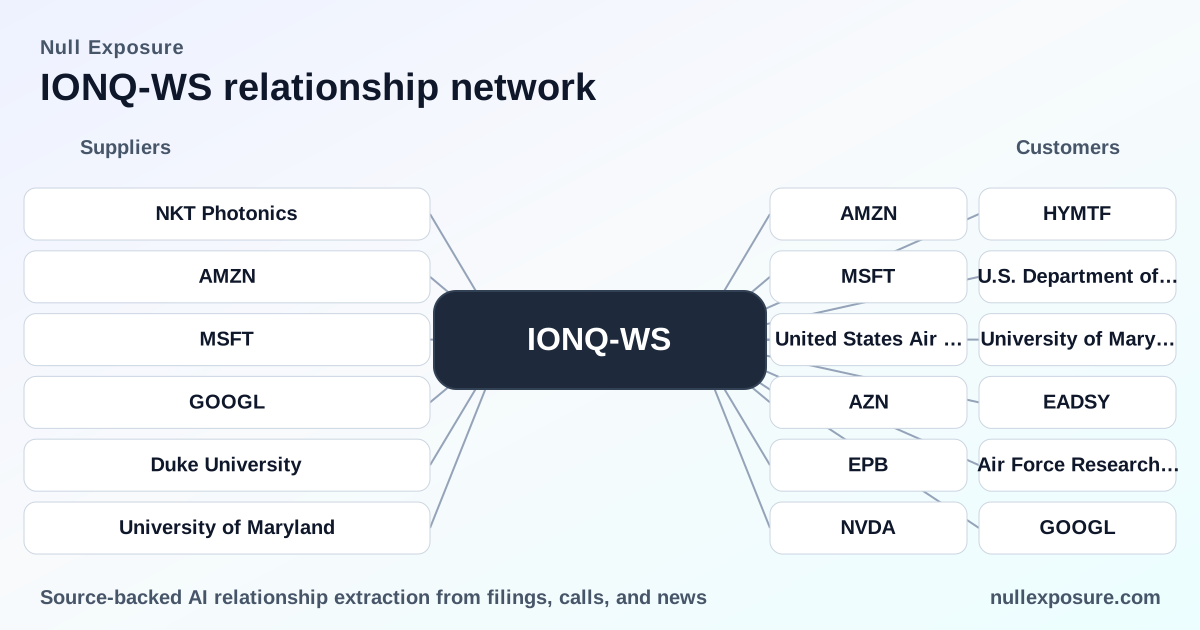
IONQ-WS: Customer Map and Commercial Implications for Investors
IONQ sells access to its trapped‑ion quantum hardware and related software, monetizing primarily through cloud-access partnerships, direct commercial agreements, and government contracts that fund development and deployment. The company’s go‑to‑market centers on platform partnerships with hyperscalers and a growing set of enterprise and government customers that pay for compute access, systems, or bespoke integrations. For a concise overview of our coverage and methodology, visit https://nullexposure.com/.
Why customer relationships matter now
IONQ’s revenue model is dual: recurring platform access through cloud marketplaces and lumpy, high‑value government or enterprise engagements that underwrite R&D and product rollouts. Investors should value the stock based on the trajectory from per‑call/cloud usage to longer‑term systems sales and strategic contracts that create durable revenue backstops and technical validation.
- Platform reach reduces go‑to‑market friction because AWS, Microsoft and Google expose IonQ systems to large developer and enterprise audiences.
- Government and large enterprise deals validate technology and create non‑linear upside, but they also produce revenue volatility given contract timing.
Explore deeper intelligence and comparable customer maps at https://nullexposure.com/.
Business model characteristics investors should weigh
IONQ’s operating posture is best read as a hybrid of a cloud‑native vendor and a defense/enterprise contractor. This has four practical implications:
- Contracting posture: The company leverages reseller/marketplace distribution through hyperscalers while negotiating direct, fixed‑price and milestone‑based contracts with governments and corporates. That combination accelerates reach but requires dual sales and compliance functions.
- Concentration: Platform distribution is concentrated among a few hyperscalers, so commercial leverage rests with those partners; however, direct contracts and system sales diversify counterparty risk.
- Criticality: Relationships with defense agencies and national labs increase strategic importance and can create long procurement cycles and higher margins when secured.
- Maturity: Commercial deployments remain early stage; even so, multi‑year and multi‑million‑dollar contracts suggest a transition toward more predictable institutional revenues.
The full customer roll call — what each relationship means
Below I cover every customer referenced in public reporting and contemporary commentary. Each entry is a plain‑English takeaway with the reporting source.
Amazon / AWS / Amazon Braket
Amazon makes IonQ systems available through its cloud marketplace and Amazon Braket, giving customers access to IonQ’s machines via AWS channels. This distribution channel drives volume exposure without IonQ needing to own all customer billing relationships. (Reported by Yahoo Finance and MarketBeat, March 2026; MarketBeat filing coverage, FY2026: https://finance.yahoo.com/news/institutional-investors-piled-ionq-rigetti-085100160.html and https://www.marketbeat.com/instant-alerts/filing-ionq-inc-ionq-shares-acquired-by-wealth-enhancement-advisory-services-llc-2026-01-29/)
Microsoft
Microsoft lists IonQ systems on Azure Quantum, enabling enterprise subscribers to run IonQ workloads through Microsoft’s cloud ecosystem. Azure integration is a strategic channel that lends enterprise credibility and potential co‑selling opportunities. (Reported by Yahoo Finance and MarketBeat, March–May 2026: https://finance.yahoo.com/news/institutional-investors-piled-ionq-rigetti-085100160.html and https://www.marketbeat.com/instant-alerts/ionq-nyseionq-shares-down-87-heres-what-happened-2025-11-04/)
Google’s Cloud Marketplace also distributes access to IonQ compute resources, broadening the multi‑cloud availability of IonQ’s hardware. Multi‑cloud presence reduces vendor lock‑in concerns for enterprise buyers and supports adoption across developer communities. (MarketBeat instant alert, FY2026: https://www.marketbeat.com/instant-alerts/filing-ionq-inc-ionq-shares-acquired-by-wealth-enhancement-advisory-services-llc-2026-01-29/)
U.S. Air Force Research Laboratory (AFRL) / Air Force Research Lab / Air Force Research Lab (duplicate references)
IONQ won a $54.5 million contract with the Air Force Research Laboratory to develop quantum networking hardware, marking a material government award that funds product development and validates national‑security relevance. This contract is one of the largest public government engagements and represents strategic validation in a defense context. (Reported by Tribune/Optica and Benzinga coverage, FY2024–FY2025: https://tribune.com.pk/story/2512734/ionq-emerges-as-a-key-player-in-quantum-computing-capturing-investor-attention and https://www.optica-opn.org/home/industry/2024/november/ionq_poised_for_growth/)
U.S. Department of Energy
IonQ signed an MOU with the U.S. Department of Energy to advance orbital demonstrations of quantum‑secure communications, indicating a role in space‑based quantum initiatives. This collaboration expands IonQ’s addressable market into space and national labs, and signals technical trust from a major federal agency. (TradingView summary quoting DOE MOU, FY2025: https://www.tradingview.com/news/zacks:b5d8efd5d094b:0-can-quantum-computing-s-government-contracts-boost-future-growth/)
AstraZeneca
IonQ’s collaborations in drug discovery have been reported to yield large speedups—one article cites work that cut drug‑discovery interference times substantially—positioning IonQ as a commercial partner in pharma R&D pipelines. Pharma partnerships demonstrate vertical use‑case traction beyond pure compute trials. (Benzinga coverage, July 2025: https://www.benzinga.com/markets/equities/25/07/46367400/why-ionq-is-my-top-stock-pick-for-2025)
Nvidia
IonQ has been reported to collaborate with Nvidia on workflows that accelerate drug‑discovery simulations, reflecting synergy between quantum compute and classical GPU tooling. Integration with leading ML/accelerator vendors helps IonQ address hybrid workflows in enterprise R&D. (Benzinga, FY2025: https://www.benzinga.com/markets/equities/25/07/46367400/why-ionq-is-my-top-stock-pick-for-2025)
EPB (Electric Power Board)
IonQ signed a roughly $22 million engagement with EPB to establish a quantum hub for grid optimization training and services in Chattanooga, indicating targeted utility sector deployments. This is an example of a vertical, city‑scale partnership that creates a local center of gravity for adoption. (Benzinga, FY2025: https://www.benzinga.com/markets/equities/25/07/46367400/why-ionq-is-my-top-stock-pick-for-2025)
Hyundai (HYMTF)
Hyundai is listed among paying customers for IonQ’s tech, consistent with auto OEMs exploring quantum‑assisted design and optimization. Automotive engagements point to longer sales cycles but high potential upside if quantum provides measurable engineering improvements. (Benzinga, FY2025: https://www.benzinga.com/markets/equities/25/07/46367400/why-ionq-is-my-top-stock-pick-for-2025)
Airbus
Airbus is reported as a corporate client using IonQ systems for aerospace R&D use cases, illustrating defense and aerospace interest beyond the US government. Aerospace customers broaden IonQ’s commercial reference list and potential licensing or systems‑sale pathways. (Benzinga, FY2025: https://www.benzinga.com/markets/equities/25/07/46367400/why-ionq-is-my-top-stock-pick-for-2025)
University of Maryland
Academic collaborations and usage evidence IonQ’s relevance for research computing and training pipelines that often feed into later commercial projects. University partnerships underpin ecosystem development and talent pipelines. (Benzinga, FY2025: https://www.benzinga.com/markets/equities/25/07/46367400/why-ionq-is-my-top-stock-pick-for-2025)
QuantumBasel
IonQ expanded a partnership with QuantumBasel, described as a multi‑year arrangement worth over $60 million through 2029, signaling meaningful commercial commitment from a European partner. This represents a material regional expansion and a longer‑term revenue profile. (SahmCapital coverage, FY2026: https://www.sahmcapital.com/news/content/assessing-ionq-ionq-valuation-after-quantumbasel-expansion-and-record-2-qubit-gate-fidelity-2026-01-22)
Horizon Quantum
IonQ signed a strategic agreement with Horizon Quantum for the sale of a 256‑qubit trapped‑ion system, representing a direct systems sale that transfers hardware and operational capability to another operator. System sales like this are proof points for scaling hardware into third‑party lab environments and monetize beyond cloud‑access fees. (SahmCapital and DailyHunt syndication, April 2026: https://www.sahmcapital.com/news/content/whats-going-on-with-ionq-stock-on-thursday-2026-04-09 and https://m.dailyhunt.in/news/india/english/benzinga-epaper-benzinga/whats+going+on+with+ionq+stock+on+thursday-newsid-n707872225)
Investment implications and risk framing
Positive signals: Hyperscaler distribution plus a pipeline of government and enterprise deals creates a hybrid revenue model with both reach and high‑value contracts. Contracts like the AFRL award and the QuantumBasel expansion are high‑impact validation events that materially de‑risk technology adoption in key verticals.
Key risks: Heavy dependence on a few cloud partners concentrates commercial exposure; government and enterprise deals can be lumpy and timing‑sensitive; and commercial monetization still sits early on a growth curve, meaning multiples must reflect optionality rather than stable cash flows.
For investors evaluating IONQ‑WS, the customer map shows a company transitioning from demonstration to commercialization with diversified go‑to‑market channels but persistent execution and concentration risks.
If you want a tailored brief comparing IonQ’s customer traction to peers or a downloadable map of relationships, visit https://nullexposure.com/ for our full coverage and data products.