Innospec (IOSP): Customer Relationships, Concentration and What Investors Should Price In
Innospec operates as a global manufacturer and seller of specialty chemicals, monetizing through the manufacture, blending and sale of performance additives and service solutions to large industrial customers across oil & gas, personal care, mining and other end markets. The business converts scale and technical formulation into recurring product sales and supplier-managed inventory arrangements; revenue is recognized at point-of-use under certain contracts, which creates working-capital dynamics investors must model alongside steady mid-single-digit margins and an EV/EBITDA multiple in the mid-single digits.
If you want a consolidated view of counterparties and commercial posture for underwriting or operational diligence, start here and then review trading- and credit-level details at the source: https://nullexposure.com/.
How Innospec actually sells — the commercial and contract model that matters
Innospec’s commercial model blends traditional manufacturing with embedded service and inventory solutions. The company manufactures specialty chemical products and also supplies them under supplier‑managed inventory arrangements where title remains with Innospec until the customer consumes the product. According to company disclosures, Innospec recognizes revenue when the customer uses the product under these arrangements; this creates usage‑based recognition and shifts invoicing and cash conversion timing relative to pure spot sales (company filing excerpts, 2024–2025).
This model implies several investor-relevant operating characteristics:
- Contracting posture: A mix of fixed sales and usage‑based supplier‑managed inventory contracts that transfer control at point-of-use. That compresses near-term revenue volatility for stocked products but defers cash until consumption (company filing).
- Counterparty concentration profile: The customer base is skewed toward large enterprise buyers — multinational refiners, chemical companies and big industrials — which supports scale pricing but concentrates exposure (company filing).
- Global sales footprint: Sales span North America, EMEA and APAC, so macro and regional energy cycles, regulatory environments and local trade terms materially influence demand (company filing).
- Role and value-add: Innospec is both manufacturer and service provider, supplying not only products but technical services such as completion and production chemicals and drag‑reducing agents (company filing).
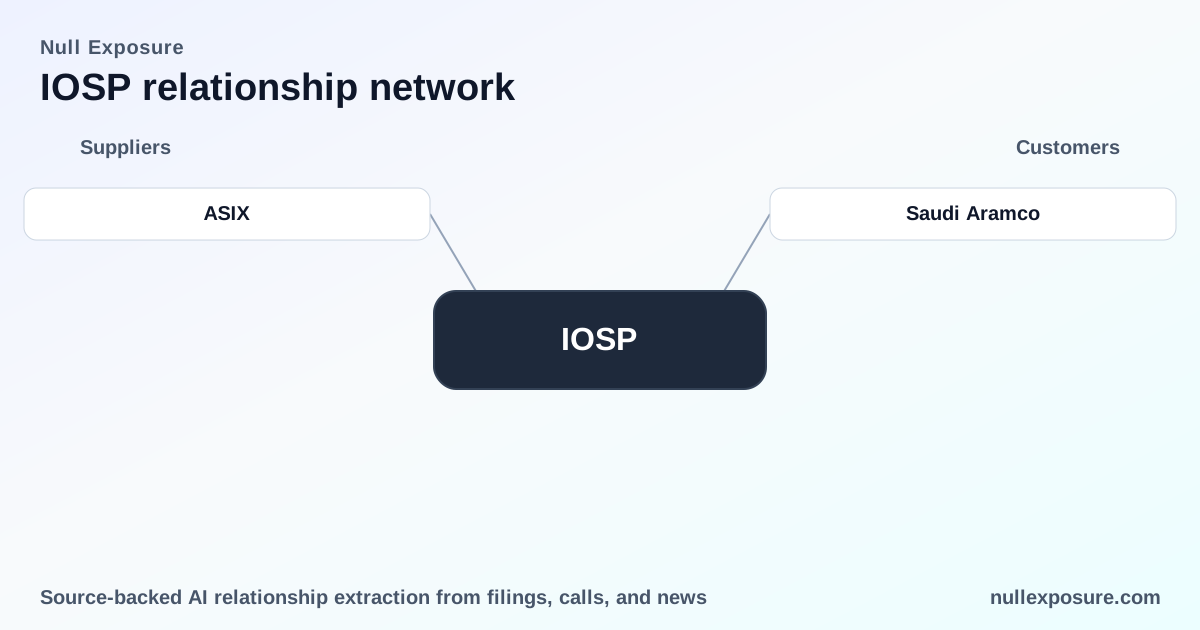
The one explicitly mentioned customer: Saudi Aramco
In a Q4 2025 earnings call transcript referenced in media coverage, management noted commercial engagement with Saudi Aramco as one of several major customers, indicating direct supplier relationships with national oil companies as part of the customer mix. The comment was published in an earnings transcript aggregation on March 10, 2026 (InsiderMonkey Q4 2025 earnings call transcript, March 10, 2026).
Takeaway: Saudi Aramco is referenced by management as a commercial counterparty, which confirms participation in high‑scale upstream/downstream procurement channels but the transcript excerpt does not disclose dollar value or contract structure.
What the filings say about customer materiality and concentration
Innospec’s filings provide a clear, quantified snapshot of concentration risk: an Oilfield Services customer accounted for $265.2 million and 13.6% of group net sales in 2023, although net sales to that same customer did not exceed 10% of group net sales in 2024 (company filing). This is a critical signal — large, material customers exist, but revenue can be volatile year-to-year.
- Materiality signal: The 2023 single-customer figure demonstrates real concentration potential that investors must model as an idiosyncratic revenue swing factor.
- Diversification counterbalance: The customer base includes manufacturers of personal care and home care products, mining, agriculture and building products, and global oil refiners; that sectoral spread reduces single-industry dependency even as individual large buyers can be material (company filing).
Why usage‑based inventory arrangements change the cash story
Supplier-managed inventory that recognizes revenue on customer use changes timing across the income statement and balance sheet. Revenue recognition on consumption improves matching of sales to end-use but delays invoicing and cash collection, increasing the need to monitor inventory staging, title terms and contract clauses that govern invoicing triggers (company filing excerpt).
Operational consequences investors should monitor:
- Working capital sensitivity to consumption patterns and seasonality.
- Exposure to customer site inventory risk where title remains with Innospec but physical product sits on customer premises.
- Potential for sudden revenue recognition acceleration if large customers draw down stocked inventory.
Geographic and sector coverage you must underwrite
Innospec sells globally (Americas, Europe, Middle East, Africa and Asia‑Pacific) and the customer set includes major multinational and national oil companies, large manufacturers of personal and home care products, and industrial customers in mining and agriculture (company filing). This global footprint spreads demand risk but creates exposure to regional policy, tariff and energy price cycles. Geographically diversified revenue reduces single-market downside but raises complexity in commercial execution and counterparty credit risk.
Valuation and margin context for customer-driven scenarios
Operationally, Innospec delivers mid-single-digit profit margins and mid-teens P/E metrics: trailing profit margin of 6.56%, operating margin around 10.3%, revenue TTM approximately $1.778 billion and a trailing P/E of 16.45 (company overview). The business trades at an EV/EBITDA of ~8.36, consistent with a specialty-chemicals model that blends recurring supply contracts with cyclical industrial exposure.
Investor lens: Model three customer scenarios — (1) stable consumption and steady inventory turns; (2) one large customer contract reducing purchases year-over-year (as seen between 2023 and 2024); (3) accelerated drawdown from stocked inventories — and test sensitivity of working capital, EBITDA and free cash flow to each.
Risks, levers and what operators should prioritize
- Concentration risk from large enterprise buyers is real and episodic; maintain commercial diversification and multi-year commitments where possible (company filing).
- Working-capital discipline is essential given usage-based revenue recognition; optimize inventory placement and tighten invoicing triggers.
- Regional exposure management: APAC and EMEA operations require local contract governance and credit oversight given national oil companies and large industrial buyers are part of the mix (company filing).
For operational or credit teams assessing counterparties, prioritize contract language on title transfer, invoicing triggers and minimum purchase commitments.
Bottom line for investors and next steps
Innospec’s model is manufacturing-led, with embedded service and usage-based inventory contracts that create predictable customer relationships but variable cash timing. Large enterprise customers including national oil companies are part of the customer base; one such relationship with Saudi Aramco was explicitly mentioned in an earnings transcript (InsiderMonkey, March 10, 2026). The 2023 single‑customer concentration episode underlines the need to stress‑test revenue and cash flow for idiosyncratic customer behavior (company filing).
For a deeper view on counterparties, contract terms and to map commercial exposure into credit metrics, review our structured intake and reporting tools at https://nullexposure.com/. If you are modeling counterparty concentration for portfolio or underwriting work, the platform provides consolidated relationship signals and source-backed excerpts to convert these qualitative signals into quantitative scenarios.