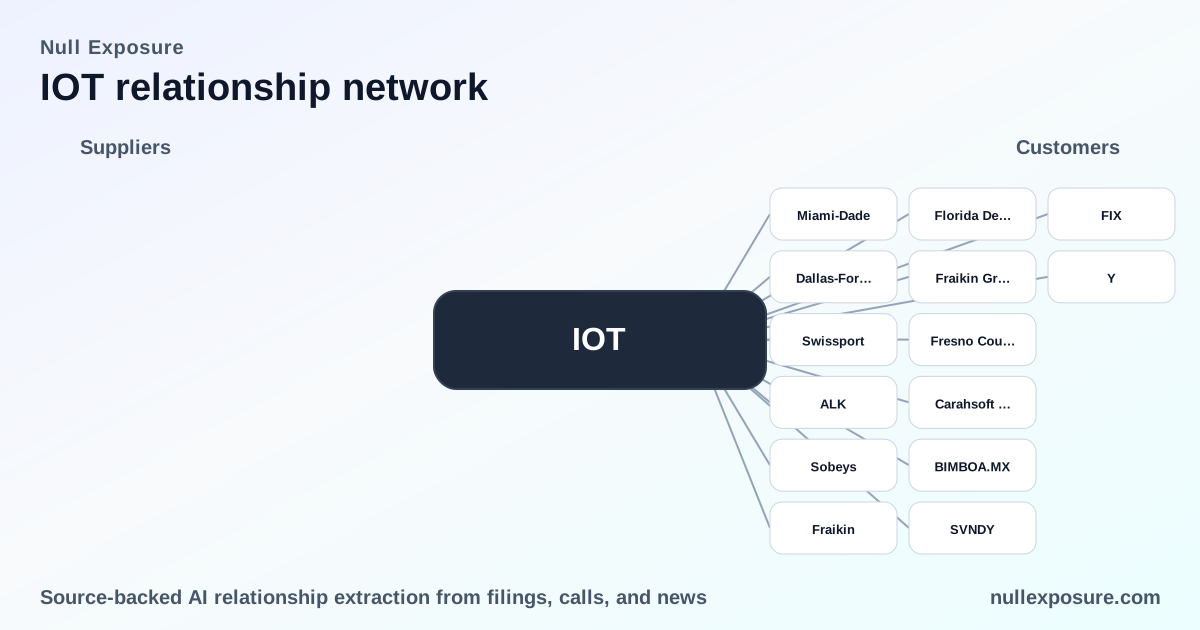
Samsara (IOT): Recurring software for physical operations with device-led distribution
Samsara monetizes by selling subscription access to a Connected Operations Platform—priced per asset and per application—paired with proprietary IoT devices (gateways, cameras, sensors). The business is a SaaS-plus-hardware model: recurring, high-margin software revenue built on device attachment and long initial contract terms, with increased focus on large enterprise and public-sector customers. For a strategic primer and dataset-level signals, visit https://nullexposure.com/.
How the operating model actually behaves for investors
Samsara’s operating model combines classic SaaS economics with hardware-led adoption. The company reports ~98% of revenue from subscriptions, contracts that are typically three-to-five years and generally non-cancelable, and a customer base concentrated toward larger accounts (over $100k ARR). That mix produces several consequential characteristics for underwriting:
- Contracting posture: Subscription-led with long initial terms; renewals drive economic upside and are central to cash flow predictability.
- Concentration: A meaningful share of ARR is concentrated in Core Customers and large enterprises; growth is skewing toward customers with >$100k ARR.
- Criticality: Customers treat the platform as mission-critical—Samsara states customer payments are its largest source of operating cash—making retention strategically essential.
- Geography and maturity: North America is the dominant revenue market (majority of sales), though international expansion is underway (roughly mid-teens percent of revenue outside the U.S. in FY2025).
- Segment and go-to-market: The product is marketed as software (Connected Operations Platform) but deployed with proprietary devices and channel partners, including OEM pre-installs and government aggregator partners.
Bottom line: Samsara is a subscription-first business with hardware attachment and long contract terms that drive durable revenue, concentrated enterprise exposure, and operational leverage as software penetration rises.
Granular relationship roll call (each mention in the sources)
Below is a concise, line-by-line summary of every relationship pulled from the collected sources; each entry is one or two sentences and includes the cited source and period.
- Miami‑Dade — Management said Public Sector saw its highest YoY growth in Q4, led by Miami‑Dade, identifying the county as a key public-sector win (Q4 2025 earnings call).
- Dallas‑Fort Worth Airport — Samsara highlighted a partnership with Dallas‑Fort Worth Airport as an example of large-scale physical-operations deployments (Q1 2026 earnings call).
- USIC — News coverage notes Samsara landed its largest-ever deal with USIC in FY2026, signaling an incremental large commercial deployment (TradingView ideas, May 2026).
- Swissport — Case studies cited Swissport’s use of Samsara’s AI platform to reduce incidents and vehicle damage, reinforcing a safety/efficiency sales narrative (SahmCapital, FY2025/FY2026).
- ALK (Alaska Air Group) — Analysts and coverage reference Alaska Airlines as a named customer showcased to position Samsara as a long-term partner for safety-critical operations (SahmCapital Fleet Watch, FY2026).
- Sobeys — Samsara’s marketing and analyst write-ups list Sobeys among enterprise customers being positioned as multi-product reference accounts (SahmCapital, FY2026).
- Alaska Airlines — Alaska Airlines is cited alongside other aviation customers to illustrate airport and airline operational use cases (SahmCapital Fleet Watch, FY2026).
- JJX Logistics — A TradingView note highlights a collaboration that produced a reported 17% reduction in fleet emissions, demonstrating sustainability outcomes (TradingView, FY2026).
- Ecolab — Ecolab reported deploying Samsara’s AI coaching at scale—pushing 5,000 coaching events in 30 days—underscoring time-savings benefits for large field fleets (Business Wire / FinancialContent press, FY2026).
- International Motors — Multiple reports describe a partnership to pre-install Samsara telematics in new trucks and IC Bus school buses to reduce post-delivery downtime (Investing.com coverage, FY2026).
- Swissport North America — Press and media cited a 60% reduction in operational incidents and a 23% decrease in vehicle damage after deployment, used as a customer proof point (Investing.com, FY2026).
- Florida Department of Fish & Wildlife — Listed as a new multi-product public-sector customer in Q3, reflecting government adoption beyond commercial fleets (Silicon Canals recap, FY2024).
- Fraikin — Fraikin is reported as a large European customer expanding Samsara across more than 10,000 vehicles, highlighting scale in Europe (Silicon Canals, FY2024).
- Fraikin Group — Management statements point to expansion within Fraikin as an example of rapid ROI driving cross-sell (Silicon Canals, FY2024).
- Fresno County — Named among new multi-product public-sector customers, indicating county-level traction (Silicon Canals, FY2024).
- Estes Express Lines — SahmCapital notes an extension of the relationship with Estes, rolling out Samsara technology across its fleet for visibility and maintenance gains (SahmCapital, FY2026).
- UNFI — UNFI announced plans to deploy Samsara’s platform to improve driver safety and delivery performance as part of its growth initiatives (Supermarket News, FY2025).
- Tyson Foods — Trading and analyst commentary list Tyson among strategic partners highlighting Samsara’s focus on innovation for large food and logistics customers (TradingView ideas, FY2026).
- 7‑Eleven — Management cited 7‑Eleven as a Q1 partner example, showing traction in retail and convenience-store logistics (Q1 2026 earnings call).
- DHL — Analyst write-ups reference DHL as a heavyweight partner used to demonstrate enterprise credibility for global logistics deployments (TradingView, FY2026).
- Carahsoft Technology Corp. — Carahsoft is identified as Samsara’s Master Government Aggregator, credited with driving Public Sector growth through dedicated GTM efforts (MarketScreener, FY2025).
- BNSF Railway — Included on an advisory board of senior operators, signaling engagement with large rail fleets and domain expertise (SahmCapital advisory board piece, FY2026).
- Old Dominion Freight Line — Named as an advisory-board participant, indicating deep industry relationships with major freight operators (SahmCapital, FY2026).
- Southern California Edison — Listed among advisory-board members tied to large industrial and utility operators (SahmCapital, FY2026).
- Bimbo Bakeries (BIMBOA.MX) — Management noted securing Bimbo Bakeries as one of several top commercial wins, underscoring food-industry scale deployments (Q4 2025 earnings call).
- SVNDY (7‑Eleven symbol entry) — Duplicate mention of 7‑Eleven as a Q1 partner example in the earnings remarks (Q1 2026 earnings call).
- JJX Logistics (TradingView duplicate) — Additional TradingView mention reiterates the 17% fleet emissions reduction case (TradingView, FY2026).
- Tyson Foods (TradingView duplicate) — A second TradingView idea again highlights Tyson as a strategic customer illustrating innovation-led GTM (TradingView, FY2026).
- DHL (TradingView duplicate) — Duplicate TradingView mention underlines DHL as a marquee logistics partner (TradingView, FY2026).
- Bimbo Bakeries (earnings duplicate) — Additional Q4 call mention reiterates Bimbo as a large commercial customer (Q4 2025 earnings call).
- Y / Sterling Crane — Sterling Crane (listed as Y in the transcript) is referenced as a large mobile crane rental customer operating across multiple job sites in Canada (Q1 2026 earnings call).
- Sterling Crane (explicit) — Management called out Sterling Crane specifically for its branch network and fleet operations, as a representative equipment-rental customer (Q1 2026 earnings call).
- Comfort Systems / FIX — Silicon Canals notes Comfort Systems (FIX) expanded with Samsara due to clear, fast ROI in facilities services (Silicon Canals, FY2024).
- Estes Express Lines (duplicate) — SahmCapital again records Estes extension across its fleet (SahmCapital, FY2026).
- Sysco — Named as an advisory-board participant, reflecting ties to major food distribution fleets (SahmCapital, FY2026).
- Old Dominion Freight Line (duplicate) — Advisory-board mention repeated, reinforcing freight-market engagement (SahmCapital, FY2026).
- Southern California Edison (duplicate) — Repeated advisory-board citation emphasizing utility relationships (SahmCapital, FY2026).
- Inigo — Inigo (insurance partner) stated driver coaching through Samsara correlates with reduced crash rates, highlighting insurtech downstream benefits (Marketscreener / Business Wire, FY2026).
- IC Bus — Partnered with International Motors to pre-install devices in IC Bus school buses, part of an OEM distribution strategy (Investing.com, FY2026).
- International Motors (multiple entries) — Several media items describe a partnership to pre-install telematics on new International trucks and IC Bus school buses to reduce delivery downtime (Investing.com and other press, FY2026).
Why these relationships matter for valuation and risk
The relationship roll call shows a clear pattern: large enterprises, public-sector contracts, and OEM partnerships. That pattern supports a revenue model with high retention potential and sizable upsell opportunities (multi-product deployments at Fraikin, Swissport, Estes). At the same time, reliance on large accounts and some government customers concentrates renewal and budget risk. OEM pre-install partnerships (International Motors, IC Bus) are strategic distribution accelerants that lower installation friction and reduce time to value.
Key investment takeaways: recurring subscription economics and long contract lengths make revenue predictable; enterprise/public-sector concentration is a double-edged sword—lift for ARR but exposure for churn and budget cycles; customer proof points (Swissport, JJX, Ecolab) validate ROI and support cross-sell.
For more detailed signals and to track how these customer relationships evolve quarter-to-quarter, see https://nullexposure.com/.