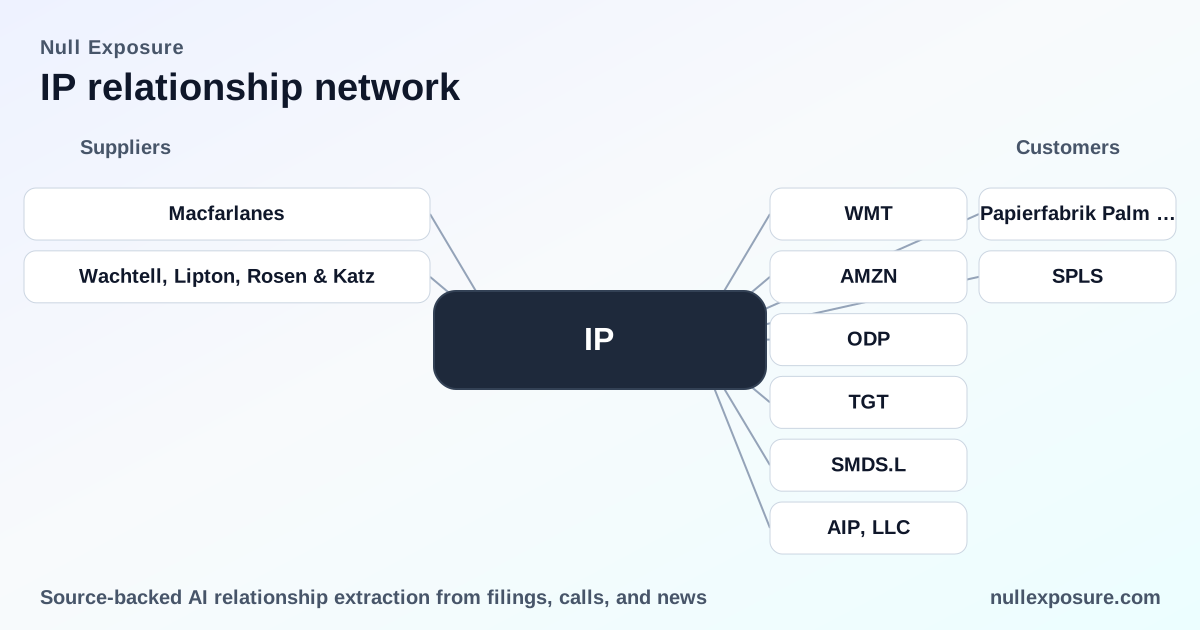
International Paper (IP): a customer map that explains revenue durability and execution risk
Thesis: International Paper (NYSE: IP) is a global manufacturer and seller of fiber‑based packaging and pulp products that monetizes through two principal cash engines — Industrial Packaging (corrugated packaging, containerboard and distribution) and Global Cellulose Fibers (pulp and cellulose products) — selling direct to converters and end‑users while also supplying major retail channels and strategic industry counterparties. For investors, the story is one of scale, geographic concentration in North America, a diversified go‑to‑market (manufacturer + distributor + reseller) posture, and active portfolio reshaping via asset sales and bolt‑on transactions. For deeper situational awareness on counterparties and channel risk visit https://nullexposure.com/.
Key operating signal: IP sells finished packaging and raw cellulose; it collects cash from industrial customers and large retail accounts, and reduces capital intensity by monetizing non‑core assets — a dynamic that supports near‑term cash generation but concentrates operating exposure by region and by channel.
How IP’s customer relationships translate to cashflow and risk
International Paper operates globally but the revenue mix is heavily weighted to North America, where net sales dominate, while EMEA and APAC represent meaningful but smaller footprints. That structure yields several investment implications: stable, volume‑driven cashflow from core industrial customers, paired with retail channel exposure that amplifies product visibility but compresses pricing power. The company’s contracts run the gamut from long‑run offtake arrangements to broad retail distribution, so monitor counterparty settlement dynamics and inventory cycles for short‑term earnings volatility.
- Geography and scale: IP reports large North American sales (over $16.3bn in the U.S. reported for 2024) with EMEA a significant regional base and APAC smaller but growing; this is a company that manufactures and sells globally.
- Role mix: IP is simultaneously a manufacturer, distributor and seller — it produces in multiple continents and also distributes through regional branches and retail channels.
- Segment posture: The firm’s core product focus is fiber‑based packaging and cellulose fiber; distribution and manufacturing are complementary operating modes.
These are company‑level signals drawn from IP’s disclosures and recent filings; they shape the contracting posture, concentration and maturity of customer relationships investors should prioritize.
Customer relationships — the on‑the‑record counterparties
Below I walk through every customer relationship identified in the public coverage captured for IP. Each entry is a concise investor‑facing read with the source cited.
SLVM (Sylvamo) — offtake, inventory settlement and operational linkage
Sylvamo’s North American paper business has offtake agreements to purchase uncoated freesheet paper produced at IP’s Riverdale and Georgetown mills, and its management references the settlement of payables to International Paper related to Riverdale tons, signaling operational and cashflow linkage between the two companies. This is reported in MarketScreener (May 3, 2026) and reinforced in a Sylvamo earnings‑call transcript (March 10, 2026).
Walmart — national retail distribution for HP paper
HP‑branded office paper manufactured by International Paper shows broad availability at Walmart, indicating a national retail channel that drives volume but exposes IP to mass retail pricing dynamics, per an ad‑hoc‑news roundup covering retail placement (March 10, 2026).
Target — another mass‑retail placement for IP paper
IP‑manufactured HP paper is distributed through Target stores across the U.S., giving IP scale in consumer‑facing channels alongside other big‑box accounts, according to the same ad‑hoc‑news retail report (March 10, 2026).
Amazon — e‑commerce outlet for IP‑manufactured paper
Amazon lists HP paper produced by International Paper, which extends IP’s reach into online retail and fulfillment networks and affects inventory cadence and promotional exposure, per the March 10, 2026 ad‑hoc‑news piece.
Office Depot — office supply channel for HP paper
Office Depot carries HP paper manufactured by IP, anchoring the company’s presence in office‑supply specialty channels and stabilizing demand from business consumers, per the March 10, 2026 ad‑hoc‑news coverage.
WMT (duplicate Walmart reference) — retail channel confirmation
A second extraction identifies the WMT ticker entry that reinforces the Walmart relationship and its role as a high‑volume retail partner for HP paper products (ad‑hoc‑news, March 10, 2026).
SLVM (earnings‑call mention) — payable settlement dynamics
Sylvamo’s Q4‑2025 earnings call explicitly links inventory build/draw patterns and the settlement of a payable to International Paper for Riverdale tons, confirming working‑capital interactions that can affect both companies’ quarter‑to‑quarter cash flows (InsiderMonkey transcript, March 10, 2026).
DS Smith / SMDS.L — strategic combination and EMEA packaging footprint
IP’s Q4‑2025 earnings call discusses the acquisition and integration of DS Smith, describing leadership roles, the combination of legacy DS Smith and IP assets in EMEA packaging, and the strategic intent to strengthen regional footprint — a signal that IP is consolidating in EMEA packaging markets to scale service and reach (IP Q4 2025 earnings call transcript, March 7, 2026).
SMDS.L (duplicate earnings‑call extraction) — reinforced EMEA strategy
A second extraction from the same earnings call reiterates the DS Smith integration and operational leadership shifts, underscoring the priority given to EMEA packaging transformation (IP Q4 2025 earnings call transcript, March 7, 2026).
Papierfabrik Palm GmbH & Co KG — sale of European corrugated plants
Papierfabrik Palm completed the acquisition of five European corrugated box plants from International Paper, a disposal that reduces IP’s European asset footprint and shifts customer relationships tied to those plants to the buyer (Simply Wall St summary, March 10, 2026).
AIP, LLC — sale of Global Cellulose Fibers business
AIP, LLC agreed to acquire IP’s Global Cellulose Fibers business for $1.5 billion, a material portfolio action that transfers customer contracts for cellulose fibers and alters future revenue mix and margin profile (Simply Wall St, March 10, 2026).
Staples — office‑supply channel distribution
Staples is listed among retailers carrying HP paper made by International Paper, anchoring IP’s presence in dedicated office‑supply channels and contributing steady retail demand (ad‑hoc‑news, March 10, 2026).
(If you want a consolidated customer impact matrix or a downloadable counterparty map, start here: https://nullexposure.com/.)
What the relationship map means for investors — operating constraints and balance of risks
The relationship trace yields several actionable company‑level constraints and business‑model characteristics you should treat as active factors in valuation and monitoring:
- Concentrated geography: North America dominates sales; EMEA is strategically important; APAC is present but smaller. That concentration creates regional demand sensitivity and currency/energy cost exposure.
- Mixed contracting posture: IP runs a combination of longer‑term offtake and payable settlements (industrial counterparties) and high‑volume retail distribution; the former supports predictability, the latter pressures pricing and inventory.
- Counterparty criticality and maturity: Relationships with large retailers (Walmart, Target, Amazon, Staples, Office Depot) are high‑volume but typically low‑margin and transactional; industrial partner ties (e.g., Sylvamo) show settlement mechanics that can create working‑capital volatility. The company’s manufacturing and distribution operations are mature, capital‑intensive businesses.
- Portfolio reshaping: Recent divestitures (European corrugated plants, the cellulose fibers sale) and the DS Smith transaction shift concentration and counterparty exposure, signaling a deliberate move to rationalize assets and concentrate on higher‑return packaging markets.
- Concentration risk vs. distribution breadth: Although retail coverage is broad, reliance on a handful of large distribution channels and major industrial counterparties concentrates counterparty risk on settlement practices, promotional cycles, and procurement decisions.
Bottom line and investor action points
International Paper is a scale manufacturer and channel operator whose customer relationships straddle predictable industrial agreements and volatile mass‑retail channels. The combination of asset sales and strategic acquisitions is reshaping where revenue comes from and which counterparties matter most.
Key investor priorities:
- Track working‑capital flows and payable/receivable settlements tied to industrial counterparties such as Sylvamo.
- Monitor margin mix changes as the Global Cellulose Fibers sale and European plant dispositions reallocate revenue and cost bases.
- Watch retail channel promotions and inventory dynamics across Walmart, Target, Amazon and Staples for near‑term volume and margin swings.
For a structured counterparty map and ongoing monitoring tools tailored to packaging and paper sector investors, visit https://nullexposure.com/ for signals and coverage updates.