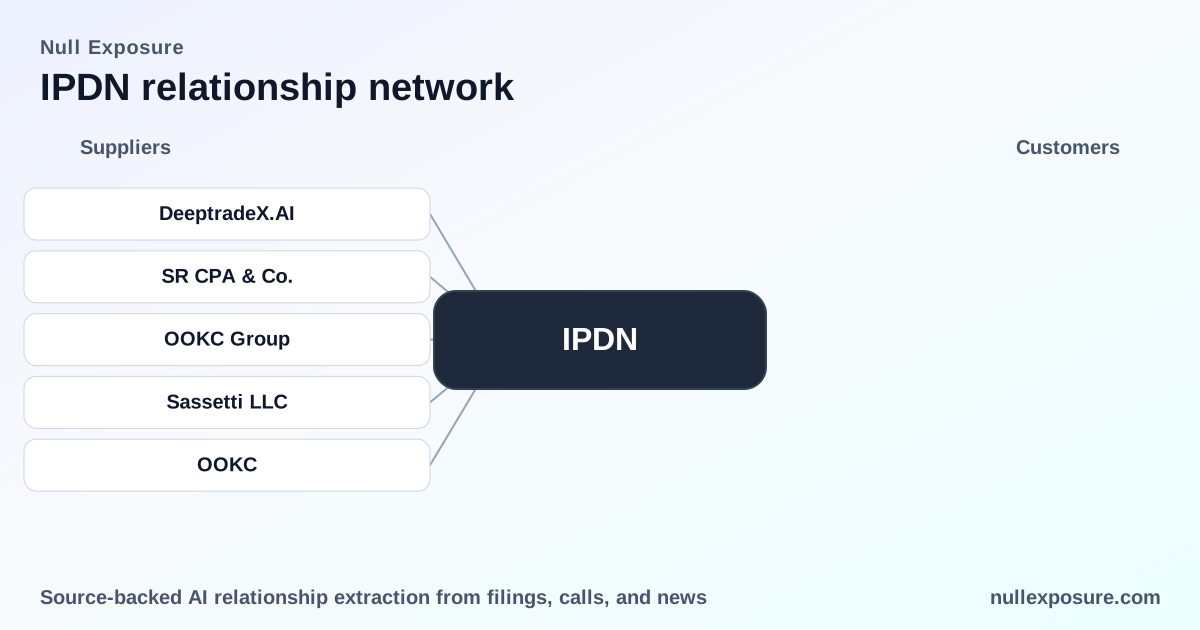
Professional Diversity Network (IPDN): Customer relationships and capital counterparties that shape the outlook
Professional Diversity Network (IPDN) operates niche online professional communities and recruitment services that monetize through a mix of membership subscriptions, advertising and pay-per-hire recruitment fees, plus software licenses and one-off services. The company generates recurring cash from annual NAPW/IAW memberships, usage-linked ad revenues and contingent placement fees while supplementing cash flow with short-term licensing (PDNRecruits) and corporate financings. For investors evaluating customer- and counterparty-driven risk, the business model blends subscription backbone with materially variable, usage-driven revenue and dependence on external capital — a dynamic that drives both upside to scaling and downside from churn and dilution. Learn more at https://nullexposure.com/.
How the business actually gets paid: subscriptions, usage and one-off services
IPDN’s revenue profile is a hybrid monetization model. The company recognizes membership revenue ratably over 12 months after annual prepayment, sells advertising on an impressions or fixed-revenue-share basis, and charges contingent fees for successful placements. RemoteMore contributes software revenue recognized monthly for delivered services, while PDNRecruits runs on renewing month-to-month licenses intended to scale residual income.
- Contracting posture: The revenue mix creates a two-tier exposure — a subscription base that gives predictable near-term cash flow and variable, usage-based lines that move with hiring and marketing cycles. Short-term licenses (month-to-month PDNRecruits) increase churn risk but enable rapid customer addition.
- Customer concentration and scale: As of December 31, 2024, IPDN reported roughly 1,450 total customers and about 300 enterprise customers, indicating a small but diversified customer base across enterprise, mid-market, SMB, government and individual users.
- Criticality and maturity: Memberships and recruitment placements are core business drivers and therefore operationally critical; however, the company’s product mix includes early-stage offerings (e.g., RemoteMore, PDNRecruits) that reflect intermediate maturity rather than broad market penetration.
- Geography and segments: The TalentAlly Network is primarily U.S.-focused while certain units such as RemoteMore target global remote-hiring customers, producing a mixed geographic exposure. IPDN reports revenue segments across software and services, reinforcing the hybrid model.
Capital-market relationship: Streeterville Capital — financing that alters the equity base
IPDN’s most visible corporate counterparty in recent reports is Streeterville Capital, LLC; the engagement is financing rather than a classic customer contract but materially affects shareholder dynamics.
Streeterville amended an existing securities purchase agreement with IPDN in May 2026, reducing the previously contemplated commitment amount and revising the terms of the original facility. This amendment changes the company’s financing runway and the potential cadence of future share issuances. Source: Investing.com SEC filing summary, May 3, 2026 (https://m.uk.investing.com/news/sec-filings/professional-diversity-network-reduces-commitment-amount-in-agreement-with-streeterville-capital-93CH-4638719?ampMode=1).
Earlier, IPDN entered a $20 million stock purchase agreement with Streeterville that allowed the company to issue and sell common stock through pre-paid advance purchases; that facility represented a substantive dilutive financing tool intended to undergird working capital and growth investments. Source: Investing.com SEC filing summary (FY2025) (https://uk.investing.com/news/sec-filings/professional-diversity-network-announces-resignations-of-two-board-directors-93CH-4273120).
Why these relationships matter to investors
- Dilution risk is explicit and immediate. The $20 million facility and subsequent amendment with Streeterville directly increase the company’s available equity issuance capacity and therefore the risk of dilution to existing shareholders; financing cadence will influence liquidity and investor returns. The May 2026 amendment trimmed the commitment, which reduces one source of dilution but still leaves equity financing as a prominent lever.
- Revenue predictability is mixed. The subscription base provides baseline stability, but usage-based advertising and contingent placement fees produce quarter-to-quarter volatility aligned with hiring cycles and advertiser demand.
- Operational leverage is limited by negative margins. IPDN’s trailing revenue of roughly $6.55 million against a negative EBITDA of approximately $6.4 million and negative EPS underscores that operating losses and cash burn remain a principal constraint on expansion absent sustained external financing.
- Customer breadth reduces single-buyer concentration, but scale is small. With ~300 enterprise customers and 1,450 total customers, client diversity exists but absolute scale is modest; that combination favors resilience to any one client loss but limits pricing power and margin expansion.
Relationship-by-relationship review (complete coverage)
Streeterville Capital, LLC — amendment to securities purchase agreement (FY2026). Professional Diversity Network announced an amendment to its securities purchase agreement with Streeterville that reduced the previously committed amount and adjusted terms of the financing arrangement. This impacts IPDN’s capital availability and potential share issuance schedule. Source: Investing.com SEC filing summary, May 3, 2026 (https://m.uk.investing.com/news/sec-filings/professional-diversity-network-reduces-commitment-amount-in-agreement-with-streeterville-capital-93CH-4638719?ampMode=1).
Streeterville Capital, LLC — $20 million stock purchase agreement (FY2025). In FY2025 IPDN entered into a $20 million stock purchase agreement with Streeterville Capital, enabling pre-paid advance purchases of common stock to provide near-term financing; this agreement established a material financing runway and a direct dilution mechanism for shareholders. Source: Investing.com SEC filing summary (FY2025) (https://uk.investing.com/news/sec-filings/professional-diversity-network-announces-resignations-of-two-board-directors-93CH-4273120).
What investors should monitor next
- Draws and amendments under the Streeterville facility: Any future amendments, utilization notices, or warrant/price adjustments will materially affect share count and valuation.
- Trends in subscription renewals and PDNRecruits license growth: Subscription renewal rates and month-to-month license uptake are the best direct indicators of whether the core recurring revenue engine is scaling.
- Advertising and placement revenue growth: Usage-based revenue lines are volatile but high-ROI if hiring and advertising demand rebound; monitor monthly impressions and contingent placement throughput.
- Cash flow and EBITDA trajectory: With negative EBITDA and thin market capitalization (~$8.2M), the company’s ability to move toward positive operating cash flow or secure non-dilutive capital is decisive.
For a concise, analyst-ready breakdown of IPDN’s counterparty exposures and contractual posture, visit https://nullexposure.com/ for our model and risk summary.
Bottom line
Professional Diversity Network runs a subscription-led, usage-augmented revenue model with emergent software offerings and short-term licensing that can scale rapidly but currently operate against a backdrop of negative operating results. The Streeterville Capital arrangements are the most consequential counterparty relationships disclosed in recent filings: they supply liquidity but also introduce material dilution and governance considerations that will govern near-term shareholder returns. Investors should weight the upside from subscription and recruitment expansion against the clear capital and margin constraints reflected in current financials.