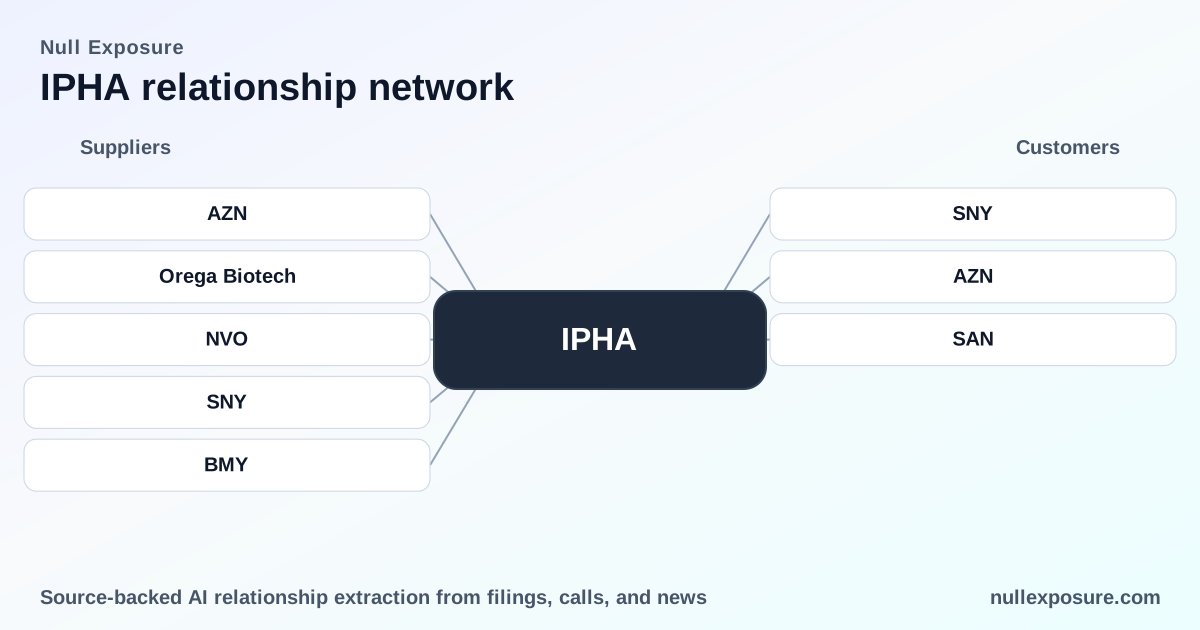
Innate Pharma (IPHA): Partner Revenue, Clinical Maturity and the Concentration Risk Investors Need to Price In
Innate Pharma discovers and develops therapeutic antibodies and monetizes primarily through licensing and collaboration agreements with large pharmaceutical partners—most notably AstraZeneca and Sanofi—receiving upfronts, milestone payments, shared-cost reimbursements and potential royalties that are highly event-driven. The company’s cash flow profile is therefore lumpy and dependent on a small number of partner outcomes, with recent financials showing collaboration receipts driving most recognized revenue. For a concise gateway to the dataset underlying this note, visit https://nullexposure.com/.
How Innate operates and why partnerships drive value
Innate is a classic asset-light biotech: it develops antibody programs through early clinical phases and transfers later-stage development and commercialization risk to large pharma partners in exchange for upfronts, milestones and royalties. That model produces two contradictory features for investors: high upside on successful partner advances (large milestones/royalties) and large downside if partners return rights, discontinue programs, or complete contracted payments. Recent filings and press commentary show both dynamics in play.
- Contracting posture: Innate routinely enters research and licensing agreements that include cost-sharing clauses and milestone/royalty economics rather than pursuing full in-house commercialization.
- Revenue concentration: A small number of counterparties account for the bulk of collaboration receipts, making revenue volatile when contracts complete or are returned.
- Program maturity: Some partnered assets have advanced to late-stage trials (supporting near-term royalty optionality), while other NK-cell engagers have been discontinued or returned, producing an uneven pipeline maturity profile.
- Cash sensitivity: Innate’s operating runway is tightly linked to timing and recognition of partner payments and to the cadence of milestone events.
The partner landscape — a concise, complete summary of every relationship in the coverage set
AstraZeneca (AZN / AstraZeneca)
AstraZeneca licensed Innate’s anti‑NKG2A antibody monalizumab under a 2018 deal that included an upfront/payment package reported at $170 million and options on multiple programs; AstraZeneca is now running monalizumab in a Phase III PACIFIC‑9 study for NSCLC, and Innate would earn double‑digit royalties in the U.S. and RoW if approval occurs. Source: FierceBiotech (FY2018) and European Pharmaceutical Review / earnings call commentary (FY2023–FY2026).
AstraZeneca also shares clinical costs on certain programs with Innate (for example equal sharing on the avdoralimab Phase 1 trial) while bearing R&D costs on other assets such as IPH5201, producing periodic settlement invoices between the parties. Source: Innate Pharma first‑half 2021 financial update (GlobeNewswire, FY2021).
Sanofi (Sanofi / SNY / SAN)
Sanofi’s relationship is multi‑layered: a long‑running 2016 partnership was expanded in later years (including a 2022 license of Innate’s B7‑H3 ANKET platform for a reported €25m upfront), and Sanofi has historically been a material sources of milestone potential—aggregate milestone opportunities in the deal family were reported in the aggregate as capable of exceeding €1 billion. Source: European Pharmaceutical Review (FY2022) and FierceBiotech (FY2025).
By 2024–2025, Sanofi returned rights on several NK‑cell programs and discontinued select oncology NK‑engager programs (for instance the BCMA‑targeting IPH640/ SAR445514 was discontinued in mid‑2025), which reduced near‑term revenue recognition and left Innate with only small collaboration receipts recognized in FY2025/FY2026 (for example €0.4m recognized from the 2022 research collaboration as of Dec 31, 2025). Source: OncologyPipeline reports and Innate Pharma full‑year business updates (FY2025–FY2026).
What the partner mix implies for revenue and valuation
- Revenue is milestone‑driven and concentrated. The FY2026 reporting cycle explicitly notes that collaboration and licensing revenues “mainly resulted from the partial or entire recognition of the proceeds received pursuant to the agreements with AstraZeneca and Sanofi,” demonstrating that partner cash flows are the dominant near‑term revenue source (PharmiWeb / BioSpace, FY2026).
- Pipeline binary risk is high. AstraZeneca’s monalizumab is the single asset with late‑stage optionality and royalty upside; other partnered programs have been returned or discontinued by Sanofi, demonstrating asymmetric outcomes across programs (European Pharmaceutical Review; OncologyPipeline, FY2023–FY2025).
- Cost and settlement mechanics influence working capital. Innate’s disclosures show explicit cost‑sharing and periodic settlement invoices with AstraZeneca on certain trials, creating intra‑cycle working capital variability (GlobeNewswire H1 2021).
- Cash runway and timing are the immediate valuation levers. Public commentary and transcripts flagged a cash runway expectation through end‑Q3 2026 absent new financing or material partner receipts, making the timing of milestones and recognition events the critical near‑term determinative factors for equity value (Investing.com coverage, FY2026).
Visit https://nullexposure.com/ for further partner‑level intelligence and to explore connected company coverage.
Investment risks and upside scenarios
- Upside: A successful AZN Phase III outcome for monalizumab converts an existing licensing arrangement into recurring royalty economics and would re‑rate Innate’s partnership optionality materially.
- Downside: Contract completions, program returns or partner discontinuations compress revenue visibility and force reliance on financing, as evidenced by the sharp revenue drop cited in FY2026 commentary when major agreements completed or were discontinued (Investing.com / FY2026).
- Operational execution: Innate’s ability to retain favorable economics in future partnerships and to generate new collaborations will determine whether it can replace large partner receipts when they evaporate.
Bottom line — how investors should think about IPHA
Innate Pharma is a high‑conviction, partner‑dependent biotech: valuation is a compound of late‑stage partner success (notably AstraZeneca’s monalizumab) and the firm’s ability to re‑monetize returned or discontinued assets. Key monitoring metrics for investors are milestone timing, revenue recognition from AstraZeneca and Sanofi, and any new licensing deals that materially change the concentration profile. With cash runway cited into Q3 2026 under current assumptions, the calendar for clinical readouts and license negotiations becomes the central short‑term driver of upside or downside.
For a practical partner‑risk dashboard and ongoing relationship tracking, explore additional coverage and alerts at https://nullexposure.com/.