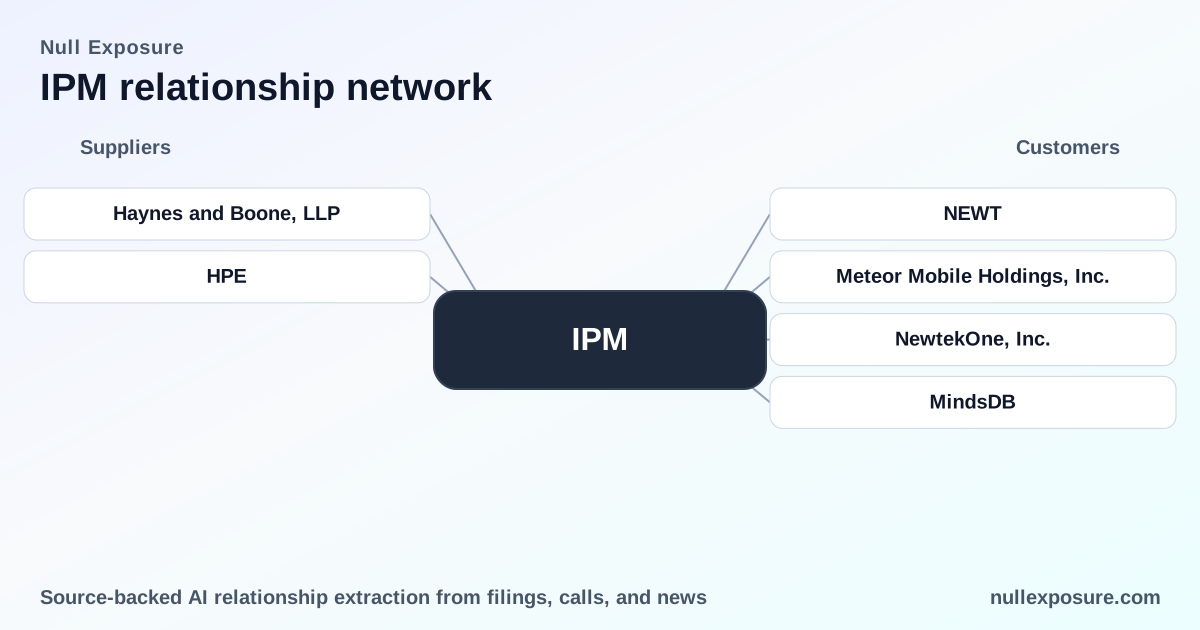
IPM Customer Landscape: Who Pays for Security and How Durable the Revenues Are
Intelligent Protection Management Corp (IPM) operates as a security- and managed-IT-services provider that monetizes through a mix of subscription-managed services, usage-priced backup and disaster recovery, and one-off divestiture/earn-out receipts. The company bundles managed security, cloud hosting, backup and professional services for customers across enterprise, mid-market and small-business segments, and it derives material revenue concentration from a small set of clients. Learn more at https://nullexposure.com/.
Investment thesis — concise and actionable
IPM sells recurring security and hosting services that drive steady, contractually governed revenues, complemented by occasional non-recurring transaction proceeds. The business is structured for recurring cash flow (subscriptions and usage billing) but exhibits customer concentration and transitional deal activity that increase near-term revenue volatility. Investors should value the company as a specialty managed-services operator with modest scale, meaningful client concentration, and identifiable near-term upside from service expansion into cloud/cybersecurity after recent transactions.
How IPM contracts and collects — practical signals for valuation
IPM’s public disclosures and transaction notices reveal the company’s commercial posture and risk profile:
- Contracting posture: Core revenues are delivered under subscription contracts (one-, six-, twelve- and 24‑month terms) with straight-line revenue recognition; backup/recovery services are charged on a usage basis. This gives a mixed recurring/variable revenue profile that supports predictability for base subscribers while allowing scalable per‑customer billing for storage-heavy clients.
- Customer mix and geography: IPM serves large enterprises, mid-market and small businesses across the United States, indicating diversified customer-size exposure but single-market geographic concentration.
- Concentration risk: Management reports that roughly 50% of accounts receivable were tied to four customers, and the company relies on a limited number of customers for a material portion of revenue — a clear concentration risk that compresses bargaining leverage and increases churn sensitivity.
- Transaction-driven cash flows: The company executed a divestiture and structured an earn-out schedule extending through 2028, reflecting mix of near-term cash and multi-year contingent receipts.
- Spend scale: The disclosed divestiture closing consideration of approximately $1.35 million establishes a mid-single-million transactional scale in recent deals.
Together these signals imply a controlled recurring revenue base with material customer concentration and episodic non‑recurring items that should be modeled explicitly when projecting free cash flow and valuing the business.
Customer relationships — what the filings and press releases show
Below are the customer and counterparty relationships surfaced in IPM’s coverage and filings, each summarized and sourced.
NewtekOne, Inc. (NEWT)
IPM (via the Paltalk/NewtekOne transaction narrative) will continue to provide managed IT security and infrastructure services to NewtekOne, with NewtekOne’s entire IT stack to be secured and managed by the retained NTS team of 47 personnel following the acquisition closing. According to a GlobeNewswire release dated December 30, 2024 and subsequent conference notices, NewtekOne is an identified customer and strategic anchor for the company’s managed-services offering. (GlobeNewswire; QuiverQuant coverage of the conference call, January 2025.)
Meteor Mobile Holdings, Inc.
IPM completed a divestiture of Paltalk, Camfrog and Vumber applications to Meteor Mobile, receiving $1,350,000 in cash at closing plus assumed liabilities and a structured earn‑out tied to legacy business revenue spanning mid‑2025 through 2028. This transaction both monetized legacy consumer assets and established an ongoing contingent payment relationship with Meteor Mobile tied to future revenues. (StorageNewsletter report, January 6, 2025; Investing.com recap of filings, 2026.)
MindsDB
IPM has initiated a reseller agreement with MindsDB and disclosed a collaboration with IT Ally to expand product and channel reach for its security and analytics capabilities. The arrangement positions MindsDB as a commercial partner for go-to-market expansion rather than a large direct customer. (TipRanks coverage of the FY2025 earnings call; The Globe and Mail earnings-related release, March 2026.)
What the relationship map means for risk and upside
- Revenue durability is mixed. Subscription contracts create a predictable base, while usage-based backup pricing creates upside aligned to intensity of customer storage/backup needs. Model recurring revenue but stress-test for concentrated customer losses.
- Customer concentration is the dominant risk. With roughly half of receivables tied to four customers, a single contract failure or non-payment materially impacts near-term cash flows. Price and customer diversification must be core assumptions in valuation scenarios.
- Transaction activity shifts risk from operations to contingent receipts. The Meteor Mobile divestiture converted legacy consumer assets into cash and a multi‑period earn-out; treat that earn-out as conditional cash flow with lower certainty than subscription revenue but higher certainty than litigation outcomes.
- Counterparty mix supports cross‑sell but limits scale. Serving enterprise to small-business clients allows unit economics variability; the reseller relationship with MindsDB and partnerships like IT Ally are growth levers that can increase software/analytics penetration without heavy upfront sales cost.
- Geographic concentration in North America simplifies regulatory exposure but ties growth to domestic IT spend cycles.
Actionable takeaways for investors and operators
- Model both recurring subscription revenue and variable usage revenue separately; assume higher churn and collection volatility for the concentrated customer set.
- Stress-test for loss of any top-four customer and assess covenant or liquidity impacts at current market capitalization and negative EBITDA.
- Value earn-outs conservatively: treat Meteor Mobile contingent payments as probability-weighted receipts over 2025–2028 rather than guaranteed cash flow.
- Monitor channel and reseller traction (MindsDB, IT Ally) as leading indicators of scalable, lower-cost customer acquisition that can reduce concentration risk over time.
For a data-driven, relationship-focused perspective on IPM and comparable managed-service providers, visit https://nullexposure.com/ for additional research and raw-source mappings.
Bold takeaway: IPM is a subscription-forward managed‑security operator with meaningful customer concentration and transactional proceeds shaping near‑term cash flow — attractive for investors who price concentration risk and upside from channel expansion.