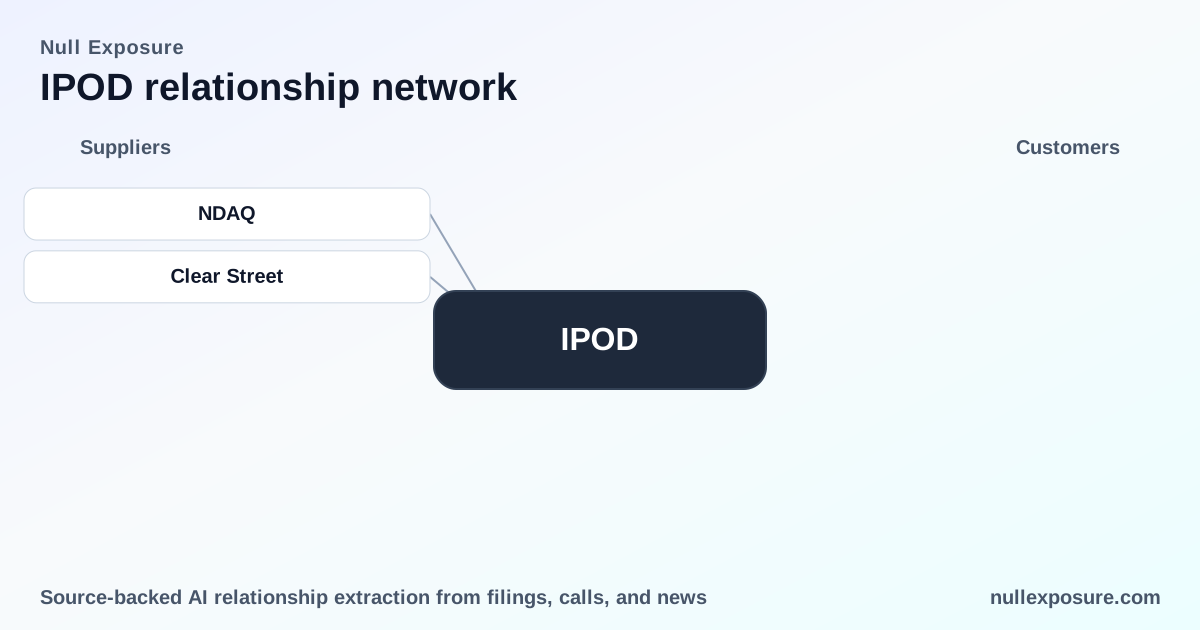
IPOD: Sponsor Handover Recasts Governance — Investment Thesis and What to Watch
Dune Acquisition Corporation II (IPOD) is a classic SPAC vehicle: it lists as a shell company that monetizes primarily through sponsor economics — sponsor shares, warrants, and the proceeds of a trust — and through completing a business combination that converts capital-light listings into operating equity. IPOD’s public market value is driven by sponsor control, the timing and quality of any target merger, and concentrated institutional ownership rather than operating revenues, since reported RevenueTTM is zero and the vehicle carries no operating gross profit.
For ongoing monitoring of portfolio-level sponsor and governance shifts, see NullExposure’s coverage at https://nullexposure.com/.
What IPOD is now: capital structure and market signals that matter
IPOD is listed on NASDAQ as a shell company in the Financial Services sector. As of the latest filings the company shows Market Capitalization of roughly $209.8 million, EPS of $0.22, Price/Trailing EPS of 47.14, and a Price/Book near 1.47, while having no reported revenue or operating margins. Shares outstanding are concentrated — institutions own virtually all the float (PercentInstitutions 99.985%), which makes market trading and governance outcomes heavily influenced by institutional holders rather than retail dynamics.
These figures underline a fundamental SPAC reality: equity value is a function of sponsor incentives, deal pipeline, and trust value rather than traditional operating metrics. Investors should treat IPOD as a governance and deal-structure exposure rather than an operating-company play.
Sponsor change: Collective Acquisition Sponsor takes a formal stake
Collective Acquisition Sponsor executed a Purchase and Sponsor Handover Agreement under which it acquired 4,475,000 Class B shares and 1,000,000 private placement warrants for $2.0 million. This is a concrete sponsorship transfer that reassigns economic and control rights embedded in the sponsor structure. According to a TradingView notice dated May 3, 2026, the agreement formalizes Collective Acquisition Sponsor as the recipient of those sponsor instruments and private placement warrants. (TradingView report, May 3, 2026.)
Takeaway: This is a governance-level transaction that directly affects who controls sponsor economics and post-merger incentive alignment.
How each relationship in the record affects IPOD (complete coverage)
- Collective Acquisition Sponsor — The sponsor handover transfers 4,475,000 Class B shares and 1,000,000 private placement warrants to Collective Acquisition Sponsor for $2.0 million, shifting sponsor economics and control rights. This was reported by TradingView on May 3, 2026. (TradingView news, 2026-05-03.)
This relationship is the only external customer/partner relationship recorded in the recent dataset and therefore commands outsized relevance to IPOD’s near-term governance and transaction pathway.
Constraints and company-level operational signals investors should internalize
There are no explicit external constraints listed in the recent scrape, so the following are company-level signals derived from public facts and the sponsorship change:
- Contracting posture: The sponsor handover indicates active renegotiation of sponsor-side agreements and a willingness to re-contract core governance documents at material economic terms. That signals a flexible contracting posture on sponsor economics rather than fixed founder ownership.
- Concentration: Institutional ownership is effectively the entirety of public float (99.985%), so decision-making and exit outcomes will be institution-driven and potentially opaque to retail.
- Criticality: With no operating revenues, sponsor and warrant terms are the critical drivers of shareholder value; sponsor transfers therefore move value directly rather than indirectly.
- Maturity: IPOD is a shell/SPAC with zero reported RevenueTTM and no operating margins; maturity as an operating business is nascent — the entity’s lifecycle is merger-focused, not revenue-driven.
These signals combine into a single operating-model message: IPOD is a governance-first vehicle where sponsor alignment and institutional votes determine value creation or crystallization.
Why the sponsor handover matters for investors
The sponsor package for any SPAC embodies the long-tail economics that reward successful deal origination and execution. By transferring Class B shares and warrants, Collective Acquisition Sponsor inherits upside potential on a completed business combination and control levers that affect deal approval and post-deal governance. For investors, this raises three concrete implications:
- Repriced alignment: New sponsor economics change the alignment between public shareholders and deal sponsors, which can accelerate or deter deal sourcing and push different target profiles onto the table.
- Voting dynamics: With institutional ownership dominant and sponsor control shifting, proxy outcomes and redemptions will be influenced by a narrower set of decision-makers.
- Valuation sensitivity: Because revenue is zero, any revaluation will be driven by perceived sponsor capability, potential target quality, and the dilution effect of warrants and sponsor shares.
Risk factors and the decision framework for operators and allocators
Operators and allocators should weigh IPOD as a governance and event-driven instrument with the following prioritized risks:
- Sponsor execution risk: Sponsor changes can either improve deal prospects if the acquirer has a credible pipeline or create friction if governance priorities diverge.
- Concentration risk: Institutional dominance reduces breadth of market signaling; large holders can push a transaction that benefits sponsor economics even if retail sentiment is indifferent.
- Dilution pathways: The transferred warrants and Class B shares translate into potential dilution post-combination; monitor filings for how these instruments convert and for any side arrangements that affect insider economics.
Investors should stress-test outcomes around deal announcements, sponsor statements of intent, and any amendments to sponsor agreements.
Practical next steps for monitoring and position management
- Track proxy statements and S-4 filings for parties named in the handover transaction to see the full legal language and conversion mechanics.
- Monitor redemption rates and institutional filings; with institutional ownership near totality, 13F or similar disclosures will reveal directional intent.
- Watch for press releases or SEC filings from Collective Acquisition Sponsor that outline target sectors or transaction timelines.
For a curated feed and to watch governance developments across SPACs, visit NullExposure at https://nullexposure.com/ — our tracker highlights sponsor movements and governance events that drive value in SPACs like IPOD.
Bottom line
IPOD is a governance-driven instrument whose value will be determined by sponsor alignment and a successful business combination rather than operating metrics. The recent Purchase and Sponsor Handover Agreement establishing Collective Acquisition Sponsor’s ownership of Class B shares and warrants is a high-impact event — it rewires sponsor incentives and therefore directly shifts the probability distribution of transaction outcomes. Investors and operators should prioritize sponsor disclosures, institutional voting patterns, and dilution mechanics when evaluating IPOD for allocation.