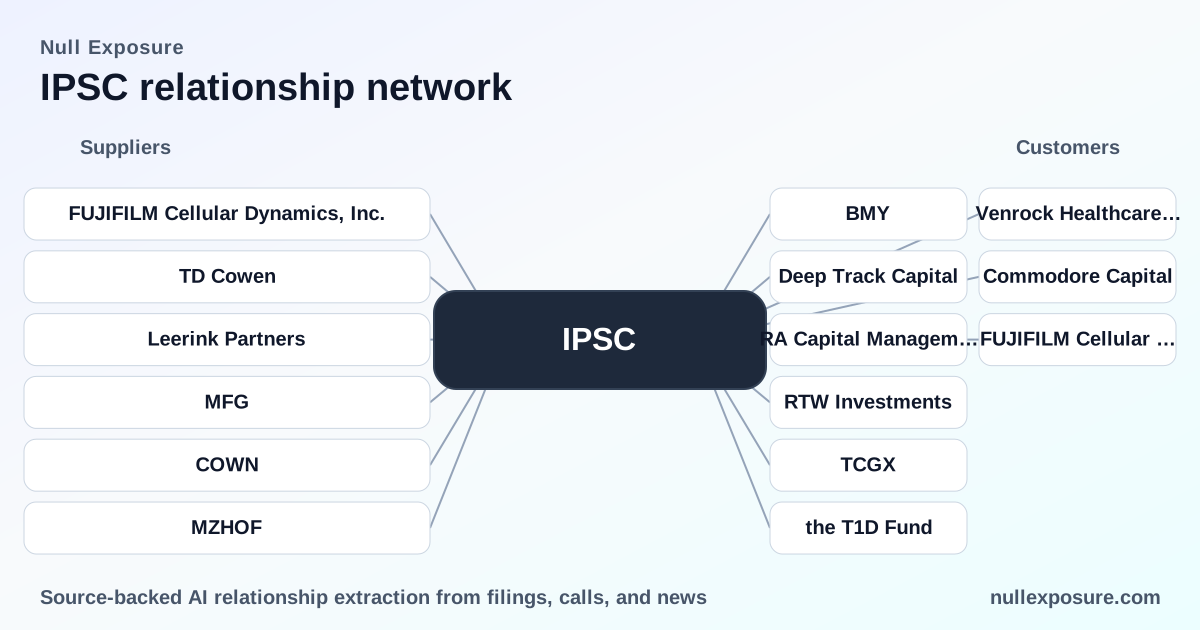
Century Therapeutics (IPSC): The customer relationships that drive near-term value
Century Therapeutics operates as a clinical-stage cell therapy innovator that monetizes primarily through strategic collaborations, license agreements, and periodic equity financings. The company’s commercial economics are heavily shaped by a multi-program collaboration with Bristol-Myers Squibb and by intermittent capital raises that bring institutional and specialist investors into the cap table. For investors evaluating customer and counterparty risk, the revenue profile is concentrated and milestone-driven, and the operating runway is a function of partner receipts plus sporadic financing. For a quick company overview, see https://nullexposure.com/.
Key investment takeaway: Century’s commercial traction is dominated by a single, high-value partnership that materially affects revenue recognition and near-term cash dynamics; at the same time, recurring participation from sophisticated life-science investors supports balance-sheet flexibility.
How Century’s commercial model actually works in practice
Century builds iPSC-derived allogeneic cell therapies and then relies on collaboration agreements—licensing, R&D funding, and milestone payments—to convert R&D progress into near-term revenue. The company’s arrangement with Bristol-Myers Squibb (BMS) is structured as a collaboration, option and license agreement that delivers both research funding and significant downstream economic consideration tied to program progress. Outside of partner receipts, value capture comes from equity financings that bring strategic and crossover investors into the company. This hybrid monetization model places Century between a pure biotech R&D operator and a collaboration-driven commercial outlet.
If you want a concise centralized view of Century’s profile and relationships, visit https://nullexposure.com/.
Relationship roster — who matters and why
Below I cover every counterparty found in the available results. Each entry is a plain-English two-sentence summary with the underlying source noted.
Bristol-Myers Squibb (BMY)
Century’s collaboration, option, and license agreement with Bristol-Myers Squibb generated $109.2 million in collaboration revenue for the year ended December 31, 2025, versus $6.6 million in 2024, reflecting milestone and recognition events tied to the partnership; the agreement covers up to four iPSC-derived NK/T programs for hematologic and solid tumors. According to Century’s full-year 2025 results released on March 12, 2026 via GlobeNewswire, the BMS relationship is the primary driver of the company’s collaboration revenue and materially impacts reported cash inflows. (Source: GlobeNewswire press release, March 12, 2026)
FUJIFILM Cellular Dynamics
As part of the BMS transaction structure, Century amended its agreement with FUJIFILM Cellular Dynamics to clarify Japanese development and commercialization rights for products arising under the BMS collaboration, preserving regional commercialization pathways. The amendment was disclosed at the time of the original collaboration announcement. (Source: GlobeNewswire press release, January 10, 2022)
TCGX
TCGX acted as lead investor in Century’s oversubscribed financing announced in March 2026, anchoring a capital raise that included several life-science specialist participants and existing holders. The leadership role by TCGX signals a committed new-money syndicate supporting the company’s near-term funding needs. (Source: Yahoo Finance coverage of the financing, March 10, 2026)
RA Capital Management
RA Capital Management participated as an investor in the March 2026 financing round alongside new and existing institutional backers, reinforcing continued institutional support for Century’s pipeline progression. RA Capital’s participation is consistent with its strategy of backing late preclinical and clinical-stage cell therapy programs. (Source: Yahoo Finance financing report, March 10, 2026)
Commodore Capital
Commodore Capital is listed among participants in the March 2026 financing, representing one of the additional financial sponsors that refreshed the company’s balance sheet during the oversubscribed raise. Their involvement diversified the investor base for the round led by TCGX. (Source: Yahoo Finance financing report, March 10, 2026)
Deep Track Capital
Deep Track Capital joined the investor syndicate in the March 2026 financing, contributing to the oversubscription and demonstrating continued private-market appetite for the company’s strategy. Their participation signals specialist interest alongside broader life-science investors. (Source: Yahoo Finance financing report, March 10, 2026)
RTW Investments
RTW Investments was named as a participant in the March 2026 funding round, adding a growth- and research-oriented investor voice to Century’s shareholder base. Their involvement reinforces institutional backing beyond strategic pharma partners. (Source: Yahoo Finance financing report, March 10, 2026)
Venrock Healthcare Capital Partners
Venrock Healthcare Capital Partners participated in the March 2026 financing, reflecting venture and growth-stage support for Century’s iPSC platform and clinical ambitions. Participation by a healthcare-focused partner like Venrock contributes domain expertise to Century’s investor consortium. (Source: Yahoo Finance financing report, March 10, 2026)
the T1D Fund
The T1D Fund (a mission-driven life-sciences investor) joined the March 2026 financing syndicate, providing a specialized investor perspective and additional capital support. Their presence underlines the eclectic mix of strategic, venture, and crossover investors in the transaction. (Source: Yahoo Finance financing report, March 10, 2026)
Why these relationships matter to valuation and downside risk
- Concentration risk is material. The BMS collaboration accounted for virtually all collaboration revenue in 2025; that single relationship therefore dominates near-term value realization and cash visibility. (Source: GlobeNewswire, March 12, 2026)
- Contracting posture is partnership-driven. Century’s primary commercial posture is to advance assets to inflection points under partner-funded collaborations and to monetize milestones and licenses rather than end-market sales today. This increases revenue volatility but reduces required upfront commercial investment.
- Counterparty criticality is high. BMS is not only a revenue source but also a strategic de-risking partner—loss or renegotiation of the BMS agreement would meaningfully affect reported revenue and projected runway.
- Maturity and capital profile. Century remains a clinical-stage developer, using equity financings (March 2026 oversubscribed raise) to supplement partner receipts; investor participation demonstrates market willingness to fund the program but does not eliminate program execution risk. (Source: Yahoo Finance financing report, March 10, 2026)
Bottom line — what investors and operators should track next
- Monitor milestone timing and revenue recognition events from the BMS collaboration, because these events drive headline revenue and materially affect cash runway. (Source: GlobeNewswire, March 12, 2026)
- Watch subsequent investor syndicate behavior and dilution dynamics; the March 2026 oversubscribed financing broadened the investor base but future raises will determine long-term capital structure. (Source: Yahoo Finance, March 10, 2026)
- Assess regulatory and regional commercialization arrangements (including the FUJIFILM Cellular Dynamics amendment for Japan) as they affect territory economics and potential downstream royalties. (Source: GlobeNewswire, January 10, 2022)
For a consolidated view of Century’s counterparties and relationship signals, visit https://nullexposure.com/ — it’s a concise starting point for due diligence on partner concentration and revenue drivers.
Bold, direct, and deal-level evidence drives the investment narrative here: Century’s near-term story is defined by one major pharma partnership supported by sophisticated institutional investors; that combination creates asymmetric upside linked to program success and asymmetric downside tied to partnership and milestone timing.