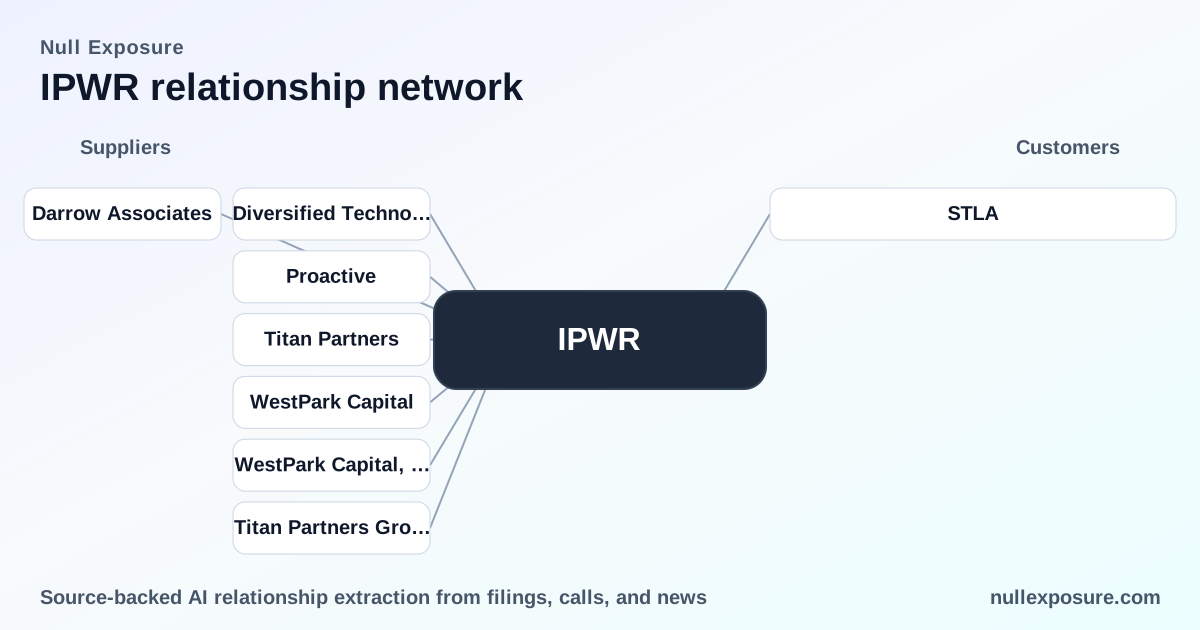
IPWR Customer Brief: Where Ideal Power’s B‑TRAN Commercialization Really Stands
Ideal Power develops and sells power conversion hardware built around its proprietary B‑TRAN switch technology, monetizing through product sales (SymCool™ power modules and IQ modules), custom development contracts with large OEMs, and multiyear co‑development and distribution partnerships. Revenue today is early and concentrated, but the company is converting pilot programs into paid development work and initial customer shipments — a dynamic investors must watch as proof points turn into scalable supply agreements. For a concise dossier on IPWR commercial relationships and what they imply for growth, see the company overview at https://nullexposure.com/.
Why customers matter for IPWR’s valuation story
Ideal Power’s commercial progress is the core value driver: the company sells hardware (not licensure), runs custom development programs for large industrial customers, and signs strategic cooperation agreements with industry incumbents to extend distribution. That mix creates an operating model characterized by early‑stage contracting posture (development and pilot agreements), concentrated counterparty set, and product‑level criticality that is high for individual programs but low for the current revenue base.
- Contracting posture: the record shows a transition from pilots and design wins into discrete purchase orders and initial shipments, indicating movement along the commercialization curve rather than a finished go‑to‑market.
- Concentration: the company names large enterprise customers and partners repeatedly; given the small absolute revenue base, each win is commercially significant but not yet material at scale.
- Criticality and maturity: B‑TRAN modules are product hardware requiring supplier maturity and manufacturing scale; IPWR has commenced shipments in 2024, but most enterprise programs are still in development or early deliverable phases.
- Geography and materiality: Ideal Power reports that its revenues and assets are primarily U.S.‑based and that international revenue has not been material historically, which constrains near‑term global diversification.
Customer roll call — what the record actually shows
Below are every customer and partner cited in the sources collected for IPWR customer coverage, with a 1–2 sentence investor‑friendly takeaway and a concise source note.
Stellantis — an OEM development partner with paid deliverables
Ideal Power secured a purchase order from Stellantis for custom development of packaged B‑TRAN devices targeting EV applications, and has completed the first of five deliverables under that order with the remainder expected by mid‑2026; historical filings show commercial revenue from an earlier Stellantis development agreement contributed to positive gross profit in 2023. Source: Q3 2025 earnings call and FY2024 Form 10‑K; multiple press releases and earnings transcripts (March–May 2026).
Lazzen / Lazen — multiyear cooperation to scale circuit protection products
The company announced a multiyear strategic cooperation agreement with Lazzen (reported variously as “Lazen”/“Lazzen” in press coverage) to co‑develop and globally sell B‑TRAN‑enabled circuit protection solutions — including solid‑state circuit breakers, battery disconnects, and EV contactors — with target markets of AI data centers, energy storage, grid applications and EV infrastructure. Source: Q4 2025 business update and related press coverage (February–May 2026).
Richardson Electronics — a distribution channel and industry incumbent
Ideal Power references working with distributors such as Richardson Electronics, indicating the company is using established power‑industry distribution channels to reach customers and leverage incumbent sales networks. Source: Q4 2025 earnings transcript and related investor materials (May 2026).
What these relationships collectively tell investors
These customer entries form a coherent commercialization narrative: IPWR is executing a hybrid model of product sales, OEM development contracts, and strategic partnerships to scale. The Stellantis engagement demonstrates paid development work translating to recorded commercial revenue in discrete periods; the Lazzen cooperation targets volume markets through an established partner; distributor relationships such as Richardson feed traditional sales channels.
- Revenue impact today is small but directional. Ideal Power’s trailing revenue is minimal relative to its market capitalization, so each design win or purchase order has outsized narrative value even before it becomes recurring revenue.
- Program risk is concentrated at the contract level. Large OEMs and multiyear partners represent potential volume, but deliverables are phased and timing matters — the mid‑2026 deliverable schedule for Stellantis is a critical near‑term checkpoint.
- Distribution and partner scaling is an explicit route to market. The Lazzen cooperation and distributor relationships reduce IPWR’s need to build global sales infrastructure internally, but they require successful product qualification and supply readiness.
For more contextual analysis of how these customer relationships affect IPWR’s revenue trajectory and risk profile, visit https://nullexposure.com/ for expanded coverage and data‑driven summaries.
Risks and operational constraints investors should prioritize
Use the following company‑level constraints as the framework for diligence rather than as isolated statistics:
- Counterparty mix is heavily biased toward large enterprises and OEMs, which increases the upside from a single program but concentrates program execution risk.
- Geographic concentration is U.S.‑centric; public filings note that international revenue and assets were not material in the most recent years, limiting near‑term geographic diversification.
- Relationship stages are mixed: active shipments have begun (SymCool modules shipped in 2024), while many programs remain in the pilot or development phase — a two‑track maturity profile that lengthens the time to predictable revenue.
- The company’s offering is hardware‑centric, which elevates supply chain, manufacturing scale, and qualification timelines as gating factors for revenue conversion.
Near‑term catalysts and watch‑items for investors
- Monitor Stellantis deliverable completion and any conversion from development work to production supply agreements (mid‑2026 is the stated window).
- Watch the Lazzen cooperation announcements for product launch timelines and distribution scope across AI/data center and EV markets.
- Track order cadence from distributors and the pace of SymCool shipments to assess whether revenues move from episodic contract receipts to repeatable module sales.
Bottom line
Ideal Power is a hardware commercialization story in transition: paid development work with large OEMs and a new strategic partner in circuit protection create credible channels to volume markets, but revenue today is small and program execution is the primary risk. Investors should value the company by progress on deliverables, partner product launches, and the conversion of pilot programs into scalable supply contracts — not by headline design wins alone.
For an investor dossier, model inputs, and regular updates on IPWR customer developments, visit our investor research hub at https://nullexposure.com/.