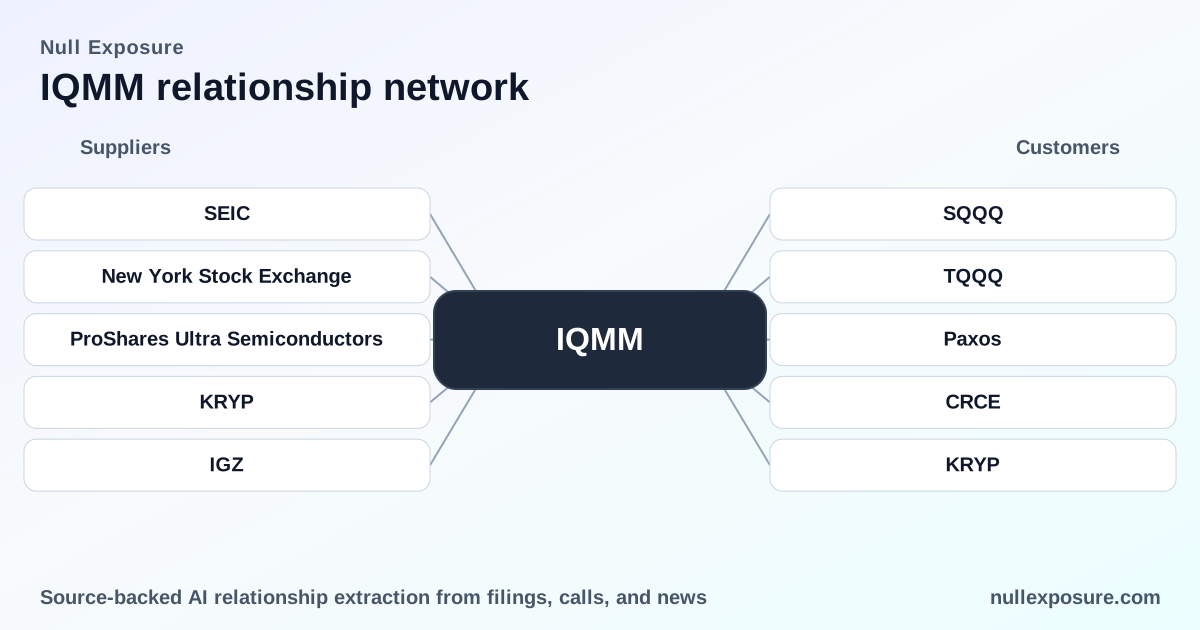
IQMM’s Customer Map: Who Funds the ETF and What that Means for Investors
Thesis—IQMM operates as a money-market style ETF that monetizes by aggregating short-term cash reserves and providing a tradable vehicle for institutional cash management; its business is driven by treasury flows from large ETF sponsors and institutional reserve allocators, not retail accumulation. At launch in FY2026 IQMM captured unusually large, concentrated inflows that were primarily internal to the ProShares ecosystem, creating a short-term asset base and counterparty profile that investors must evaluate for concentration, operational criticality, and regulatory counterparty risk. For more background or to follow this coverage, visit https://nullexposure.com/.
A record launch anchored by internal flows — why scale doesn’t equal distribution
IQMM debuted with very large first-day assets, but the composition of those assets is the defining feature for investment analysis. Multiple reports show the bulk of IQMM’s initial assets were reallocated from ProShares’ own funds, with a handful of leveraged ETFs contributing the largest single positions. That structure gives IQMM immediate scale and fee capture potential but concentrates counterparty and redemption dynamics inside one sponsor group rather than across diversified third-party customers (ETF.com, May 2026; TradingView/Cointelegraph, Mar 2026).
Key coverage:
- ETF.com documented that much of IQMM’s launch was internal to ProShares, noting affiliated ProShares funds held the bulk of shares (ETF.com, May 3, 2026).
- Market notices and trade reporting (TradingView summarizing Bloomberg and Cointelegraph, Mar 2026) reiterated that internal transfer activity explained most early inflows.
Who the reported relationships are (each relationship covered)
ProShares (sponsor and primary allocator)
ProShares transferred large amounts of cash from its own funds into IQMM to manage treasury across its ETF suite, making the sponsor the dominant operational customer. ETF.com and ETF Trends reported that a large portion of opening assets came from ProShares for cash management purposes (ETF.com, May 3, 2026; ETF Trends, Apr 2026).
ProShares UltraPro QQQ — TQQQ
TQQQ is reported as the single largest holder, accounting for roughly one-third of IQMM’s assets at launch, making it a material internal source of funds. Trading and ETF reporting cite Bloomberg and ETF.com figures showing the ProShares UltraPro QQQ held about 34% of IQMM’s assets in the initial period (ETF.com, May 3, 2026; TradingView, Mar 2026).
ProShares UltraPro Short QQQ — SQQQ
SQQQ accounted for another material slice of initial holdings (reported at around 8–9%), reinforcing that leveraged and inverse ProShares products were used for intra-sponsor cash management. ETF.com’s launch coverage put SQQQ at roughly 8.5% of assets (ETF.com, May 3, 2026).
KRYP (as cited in market reports)
Market commentary named KRYP in coverage of launch flows and noted a leveraged ProShares vehicle moved several billion dollars into IQMM on day one; KRYP references appear in trade reporting summaries. Trade press such as Mugglehead and TradingView highlighted an approximate $6 billion transfer from a single proximate leveraged ETF into IQMM at debut (Mugglehead, Mar 2026; TradingView/Cointelegraph, Mar 2026).
Paxos
Industry coverage identified Paxos among major stablecoin and custody operators positioned to benefit from institutional reserve-management tooling, with Paxos cited as a logical counterparty or partner in the broader market narrative. Crypto and market blogs discussed Paxos’s role in reserve and compliance tooling relevant to products like IQMM (CryptoRank, Mar 2026; MEXC News, Mar 2026).
Circle (CRCE)
Coverage singled out Circle as a potential allocator of reserves into IQMM and as a beneficiary of standardized reserve-management infrastructure. Multiple outlets speculated that Circle could use a product like IQMM to manage legally required reserves, and analysts suggested Circle was likely among the larger stablecoin operators eyed for reserve placement (SQ Magazine, May 2026; Bitget, Mar 2026).
Tether
Journalists and analysts listed Tether among stablecoin issuers that allocated or were likely to allocate reserves into IQMM, indicating potential crypto-native reserve flows into the fund. ETF.com and related articles noted that one or more stablecoin issuers—Tether among them—were tied to reserve allocations into IQMM (ETF.com, May 3, 2026).
Ripple
Ripple was cited in industry coverage as another major digital-asset issuer that could conceivably use a vehicle like IQMM for standardized reserve management. Press mentions grouped Ripple with other large issuers as potential users of institutionalized reserve products (SQ Magazine, May 2026).
(Each relationship summary above is drawn from market and sector reporting in March–May 2026, including ETF.com, TradingView/Cointelegraph, ETF Trends, ETFDB, CryptoRank, MEXC News, Mugglehead, SQ Magazine, and Bitget.)
Operating model and business-model characteristics investors must weigh
- Contracting posture — sponsor-centric and internal first. IQMM launched as a vehicle used predominantly by its sponsor network rather than through broad external distribution, indicating a contracting model that prioritizes intra-group treasury efficiency over immediate third-party customer diversification.
- Concentration — very high and immediate. Public reporting places affiliated ProShares funds as holders of roughly 98.9–99% of IQMM shares in the early period, creating single-sponsor concentration risk for asset composition and redemption behavior (ETF.com; TradingView/Bloomberg, Mar–May 2026).
- Criticality — acts as a treasury hub. For ProShares the fund functions as a central cash-management utility, increasing its operational importance to the sponsor and making sponsor behavior a dominant driver of flows.
- Maturity — new product with institutional-scale launch. IQMM is nascent (FY2026) but already operating at institutional scale, which short-circuits typical product take-up timelines while adding risks linked to launch dynamics and sponsor reallocation decisions.
- Counterparty mix — traditional money-market counterparties plus digital-asset reserve players. Reporting links the fund to stablecoin issuers and custody/settlement operators, introducing a hybrid counterparty risk profile (traditional cash managers plus crypto-native reserve holders).
Investment implications — what to watch next
- Concentration is the primary risk: heavy ownership by ProShares creates correlated redemption and reallocation risk; an adverse decision by the sponsor would materially affect AUM and liquidity.
- Operational importance reduces manager-level survival risk but raises governance and conflicts-of-interest questions. A sponsor using the fund for internal treasury is supportive of continuity but concentrates decision authority.
- Counterparty/regulatory exposure to stablecoin issuers introduces non-bank reserve risk; monitor SEC guidance and counterparties named in filings and trade reports.
- Read-through for fees and monetization: large intra-sponsor flows generate fee revenue and distribution scale quickly, but longevity depends on marketing the vehicle beyond the sponsor base.
If you want ongoing coverage and deeper relationship-mapping for IQMM’s counterparty set, visit https://nullexposure.com/ for our tracked updates and alerts.
Conclusion — IQMM’s launch delivered headline scale, but the economic and credit story for investors is defined by internal sponsor concentration, treasury utility status, and emerging stablecoin-reserve connections. For investors and operators evaluating IQMM as a customer relationship, the priority is to monitor sponsor flow behavior, any shift toward third-party distribution, and regulatory or counterparty developments tied to stablecoin reserve placements.