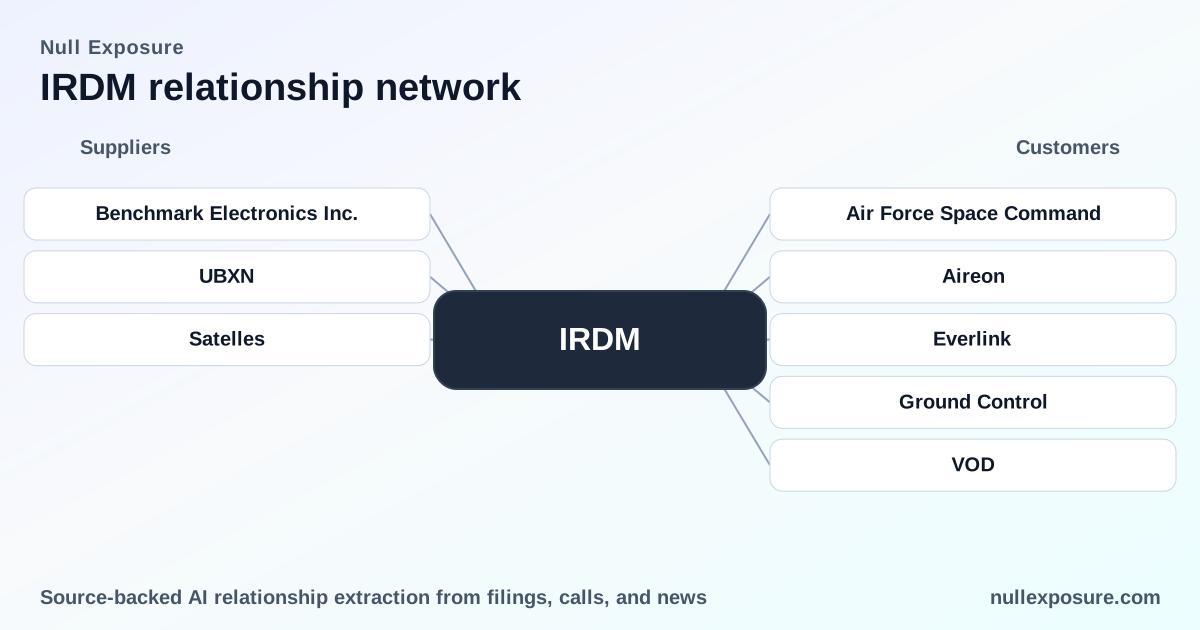
Iridium (IRDM) customer map: Government anchor, channel partners and device OEMs that drive revenue
Iridium operates a global low‑Earth orbit satellite network and monetizes that network through recurring airtime and data services sold to governments, enterprises, resellers and device manufacturers, plus value‑added services such as PNT (positioning, navigation and timing) and IoT connectivity. The company’s commercial model combines multi‑year government contracts that provide cash‑flow stability with a broad wholesale/distributor channel that scales device adoption and Certus/NTN connectivity revenue.
If you want a consolidated view of Iridium’s customer relationships and what they imply for revenue durability and growth, see the company overview at https://nullexposure.com/ for additional research and signals.
What the customer base says about Iridium’s operating model
Iridium’s customer mix reveals a hybrid of contracted stability and channel-driven growth. Company filings and public reporting show a significant U.S. government concentration—the government accounted for roughly 29% of 2025 revenue—anchoring cash flow through fixed‑price, multi‑year arrangements. At the same time, Iridium exploits a large wholesale network (around 120 service providers, 310 VARs and 90 VAMs per the company), enabling device OEMs and integrators to scale Iridium‑powered services globally.
- Contracting posture: The company operates under multi‑year, fixed‑price government contracts (the EMSS contract is a seven‑year arrangement signed in 2019 with a fixed annual service fee), which drives recurring revenue not tied to per‑subscriber usage. This is a company‑level signal from Iridium’s FY2025 10‑K.
- Concentration and criticality: Government revenue is material and strategic—29% of 2025 revenue—creating both revenue stability and concentration risk if federal spending shifts.
- Channel and commercial maturity: The wholesale/distributor network and partnerships with device OEMs and semiconductor partners indicate a mature, scaled go‑to‑market for commercial services and IoT.
- Geography and addressable market: Revenues are both US‑heavy and global: Iridium reports significant U.S. revenue but positions itself as the only commercial provider offering true global coverage.
For deeper coverage on Iridium’s commercial signals, visit https://nullexposure.com/.
The customer relationships investors should track now
Below are the publicly reported counterparties and partners cited in filings and news coverage, each with a concise investor‑focused description and source.
Air Force Space Command — a named government contract counterparty
Iridium disclosed a contract for Enhanced Satellite Services between Iridium Government Services LLC and Air Force Space Command, effective September 15, 2019; the EMSS framework underpins a material portion of government revenue. According to Iridium’s FY2025 10‑K, the EMSS arrangement is a cornerstone government agreement (FY2025 filing).
U.S. Space Force — the EMSS anchor and revenue driver
Iridium’s government service revenue is anchored by a seven‑year EMSS contract with the U.S. Space Force valued at $738.5 million, which contributes contractual rate increases and predictable cash flow. A news report in May 2026 summarized the company’s Q1 commentary highlighting the EMSS contract as the government revenue anchor (May 2026 coverage).
Missile Defense Agency — government procurement access via IDIQ
Iridium won a spot on the Missile Defense Agency’s SHIELD IDIQ contract in January 2026, opening opportunities to deliver capabilities at scale under a large federal procurement vehicle. IBTimes reported on the SHIELD IDIQ award and its potential to accelerate Iridium’s DoD engagements (January 2026 / May 2026 reporting).
U.S. Department of Transportation — PNT testing and deployment partner
Iridium secured a contract with the U.S. Department of Transportation for PNT deployment and testing, indicating the company’s strategic push into timing and navigation services for civil infrastructure. The DOT engagement was included in coverage of Iridium’s Q1 results and strategic priorities (May 2026 press coverage).
Everlink — enterprise IoT integrator using Iridium 9604
Everlink integrated Iridium’s 9604 module into its secure cloud platform to provide global connectivity and operational telemetry for customers, signaling commercial uptake among enterprise IoT integrators. CEO Dean Welten’s comments were published in March–May 2026 trade coverage announcing Iridium’s next‑generation IoT platform (March–May 2026 articles).
Ground Control — early adopter improving product economics
Ground Control reported that using the Iridium three‑in‑one 9604 module materially changed its product economics, reflecting cost and integration advantages for device manufacturers building on Iridium Certus/NTN. CEO Alastair MacLeod’s remark was reported in March–May 2026 industry news (March–May 2026 coverage).
Garmin (GRMN) — consumer safety devices and satellite SOS service
Garmin’s inReach devices use Iridium satellite coverage for SOS and two‑way messaging, embedding Iridium into the safety and consumer navigation ecosystem and driving consumer airtime. Multiple March 2026 reports on Garmin’s inReach annual SOS message data referenced Iridium as the satellite backbone (March 2026 reporting).
NXPL (NextPlat unit) — dual‑mode terminals powered by Iridium Certus
NextPlat’s unit won an NATO satellite IoT contract for terminals that use Iridium Certus combined with LTE, illustrating adoption of Iridium connectivity in hybrid terminal designs. Investing.com reported on the contract and noted the terminals’ dual‑mode satellite/LTE capability in May 2026 (May 2026 article).
Aireon — embedded ADS‑B air‑traffic surveillance payload partner
Every Iridium NEXT satellite carries Aireon’s ADS‑B receiver payload, enabling real‑time global aircraft surveillance and anchoring aviation safety services as a business use case for the constellation. Aviation trade reporting in early 2026 described the integrated payload and Aireon’s role (March 2026 reporting).
GCT Semiconductor (GCTS) — chipset integration for NTN Direct
GCT Semiconductor is integrating Iridium’s NTN Direct service into its GDM7243SL chipset, a move that expands device‑level access to Iridium connectivity and supports IoT and direct‑to‑device use cases. EEAsia reported on the GCT‑Iridium collaboration in March 2026 (March 2026 coverage).
Vodafone (VOD) — strategic commercial opportunity and capital allocation focus
Analysts and coverage have flagged projects such as Vodafone IoT and direct‑to‑device initiatives as key catalysts that will compete for Iridium’s capital with dividends and buybacks, highlighting the importance of commercial partnerships in Iridium’s growth plan. Simply Wall St commentary in March 2026 discussed Vodafone‑related projects in the context of Iridium’s capital allocation (March 2026 analysis).
What investors should infer from the relationship map
- Revenue durability is real but concentrated. Government contracts — especially the EMSS arrangement — supply fixed, predictable cash flow that underpins valuation multiples, but they also concentrate counterparty risk (29% of 2025 revenue).
- Channel depth enables scale. A large wholesale and VAR network plus chip and OEM integrations (GCTS, Ground Control, Everlink, Garmin) create scalable paths to consumer, enterprise and IoT end users without proportional fixed sales expense.
- Technology enables adjacent expansion. Partnerships like Aireon and PNT engagements with DOT and aviation customers position Iridium to monetize positioning and safety services beyond basic airtime.
- Contract timing is a governance and timing risk. The EMSS contract terms and the ability of federal agencies to extend or reprocure services are corporate governance and renewal events investors must watch closely (company FY2025 disclosures).
Bottom line and actionable signals
Iridium’s business is a hybrid of government‑anchored recurring revenue and commercially distributed device/IoT growth; investors should value cash‑flow predictability from government programs against concentration and reprocurement risk while tracking chipset and OEM integrations that drive future monetization. For continued monitoring and curated signals on IRDM customer and contract dynamics, consult the research hub at https://nullexposure.com/.
Key monitoring events: EMSS contract expiration and potential extensions, SHIELD IDIQ task awards, GCT chipset rollouts, and OEM device launches that embed the Iridium 9604/Certus/NTN capabilities.