IREG’s Customer Backbone: One Giant Contract and What It Means for Investors
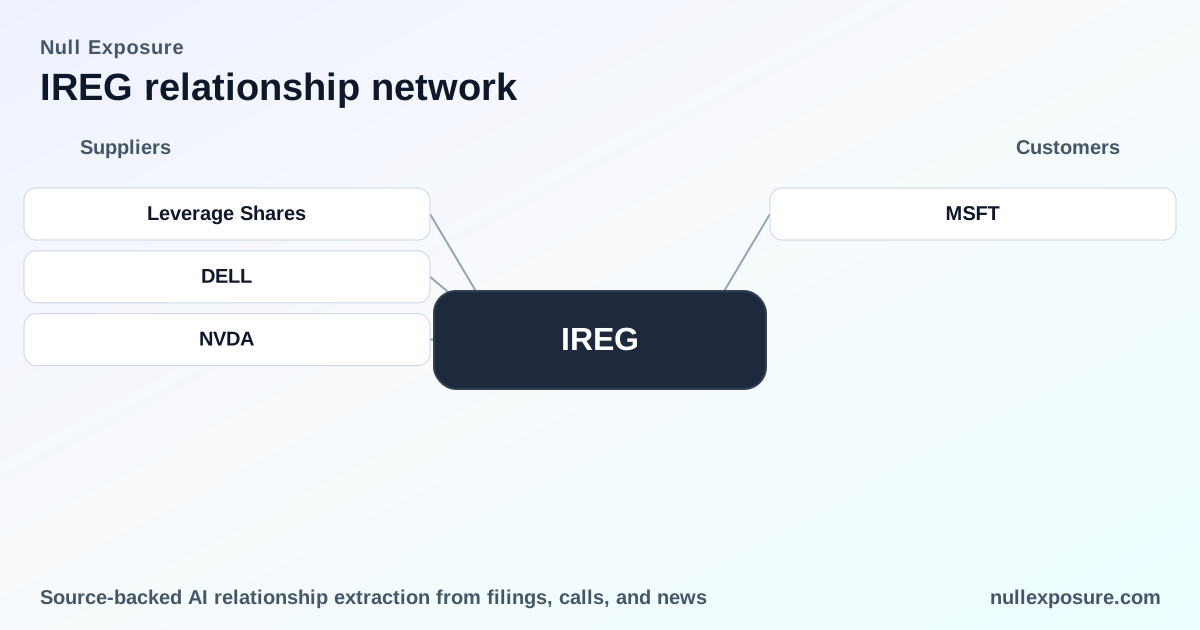
IREG operates as a commercialization and distribution intermediary that monetizes access to scarce AI compute capacity by contracting multi-year supply arrangements with hyperscale buyers. The company’s revenue model centers on locking in upstream inventory (in this case, Nvidia AI chips) and selling contracted access to large enterprise customers under multi-year agreements; the recent Microsoft engagement is the defining commercial relationship that drives scale, cash flow timing and counterparty risk. For a deeper look at how that contract shapes IREG’s risk/reward profile, see Null Exposure’s research hub: https://nullexposure.com/.
The headline contract that moves the needle
A single contract can change a growth and risk profile overnight. In IREG’s case, a $9.7 billion, five-year commitment from Microsoft shifts the company from a fragmented reseller to a strategic capacity allocator for one of the world’s largest cloud providers. According to a ts2.tech news report, Microsoft signed the agreement to secure access to Nvidia’s advanced AI chips amid tight industry capacity, with reporting tied to FY2025 and indexed in March 2026. This contract is the principal commercial fact investors should evaluate when modeling revenue concentration, working capital needs, and negotiating leverage.
Customer relationship inventory: everything in the record
Below I list every customer relationship returned in the public relationship results and the plain-English takeaways investors need.
Microsoft (MSFT) — first record
Microsoft signed a $9.7 billion, five-year contract with IREN to secure access to Nvidia’s advanced AI chips, positioning IREG as the commercial conduit for constrained hardware capacity, per ts2.tech coverage (FY2025 reporting, first indexed March 10, 2026). The deal implies material, predictable top-line and strategic priority from Microsoft’s procurement team.
Source: A ts2.tech report documenting the FY2025 agreement, indexed March 10, 2026.
Microsoft (MSFT) — second record (duplicate)
The second result duplicates the first: the same $9.7 billion, five-year contract with Microsoft is recorded again in the results set. This redundancy reinforces the prominence of the Microsoft engagement in public signals and internal indexing but does not represent a separate counterparty. The duplicate entry references the same ts2.tech piece tied to FY2025.
Source: Same ts2.tech reporting as above (FY2025, indexed March 10, 2026).
What the commercial picture says about IREG’s operating model
With no other customer relationships reported in the public results, IREG’s operating model is dominated by large, long-dated contracts rather than many small transactions. That shapes four practical characteristics investors must price into valuation and operational diligence:
- Contracting posture: IREG transacts using high-value, multi-year agreements. These contracts create predictable revenue streams but require sophisticated procurement, legal and fulfillment capabilities to manage performance obligations over long horizons.
- Concentration: The Microsoft contract represents a very large portion of commercially visible demand; revenue concentration is therefore high and must be treated as a principal risk when forecasting free cash flow.
- Criticality to buyers: By securing access to scarce Nvidia AI chips and transferring that access to hyperscalers, IREG occupies a strategic, high-criticality role for buyers that perceive inventory scarcity as existential to AI deployments.
- Commercial maturity: A $9.7 billion, five-year agreement reflects institutional contracting maturity on both sides—IREG demonstrates capacity to negotiate and deliver against enterprise-grade service-level expectations.
These operating signals are company-level observations drawn from the visible relationship footprint rather than discrete constraints tied to any single vendor excerpt.
Risk profile and what investors should stress-test
The Microsoft engagement materially improves revenue visibility while simultaneously concentrating execution risk. Key points for modeling and due diligence:
- Counterparty concentration risk: With Microsoft as the dominant visible buyer, revenue downside from non-renewal or renegotiation is severe; underwrite scenarios that include a 20–60% reduction in expected volumes over the contract’s term.
- Upstream dependency and margin pressure: IREG’s value derives from access to Nvidia chips; supply tightness creates pricing power but also exposes margins to upstream cost swings and passthrough dynamics.
- Operational delivery risk: Fulfilling a multi-year $9.7 billion engagement requires reliable logistics, inventory financing and contract compliance capability; execution shortfalls would translate quickly into reputational and financial damage.
- Contract renewal and price reset risk: When the five-year term ends, access dynamics and Nvidia’s capacity expansion will determine renewal economics—investors should model downside renewal pricing aggressively.
Bottom line: the Microsoft contract is both the company’s greatest asset and its largest single-point risk.
What valuation and capital markets investors should model
Investors should treat the Microsoft contract as an anchor scenario in any financial model: build a base case that assumes full contract performance and a conservative downside case where volumes or prices decline. Key modeling levers to stress-test:
- Contract revenue recognition patterns and the timing of cash collections.
- Working capital and inventory financing needs to secure and hold chip allocations.
- Counterparty credit and concentration-adjusted discount rates.
- Renewal probability and price reversion at the five-year mark.
For investors wanting a structured platform view and further relationship scoring, Null Exposure provides curated analysis and a subscription option at https://nullexposure.com/ that consolidates public relationship data and commercial risk indicators.
Investment conclusions and tactical considerations
- Positive thesis: The Microsoft deal provides scale, clarity of demand and strategic positioning in the undersupplied AI compute market—attributes that support higher revenue multiples if execution is flawless.
- Negative thesis: Concentration in one mega-counterparty elevates single-event risk, requiring disciplined scenario analysis and a premium for execution uncertainty.
Key investor action items: verify contract cashflow schedules, assess inventory financing capacity, obtain counterparty contract terms where possible (termination, force majeure, price resets), and stress-test renewal economics.
Final takeaway
IREG’s public relationship footprint is succinct but powerful: one dominant, multi-year engagement with Microsoft defines both the opportunity and the principal risk. Investors and operators should align valuation, covenant language and operational planning to that reality rather than assuming a diversified customer base. For a consolidated view of relationship signals and next-step diligence checklists, visit Null Exposure: https://nullexposure.com/.