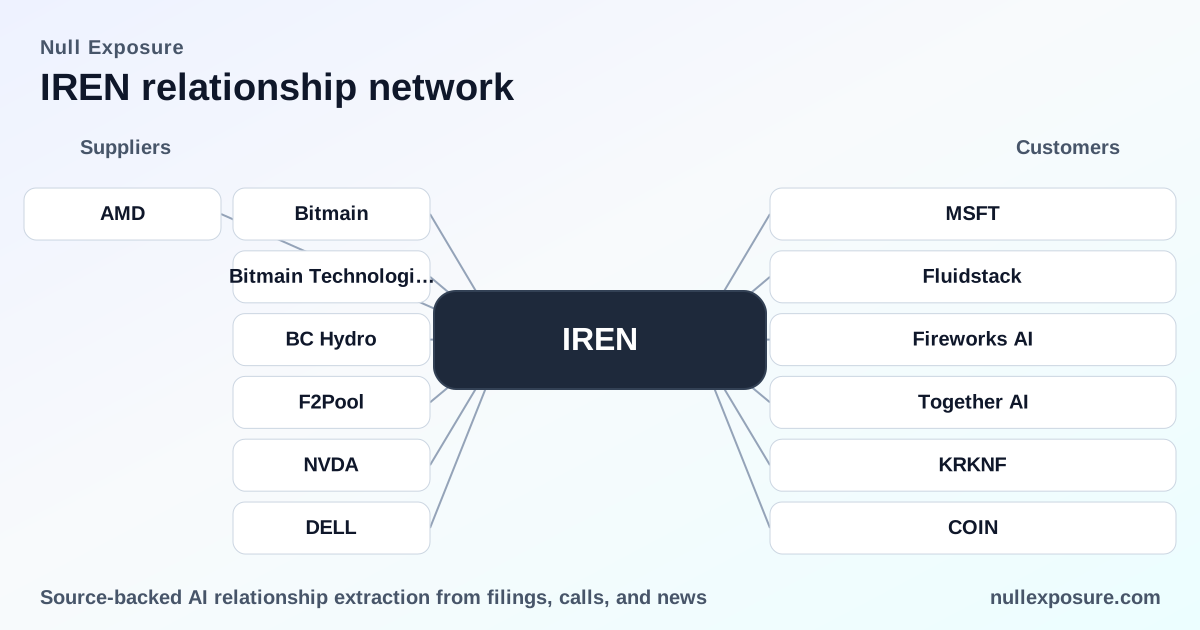
IREN’s Customer Map: From Bitcoin Pools to a $9.7bn Microsoft AI Pivot
IREN Limited operates large-scale, renewable-powered data centers in North America and monetizes through two core streams: high-density GPU cloud services sold to AI and HPC customers and compute provided to cryptocurrency mining pools. The company converts physical power and rack capacity into recurring revenue via multi‑year leases and usage-based arrangements, while also using strategic financing and customer prepayments to de‑risk capital-intensive GPU deployments.
If you evaluate partner and customer counterparty risk, or the durability of IREN’s AI pivot, this note distills every customer relationship reported in public filings and press coverage, and translates operating constraints into investor-relevant signals. For a deeper look at counterparty exposure and contract structure, see the IREN customer intelligence hub at https://nullexposure.com/.
Why customers matter to the investment case
Two facts drive the thesis: IREN’s revenue recognition is increasingly tied to a small set of large contracts, and the company uses customer prepayments and targeted financing to underwrite the cost of GPU deployments. That combination boosts near‑term cash coverage of capex but concentrates economic exposure—good for scale and margin if counterparties perform, risky if contracts are resized or delayed.
Key takeaway: IREN’s monetization model is scale‑sensitive: securing hyperscale AI commitments converts capacity into high‑margin recurring revenue, but also creates customer concentration that dominates valuation and credit dynamics.
Customer relationships — who IREN sells to and what it means
Microsoft — the transformational anchor customer
IREN signed a multi‑year, headline $9.7 billion agreement to provide Microsoft with high‑density AI cloud capacity (reported as a five‑year deal) and associated access to Nvidia GB300‑class GPUs, with phased deployments at Childress, Texas and other sites. The contract included $1.9 billion in customer prepayments and was accompanied by $3.6 billion in delayed‑draw GPU financing to cover most GPU capex. These arrangements position Microsoft as the dominant revenue source for the near term. (Sources: TS2 Tech, The Globe and Mail, November 2025–FY2026 coverage.)
Together AI — a multi‑year enterprise customer in the AI stack
IREN has signed a multi‑year AI cloud agreement with Together AI as part of its early AI customer cohort, providing GPU capacity and white‑label compute to accelerate Together’s training and inference workloads. This relationship is described in press summaries of IREN’s AI customer pipeline. (Source: TS2 Tech, December 2025 coverage.)
Fireworks AI — part of the early AI customer cohort
Fireworks AI appears among a cluster of smaller, multi‑year AI customers contracted to source GPU compute from IREN as IREN builds AI Cloud ARR. These relationships support the company’s goal of scaling AI Cloud ARR beyond legacy mining revenue. (Source: TS2 Tech / ad‑hoc news, late 2025 coverage.)
Fluidstack — a strategic mid‑market cloud customer
Fluidstack is listed alongside other AI cloud clients that have signed multi‑year deals with IREN, taking advantage of IREN’s high‑density, renewable‑powered facilities. The Fluidstack arrangement diversifies IREN’s customer mix into software‑defined and reseller models. (Source: TS2 Tech / ad‑hoc news, December 2025.)
Kraken — the legacy mining counterparty for BTC liquidation
IREN’s FY2025 10‑K discloses that the company utilized Kraken, a U.S.‑based digital asset trading platform, to liquidate bitcoins mined by its operations. This is a legacy operational relationship tied directly to IREN’s mining revenue stream rather than AI cloud. (Source: IREN FY2025 10‑K (June 30, 2025).)
Coinbase — a disclosed backup trading platform
IREN’s FY2025 10‑K also names Coinbase as a backup U.S. trading venue, though the filing states IREN had not yet utilized Coinbase as of June 30, 2025. Coinbase is therefore a secondary liquidity counterparty in the Bitcoin monetization process. (Source: IREN FY2025 10‑K (June 30, 2025).)
What the documented constraints tell investors
Public filings and reporting provide a multi‑dimensional view of how IREN structures customer relationships and the operational profile they create:
- Contract mix: IREN supports both usage‑based/on‑demand and multi‑year (up to three years) AI cloud contracts, indicating a hybrid revenue model that blends recurring term revenue with variable consumption. (Company filing language on AI Cloud Services.)
- Counterparty type and concentration: The customer base skews toward large enterprises—notably Microsoft—which implies high contract criticality and significant revenue concentration. Several market reports attribute more than half of near‑term revenue to Microsoft. (Market coverage FY2026.)
- Geography and asset footprint: Operations and customers are predominantly in North America, with material presence reported in Canada and Australia for historical operations; this geographic concentration affects regulatory, grid and energy‑sourcing risk. (IREN corporate disclosure.)
- Relationship roles and maturity: IREN functions as both seller of compute and service provider for AI/HPC workloads; its AI cloud business is active and scaling, supported by deployed NVIDIA H100/H200 hardware in production sites. (Company filing and press disclosures.)
- Materiality of mining: Legacy mining revenue remains material and critical for historical periods, with mining pools responsible for the bulk of prior revenue, indicating an operational dependency that is transitioning but not yet eliminated. (FY2025 revenue disclosures.)
These constraints collectively describe an operating model that is capital‑intensive, levered to large counterparty commitments, and structured to convert upfront customer economics into lower dilution through prepayments and structured debt.
Explore a full counterparty risk brief and contract templates at https://nullexposure.com/ if you want structured portfolio-level analysis.
Investment implications and risk checklist
- Upside: The Microsoft agreement, if executed to plan, provides a predictable multi‑year revenue stream and de‑risked GPU capex through customer prepayments and targeted financing, improving cash conversion and margin scalability. This is the primary driver of valuation re‑rating.
- Concentration risk: Heavy reliance on one hyperscaler creates single‑counterparty sensitivity—any resizing, delayed financing or inventory supply issues would have outsized revenue and cash flow consequences.
- Execution risk: Delivering liquid‑cooled, GB300‑class GPU capacity on schedule is an operational task requiring supply chain, construction and financing coordination; successes here unlock high ARR targets, failures compress guidance.
- Legacy exposure: Mining operations and associated liquidity partners (Kraken) remain an operational baseline; volatility in mined BTC prices or changes in custody/liquidation strategy could affect cash flow continuity.
Bottom line and next steps for analysts
IREN has converted physical data‑center capacity into a high‑value, hyperscale AI revenue stream anchored by Microsoft while maintaining legacy mining monetization routes. That strategic pivot materially increases upside but also introduces large counterparty concentration that dominates near‑term cash and execution risk.
For a structured counterparty heat map, contract exposure modeling, and ongoing news monitoring of IREN’s customer milestones, see the IREN customer intelligence hub at https://nullexposure.com/.