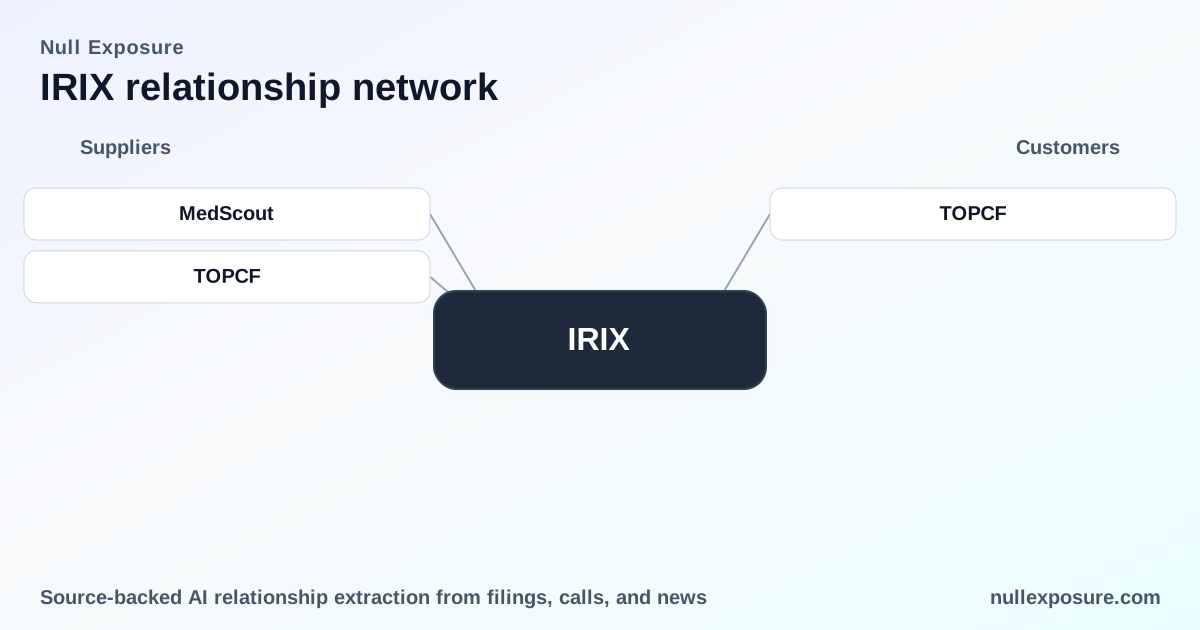
IRIDEX (IRIX): Monetizing ophthalmic lasers through hardware, consumables, service and selective distribution
IRIDEX sells laser systems, delivery devices and consumable probes to ophthalmologists, hospitals and surgery centers, and monetizes through equipment sales, recurring consumables and paid service contracts; selective licensing arrangements and exclusive distribution agreements further extend reach and create periodic royalty-like revenue. The company’s business model is hardware-led with predictable recurring components (consumables, service) and a distribution overlay that accelerates international scale without building a full global sales force. For a quick look at broader coverage and tools for monitoring these relationships, see https://nullexposure.com/.
How IRIDEX actually makes money and why that matters to investors
IRIDEX’s core revenue comes from selling laser consoles and associated delivery devices, supported by recurring sales of disposable probes and multi-year service and warranty offerings. The company explicitly sells one-year incremental service contracts after a standard two-year warranty, giving a subscription-like recurring revenue component that smooths hardware-driven seasonality. The firm also recognizes sales-based licensing income at the point of subsequent sales, which introduces episodic, royalty-like revenue tied to third-party commercialization. Geographically, IRIDEX generates material revenue in North America, EMEA and APAC, selling directly in markets such as the United States and Germany while relying on independent distributors elsewhere.
This mix produces several investor-relevant characteristics: highly capital-intensive sales cycles for hardware, sticky consumables/service revenue that boosts lifetime value, distributor-driven international growth that limits near-term SG&A expansion, and limited institutional ownership that can amplify share price volatility.
Customer and partner relationships reported in public sources
Below I summarize every relationship the public record currently shows for IRIDEX in the provided results, with a concise takeaway and citation for each item.
Virginia Retina Center (FY2024)
A senior clinician at Virginia Retina Center praised IRIDEX’s 577 nm laser for its compact design, treatment-session recording and workflow benefits, and noted long-term reliance on IRIDEX systems over a 30-year span—an endorsement that signals strong clinician-level product acceptance. (Ophthalmology Times, May 2026: https://www.ophthalmologytimes.com/view/iridex-launches-new-lasers-in-us-market)
EyeProGPO (FY2026)
IRIDEX announced a partnership with EyeProGPO, an ophthalmology-focused group purchasing organization that serves practices, ASCs and hospitals, positioning IRIDEX to expand procurement reach into member networks and potentially accelerate consumable and service sales. (Yahoo Finance press release, May 2026: https://finance.yahoo.com/sectors/healthcare/articles/iridex-announces-partnership-eyeprogpo-expand-200500793.html)
Topcon (FY2026) — earnings call reference
Management confirmed the Topcon partnership remains active and emphasized monitoring macro conditions while expecting improvements, indicating the relationship is an ongoing component of IRIDEX’s international distribution and commercial strategy. (Earnings call transcript, Investing.com, Q4 2025 / FY2026 commentary: https://www.investing.com/news/transcripts/earnings-call-transcript-iridex-q4-2025-sees-revenue-growth-narrows-losses-93CH-4583863)
TOPCF (Topcon) (FY2021) — distribution and equity
Topcon committed to purchasing exclusive rights to distribute IRIDEX retina and glaucoma products in specified global markets and acquired approximately a 10.4% common equity stake in IRIDEX, creating both a strategic commercial partner and a meaningful financial investor. (MassDevice report, March 2026 referencing the FY2021 deal: https://www.massdevice.com/iridex-topcon-seal-eye-care-deal/)
Topcon (FY2021) — repeated coverage of the distribution/equity deal
Industry reporting reiterates that Topcon’s investment and exclusive distribution rights underpin IRIDEX’s international go-to-market in certain territories, effectively outsourcing local market development to a large incumbent in eye care. (MassDevice, March 2026: https://www.massdevice.com/iridex-topcon-seal-eye-care-deal/)
Topcon (FY2026) — distribution strategy cited in filing coverage
IRIDEX’s 10‑K commentary notes that international markets are primarily served through distributors, and cites exclusive distribution agreements (e.g., Topcon) as a shaping factor for international strategy, confirming distribution exclusivity as a structural element of global revenue generation. (TradingView coverage of 10‑K / FY2026 filing commentary: https://www.tradingview.com/news/tradingview:3c51139616868:0-iridex-10-k-revenue-52-7m-eps-0-26/)
Operating constraints and business-model signals investors should weigh
IRIDEX’s public filings and disclosures generate several company-level signals that shape risk and opportunity profiles:
- Contracting posture: IRIDEX sells hardware with a standard two-year warranty and offers incremental one-year service contracts thereafter, creating a repeatable service revenue stream that behaves like a subscription. The company also enters sales-based licensing arrangements, recognizing license-related revenue at the point of subsequent third-party sales under ASC 606 guidance.
- Customer mix and criticality: End customers include practicing ophthalmologists in offices, ambulatory surgical centers and hospital ORs, plus government and non-profit entities; this indicates high clinical criticality for devices used in specialized procedures and supportable diversification across buyer types.
- Distribution and concentration: IRIDEX uses direct sales in the U.S. and Germany and relies on independent distributors elsewhere; exclusive distribution agreements (explicitly noted for Topcon) concentrate go‑to‑market exposure in select strategic partners for certain territories.
- Geographic footprint and maturity: Revenue is reported across North America, EMEA and APAC with a global customer base, pointing to market maturity in core regions but continued growth potential in others through distributor arrangements.
- Product mix: The company is hardware-led, with consumables and services supplying recurring margin—this structure creates lumpier recognition on equipment deals offset by steady consumable consumption.
Key investment takeaways
- Hardware-first model with recurring levers. Consumables and service contracts provide margin stability and better lifetime value versus stand-alone device sales.
- Distribution amplifies reach and limits SG&A. Exclusive distributor partnerships such as with Topcon accelerate penetration in complex international markets but concentrate counterparty exposure.
- Clinician endorsements matter. Practitioner-level advocacy (e.g., Virginia Retina Center) supports adoption and procurement momentum in clinical settings.
- Mixed revenue recognition. The presence of sales-based licensing and point-in-time recognition of related royalties introduces revenue lumpiness tied to licensees’ downstream performance.
For ongoing surveillance of IRIDEX customer and partner dynamics, explore tools and coverage at https://nullexposure.com/.
Conclusion: IRIDEX operates a capital-intensive, hardware-driven medical device model that uses consumables, service contracts and strategic distributor relationships to generate recurring revenue and international scale. Investors should weigh the stabilizing effect of recurring consumables and service revenues against concentration risk from exclusive distributors and episodic licensing income when modeling growth and margin trajectories.