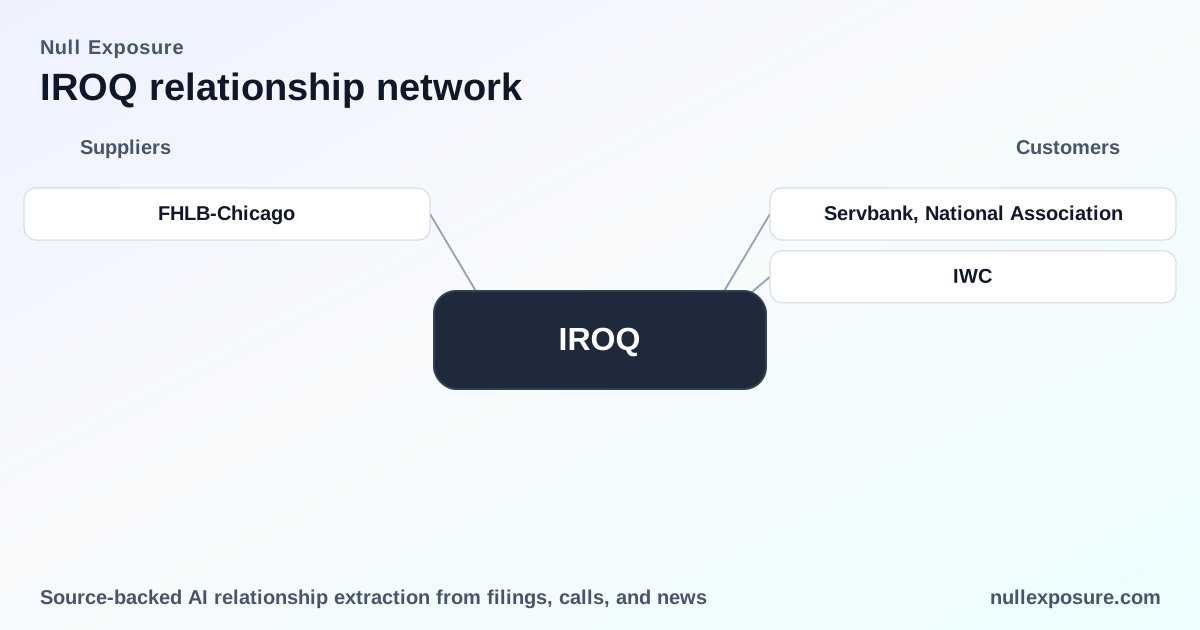
IROQ customer relationships: how a regional bank franchise converts local credit into predictable fees and interest income
IF Bancorp (ticker IROQ) operates as a regional banking franchise that originates and services mortgage, commercial and consumer loans, gathers deposits, and generates fee income from servicing and ancillary products. The company monetizes through net interest margin on a largely long-duration loan book (including fixed-rate 30-year mortgages) and recurring service fees related to deposit accounts and mortgage servicing. For investors assessing customer relationships, the lens should be on counterparties (individuals, small and mid‑market businesses, public units), geographic concentration in Illinois and adjacent counties, and the implications of long-term assets for funding and interest rate exposure.
For full context on relationship mapping and analytics, visit the Null Exposure homepage: https://nullexposure.com/
What the disclosed customer links tell investors
The data set identifies three distinct relationship entries tied to IROQ: an acquirer (Servbank, National Association) and two ETF-context references (IWC / IWC iShares Microcap ETF). Each entry is short but consequential for different investor questions—M&A outcome, passive investor exposure, and liquidity profile.
Servbank, National Association
Servbank signed a definitive agreement to acquire IF Bancorp, Inc. (NasdaqCM: IROQ) for $91.1 million, with the transaction dated October 29, 2025, as reported by MarketScreener in March 2026. This is a material corporate action that alters the ownership and strategic runway for IROQ and is the primary counterparty-level event for investors tracking exit execution and valuation. (Source: MarketScreener, item surfaced March 10, 2026.)
IWC
TradingView’s Nasdaq‑IROQ ETF page references IWC (iShares Microcap ETF), highlighting the ETF’s profile and microcap exposure metrics in the FY2026 context. For investors, the IWC reference provides a lens into passive investor interest and potential index-related liquidity for IROQ shares or its peer set. (Source: TradingView Nasdaq‑IROQ/ETFs page, accessed March 10, 2026.)
IWC iShares Microcap ETF
The TradingView ETF page repeats the IWC iShares Microcap ETF reference, noting fund-level statistics such as assets and performance in the FY2026 period; this reinforces that IWC is a relevant ETF for microcap exposure and therefore a likely channel for passive flows affecting IROQ liquidity. (Source: TradingView Nasdaq‑IROQ/ETFs page, accessed March 10, 2026.)
Operating model and business constraints that shape relationship risk
The underlying constraint signals deliver a coherent portrait of how IROQ runs its customer relationships and why those relationships matter for valuation.
-
Contracting posture: long‑term fixed-rate mortgage focus. IROQ offers fixed-rate conventional mortgage loans with terms up to 30 years and fully amortizing monthly payments, creating a long-duration asset base that requires disciplined funding and interest‑rate risk management. This long-term lending posture makes customer relationships inherently durable but increases sensitivity to rate shifts and prepayment behavior. (Company disclosure excerpts, FY2025–FY2026.)
-
Counterparty mix: retail plus small and mid‑market commercial clients. The bank originates consumer loans to individuals and commercial loans generally to small‑ and medium‑sized companies in its primary market area; it also serves public unit accounts through FHLB letter‑of‑credit arrangements. This mix means credit risk is concentrated in local households and SMEs, while deposit relationships include municipal/public unit dynamics. (Company disclosure excerpts.)
-
Geographic concentration: localized Midwest footprint. Operations are centered on seven full‑service branches in Illinois and a loan production office in Missouri, with primary lending counties identified as Vermilion, Iroquois, Champaign, and Kankakee and adjacent Illinois/Indiana counties. This regional focus strengthens customer intimacy and underwriting visibility but creates concentration risk tied to local economic cycles. (Company disclosure excerpts.)
-
Relationship role: service provider across deposit, payment and servicing channels. IROQ acts as a direct service provider—offering checking, savings, CDs, IRAs, mobile and online banking, ACH, remote deposit capture, and mortgage servicing. The bank reported mortgage loans serviced for others with an unpaid principal balance of about $134.3 million (June 30, 2025) and capitalized mortgage servicing rights with fair value around $1.43 million, indicating recurring fee streams from servicing but modest MSR scale. (Company disclosure excerpts, FY2024–FY2025.)
-
Stage and segment signals: active relationships in services. Evidence shows active deposit and lending channels and a services segment focus, meaning revenue is a mix of interest income and transactional/service fees rather than product‑sales alone. (Company disclosure excerpts.)
How these constraints affect investor judgement
- Valuation sensitivity: Long-duration mortgages and a modest MSR book imply earnings are sensitive to net interest margin compression and shifts in prepayment speeds; valuation must incorporate duration-driven economic value of equity and possible deposit repricing costs.
- Concentration risk premium: Strong local concentration requires a higher dispersion assumption compared with diversified regional banks—underwriting quality, local unemployment, and commercial vacancy trends are direct drivers of loss experience.
- Liquidity and marketability: ETF references (IWC) signal potential microcap ETF inclusion dynamics that affect trading liquidity; acquisition news (Servbank) supersedes this by delivering resolution to public equity liquidity and control.
- Service continuity and criticality: As a provider of everyday banking services to individuals and SMEs in a defined geography, customer relationships have operational stickiness; however, the economics of those relationships depend on interest rate cycles and fee pricing power.
Investment implications and what to watch next
- M&A crystallizes value: The Servbank acquisition reported at $91.1 million is the single most important event for investors—confirm the transaction terms, closing conditions and any earn‑outs or regulatory approvals in the filing trail. (MarketScreener report, transaction dated October 29, 2025.)
- Monitor funding mix and NIM: Given the long-term mortgage book, watch deposit growth, cost of funds, and hedging disclosures that will determine near-term NIM and earnings stability.
- Local credit indicators matter: Track regional employment, agricultural and small business loan performance in IROQ’s primary counties as forward indicators of credit stress.
- Passive flows and liquidity channels: ETF listings and holdings (IWC references) can amplify price moves in a microcap environment, but with the acquisition announced, passive flow relevance is secondary to M&A execution. (TradingView ETF references, FY2026.)
For a deeper read on how relationship mapping shapes event risk and investment timing, Null Exposure provides focused coverage and analytics—start at the main page: https://nullexposure.com/
Bottom line
IROQ is a classic regional banking franchise monetizing long-term mortgage assets and local deposit/customer relationships. The definitive acquisition agreement from Servbank is the critical development for investors; concurrent ETF references underline how microcap positioning can influence market liquidity prior to that corporate action. Evaluate IROQ through a lens that combines long-duration asset economics, local credit concentration, and the transaction mechanics that will determine ultimate value realization.