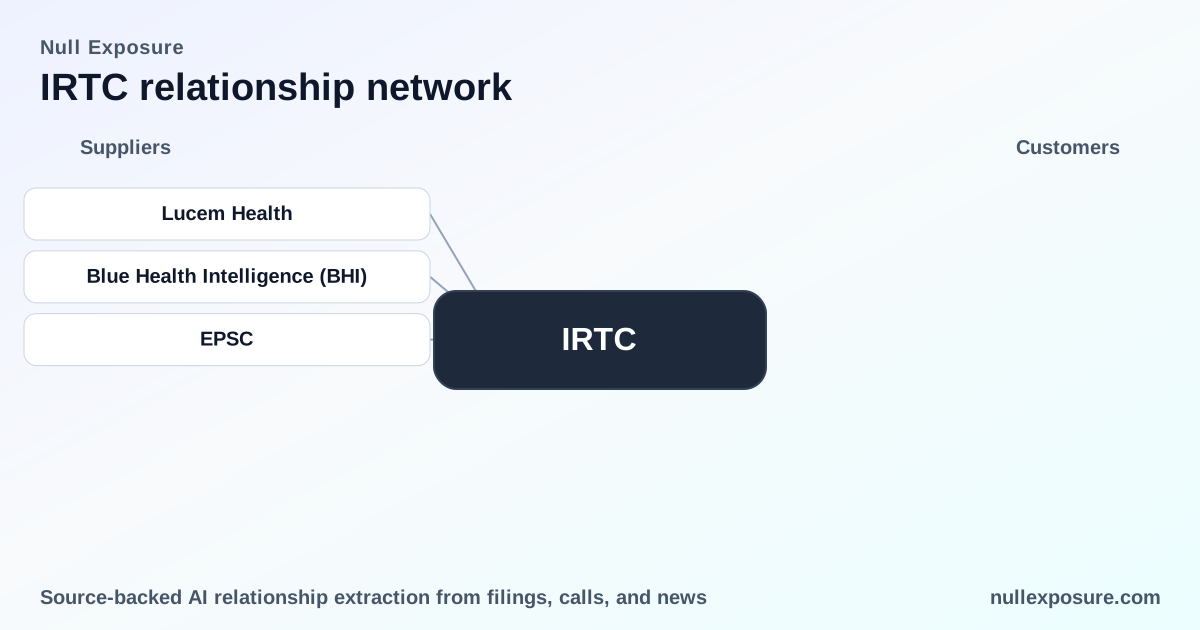
iRhythm (IRTC) — customer relationships, operating signals, and what investors should know
iRhythm monetizes a combined hardware-plus-recurring-services model: the company sells the Zio wearable ECG monitor and captures recurring revenue by providing cloud-based analysis and clinical reporting to payors and healthcare providers. Revenue is driven by device deployment and largely reimbursed through contracted third‑party payors, including Medicare, giving the business a payor‑dependent, recurring cash flow profile. For more on how we map counterparty relationships and operating constraints, visit https://nullexposure.com/.
Single-sentence investor thesis
iRhythm is a specialized medical‑device and remote cardiac‑monitoring services company that converts device installs into ongoing service revenues paid predominantly by commercial and government payors, producing high gross margins but concentrated counterparty exposure to reimbursement dynamics.
The NXGLW agreement — a supplier relationship worth noting
NXGLW reported on its 2025 Q3 earnings call that it signed an agreement in May to supply hydrogels for iRhythm’s Zio ECG heart‑monitoring system. This is a supplier contract rather than a commercial customer relationship for Zio services, and it signals ongoing sourcing activity for adhesive and consumable components used with the Zio patch. (NXGLW, 2025 Q3 earnings call; first posted March 7, 2026.)
Complete list of customer and close supplier mentions
- NXGLW: On its 2025 Q3 earnings call, NXGLW confirmed a May agreement to supply hydrogels used in iRhythm’s Zio ECG system, indicating an active sourcing relationship for device consumables (NXGLW, 2025 Q3 earnings call, March 2026).
How iRhythm’s business model shapes counterparty risk and contracting posture
iRhythm operates at the intersection of medical hardware, regulated software analytics, and recurring clinical services. That tripartite model creates distinct contracting and concentration dynamics:
- Contracting posture — payor‑centric, B2B2C execution. iRhythm sells a medical device paired with diagnostic services, but the cash collection model is primarily B2B with commercial insurers and government payors rather than direct patient billing. The company markets to clinicians and healthcare institutions, but payors drive economics and contract terms.
- Concentration — meaningful reliance on third‑party payors. For the year ended December 31, 2024, iRhythm generated approximately 84% of revenue through third‑party payors, with roughly 24% of total revenue from Medicare, making reimbursement policy a primary revenue risk (iRhythm FY2024 disclosure).
- Criticality — the service is mission‑critical for arrhythmia detection but commoditizable at the component level. Clinical customers rely on Zio for diagnostic workflows, establishing stickiness at the service/reporting layer; conversely, consumable components (adhesives, hydrogels) are replaceable, creating supply‑chain and vendor‑management focus for operations.
- Maturity and international posture — U.S. revenue dominant, deliberate international rollouts. The majority of revenue is U.S.‑based, but iRhythm initiated commercial launches in multiple EMEA markets in 2024 and secured regulatory approval in Japan in September 2024, reflecting staged global expansion that will test reimbursement heterogeneity and growth scalability.
What the constraints tell investors (company‑level signals)
The constraint evidence in filings and disclosures yields actionable, company‑level signals for investors evaluating IRTC customer relationships:
- Payor dependency is material. The company reports that the bulk of Zio Services revenue flows from contracted third‑party payors and CMS; this creates sensitivity to coverage policy, coding, and rate negotiations.
- Patient reach underpins data and competitive moat. iRhythm reports having served more than eight million patients since FDA clearance, which supports the clinical dataset and the efficacy claims behind its analytics—an important intangible asset for differentiation.
- Product mix is multi‑segment: hardware + software + services. The Zio System is an integrated offering: a wearable biosensor (hardware), FDA‑cleared analytic software, and ongoing clinical reporting (services). That integration drives higher gross margins on services while exposing the company to capital and supply needs on the hardware side.
- Geography exposure is concentrated but expanding. While the U.S. drives current revenue, recent regulatory approvals and EMEA launches indicate new market openings that will require localized commercial and reimbursement strategies.
- Supplier relationships matter operationally. Agreements such as the NXGLW hydrogel supply contract highlight that consumable sourcing is a non‑trivial operational dependency even though it is not a direct revenue driver.
Investment implications — what to watch next
- Monitor reimbursement momentum and coding updates. Given that ~84% of revenue is payor‑driven and Medicare accounts for a sizable share, any shifts in coverage or payment rates will materially affect cash flow.
- Evaluate margin leverage between services and hardware. The services/analytics platform delivers higher recurring margin potential; growth that shifts mix toward services will be accretive to operating leverage.
- Track supply‑chain resiliency for consumables. Contracts with component suppliers (for example, the NXGLW hydrogel agreement) reduce execution risk for device deployment, but investors should watch vendor concentration and alternative sourcing.
- Assess international commercialization execution. Approval in Japan and EMEA launches are positive for long‑term TAM expansion, but near‑term P&L impact will depend on local reimbursement and launch cost intensity.
- Data scale reinforces defensive positioning. Serving millions of patients and accumulating multi‑billion hours of heartbeat data strengthens iRhythm’s clinical analytics positioning and creates switching costs at the provider level.
Final takeaway for portfolio managers
iRhythm is a service‑anchored medical device franchise with a revenue base tied tightly to third‑party payors and a supply chain that supports consumable device deployment. The NXGLW supply agreement confirms ongoing vendor relationships for device components, but the principal investment sensitivity remains reimbursement concentration and the company’s ability to capture recurring service economics as it scales internationally. For structured relationship intelligence and continuous monitoring of counterparties, see https://nullexposure.com/.
Bold summary: IRTC is a high‑margin, payor‑dependent services business layered on hardware; supplier ties like NXGLW reduce execution risk for device operations but do not eliminate reimbursement‑driven revenue volatility.