IsoEnergy (ISOU) — customer and partner relationships investors should price into the cap table
IsoEnergy Ltd. explores and advances uranium properties across Canada, the U.S. and Australia, and funds that work through a mix of equity placements and selective asset disposals. The company monetizes progress primarily by raising capital from strategic shareholders and by selling non-core or early-stage acreage, rather than by operating producing assets — a business model that places financing counterparties and occasional asset buyers at the center of value realization.
For a concise view of how partner actions have reshaped IsoEnergy’s capital position in 2026, visit https://nullexposure.com/ for tracking and contextual analytics.
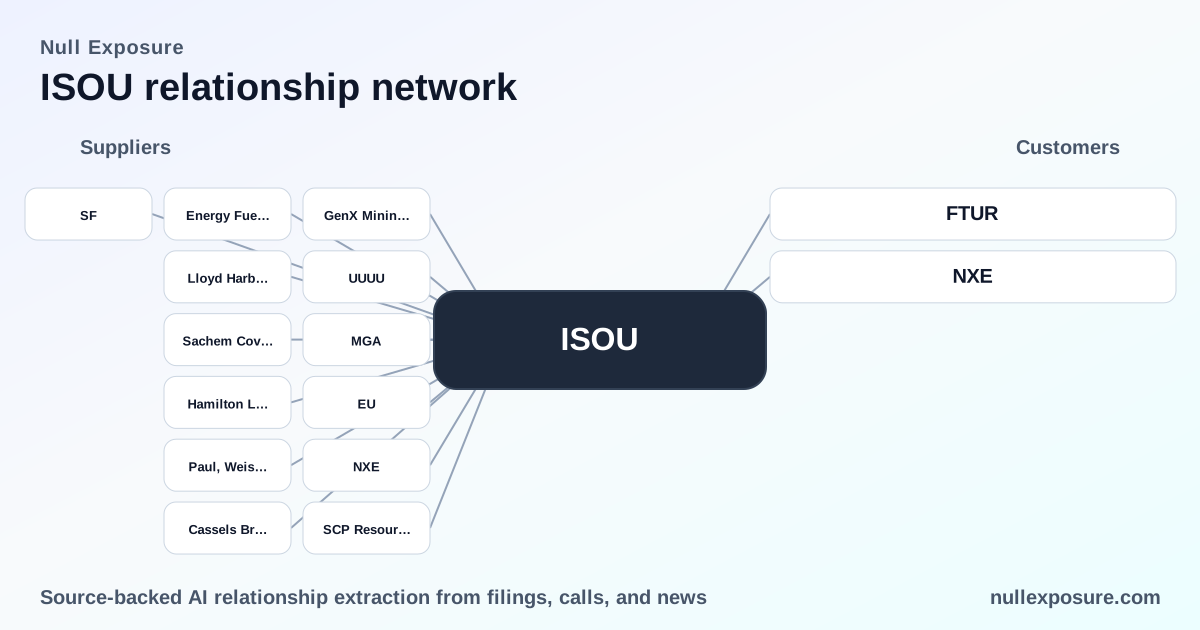
Strategic capital from a strategic shareholder — NexGen Energy
IsoEnergy completed a concurrent non‑brokered private placement with NexGen Energy in which it issued 1,666,667 common shares at C$15.00 per share for aggregate gross proceeds of C$25,000,005. This transaction was structured to preserve NexGen’s roughly 30% ownership stake and to strengthen IsoEnergy’s balance sheet for project advancement. According to press reporting and company notices in March–May 2026, the placement was positioned as non‑brokered and supportive of ongoing exploration programs and resource expansion initiatives (press release coverage in The Globe and Mail and IRW‑Press; Intellectia.ai commentary, March–May 2026).
Why this matters: NexGen’s equity infusion reduces near‑term dilution risk from broader market financings and signals a strategic investor relationship rather than a purely transactional financing. For investors, that translates into a capital partner with aligned incentives in project maturation and resource economics.
Asset monetization — Mountain Lake sale to Future Fuels
IsoEnergy completed the sale of the Mountain Lake Property in Nunavut to Future Fuels Inc. (TSXV: FTUR) during FY2026, a disposition consistent with selective divestment of non-core holdings. Simply Wall St and related reporting in March 2026 recorded that Future Fuels closed the acquisition of Mountain Lake from IsoEnergy (Simply Wall St, March 2026).
Why this matters: Asset sales reduce overhead and fund exploration at core projects while converting geological upside into near‑term cash or liability reduction. For holders of IsoEnergy equity, such disposals are a mechanism to reallocate capital toward higher‑priority, higher‑return targets in the portfolio.
Operating posture and business-model constraints you should price in
The source set did not return formal constraint excerpts; nevertheless, company disclosures and the 2026 activity pattern produce clear signals about IsoEnergy’s operating model:
- Contracting posture — financing-driven: IsoEnergy markets equity to strategic partners through non‑brokered private placements and completes selective asset disposals to fund its exploration pipeline rather than generate operating cash flow. This is a typical exploration‑stage posture where counterparty relationships double as capital providers.
- Concentration — meaningful shareholder influence: The company reports ~35% insider ownership and ~27.5% institutional ownership, while NexGen’s maintained ~30% position after the placement represents a concentrated strategic stake that materially influences capital decisions and exit sequencing.
- Criticality — strategic equity over commercial offtake: Given IsoEnergy’s zero reported revenue across the trailing twelve months and negative EBITDA, counterparties whose actions determine capital access (investors and asset acquirers) are more critical to value realization than end markets or offtake contracts at this stage.
- Maturity — exploration and capital intensity: Financials show no operating revenue, negative EBITDA, and a market cap in the mid‑hundreds of millions (USD 642m); IsoEnergy is in a capital‑intensive, pre‑production phase where value is realized through resource definition, permitting milestones and strategic financings, not cash flow.
These signals frame the company as an exploration-stage uranium developer reliant on a small set of counterparties to fund near‑term advancement.
All relationships captured in the public results (concise investor view)
- NexGen Energy Ltd. — IsoEnergy issued 1,666,667 common shares at C$15.00 per share to NexGen for C$25,000,005, preserving NexGen’s ~30% ownership and strengthening the company’s capital for project work. Reported in multiple sources, including a company press release covered by The Globe and Mail and IRW‑Press (March–May 2026).
- Future Fuels Inc. (FTUR) — Future Fuels completed the acquisition of the Mountain Lake Property in Nunavut from IsoEnergy, representing a non‑core asset disposal executed in FY2026 and reported by Simply Wall St in March 2026.
Each relationship above is documented in public coverage and press statements in March–May 2026; the items above reflect the entire relationship set returned in the source collection.
Investment implications and risk roadmap
- Capital dependence: IsoEnergy’s path to value requires continued equity support and disciplined asset recycling; the NexGen placement demonstrates capacity to secure strategic capital but does not change that equity raises are the primary funding vector.
- Control and optionality: High insider and strategic investor concentration constrains free‑float dynamics and gives major holders outsized influence over timing of project advancement, future placements, and asset sales.
- Execution risk over commodity risk: With no revenue and negative operating income, investor returns hinge on exploration success, permitting, and financing execution rather than near‑term uranium price exposure.
- Liquidity profile: With ~55 million shares outstanding and a significant insider stake, liquidity can be uneven; market moves can reflect both fundamental resource news and block transactions by strategic holders.
Bottom line: what to price into ISOU now
IsoEnergy operates as an exploration developer financed through strategic equity placements and targeted asset sales; the NexGen placement and the Mountain Lake disposition are textbook examples of that monetization model. For investors, the key calibration is forecasting financing cadence and partner behavior rather than near‑term operating margins. Value accrual is milestone-driven and dependent on continued strategic support.
If you want continuous, structured monitoring of these partner dynamics and how they change IsoEnergy’s financing runway, explore the analytical tracker at https://nullexposure.com/.
Bold takeaway: IsoEnergy is not a revenue‑driven operator — it is a capital‑dependent developer whose valuation moves with partner financings and asset disposition outcomes.