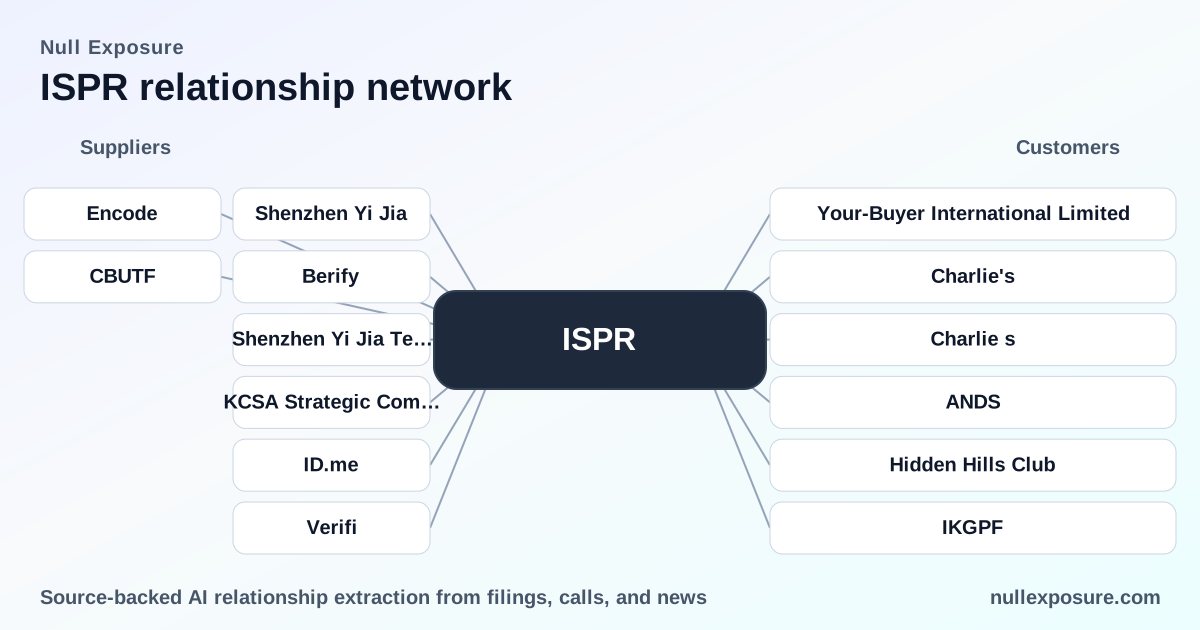
Ispire Technology (ISPR) — Customer Map, Key Relationships, and Investor Implications
Ispire Technology manufactures and supplies vaping hardware and ODM cannabis vape products, monetizing through direct sales to distributors and contract manufacturing for brand partners. The company sells branded e‑cigarette products globally and fulfills ODM agreements that supply other vapor brands, earning margins on hardware production and distributor mark‑ups while relying on a concentrated European distribution footprint. For focused diligence, see additional research at https://nullexposure.com/.
How Ispire runs the commercial engine
Ispire operates a mixed go‑to‑market model: a wholesale/distributor network for its Aspire nicotine products combined with ODM manufacturing for cannabis brands. Revenue recognition is driven by product shipments to distributors and contracted customers; Ispire discloses short settlement horizons for contract liabilities and a largely non‑exclusive distributor framework. The company’s financials show negative operating margins and concentrated revenue, indicating the business depends on a few large distribution relationships to drive scale while it pursues higher-volume OEM agreements.
Operating constraints that shape customer risk
- Short-term contract posture. Ispire states it expects contract liabilities to be settled in less than one year, which implies limited long-duration revenue protections and higher sensitivity to quarterly demand swings.
- Framework distributor model, non‑exclusive. The global distributor network (150+ distributors across 30+ territories) functions under non‑exclusive agreements, which reduces switching frictions for customers and increases competitive exposure for Ispire.
- Geographic concentration toward EMEA. Europe accounted for roughly 58% of FY2025 revenue, with North America and Asia Pacific smaller but material contributors; this regional mix drives FX, regulatory, and supply‑chain risk centered on EMEA markets.
- Material customer concentration. The company reports one distributor as its largest single customer contributing a quarter to a third of revenue in recent years, which elevates counterparty concentration risk to the top line.
- Dual role as manufacturer and seller. Ispire operates both as a branded seller and as an ODM manufacturer for other vapor companies, exposing the company to both wholesale volume dynamics and the client‑specific R&D / customization obligations of ODM work.
Who the customers are (each relationship in the public record)
Your‑Buyer International Limited
Ispire’s largest distributor for the UK and France territories generated approximately $32.7 million or 25.7% of FY2025 revenue, and accounted for roughly $45.6 million or 30.0% in FY2024 — a clear concentration at the company level. This relationship is explicitly named in Ispire’s FY2025 Form 10‑K filing for the year ended June 30, 2025.
Charlie’s (Charlie's / Charlie s) — OEM development partnership
Ispire announced a development and supply arrangement with Charlie’s that targets an initial production run of 2–3 million chips per month, with an aspirational ramp to 10 million devices monthly over the subsequent year; management characterized the deal as “groundbreaking” on the Q2 FY2026 earnings call. Coverage includes a March 2026 Globe and Mail earnings transcript, a May 2026 press release summarizing the cost‑driven reset and ramp targets, and an InsiderMonkey report quoting management’s characterization of the deal (Q2 FY2026 / March–May 2026).
Hidden Hills Club
Ispire announced a global licensing agreement with Hidden Hills Club as part of its go‑to‑market for CBD and cannabis pod systems, signaling a channel expansion into licensed brand partnerships. The licensing arrangement was reported by 2firsts in coverage dated March 2026 and references prior FY2024 commercial activity.
ANDS (MENA five‑year distribution agreement)
Ispire signed a five‑year distribution agreement with ANDS to cover MENA markets, establishing a multi‑year distribution commitment in that region and formalizing channel access across the Middle East and North Africa. This agreement is noted in 2firsts coverage summarizing Ispire’s FY2024–FY2025 regional expansion initiatives (reported March 2026).
IKE
Ispire’s FY2025 Form 10‑K discloses an exclusive supply agreement with IKE under which IKE is obligated to purchase products at cost plus a 5% mark‑up for products sold by IKE in the nicotine field, establishing a captive supply relationship and predictable transfer pricing for that channel. This contractual detail is recorded in the company’s June 30, 2025 10‑K.
IKGPF
An additional entry in the FY2025 10‑K references IKGPF using the same language as the IKE disclosure, indicating the same exclusive supply obligation — cost plus 5% — for nicotine products sold by the counterparty. The FY2025 10‑K is the source for this disclosure; the filing records the purchase obligation and pricing formula.
What these relationships imply for investors
- Concentration risk is acute. One distributor contributes roughly a quarter to a third of revenue; loss or disruption to that relationship would have an outsized impact on top line and working capital. The explicit naming of Your‑Buyer in the FY2025 10‑K underscores this point.
- Revenue is heavily Europe‑tilted. With Europe ~58% of FY2025 sales, macroeconomic or regulatory shifts in EMEA carry direct revenue consequences.
- Short contract horizons increase volatility. Company statements tying contract liabilities to <1 year and non‑exclusive distributor frameworks imply revenue renewal is annual and competitively contested, not locked long term.
- ODM deals like Charlie’s are scale levers. The Charlie’s development agreement targets volumetric scale (single‑digit millions of chips/month rising toward 10 million), which, if achieved, would materially change manufacturing throughput and unit economics; management’s public commentary highlights the strategic significance of that partnership.
- Mixed roles compress margins but diversify routes to market. Acting as a seller and an ODM manufacturer dilutes margin predictability (evidenced by recent negative operating margins) but provides multiple channels to grow unit volume.
Practical next steps for diligence
- Reconcile shipment timing and revenue recognition for the largest distributor to test concentrated cash‑flow risk; the FY2025 10‑K is the primary reference for material customer disclosure.
- Model a sensitivity where the largest distributor’s purchases decline 20–40% to evaluate working capital and covenant stress under short contract horizons.
- Track Charlie’s ramp metrics quarterly against production capacity and cost forecasts to evaluate potential margin improvement from scale.
For a concise due‑diligence checklist and comparative customer exposure models, visit https://nullexposure.com/ for structured investor workflows and additional ISPR monitoring tools.
Bold takeaways: Ispire is a hardware‑centric supplier with high customer concentration in Europe, short contractual horizons, and a potential volume inflection via Charlie’s; investor focus should be on counterparty stability, regional regulatory exposure, and execution on large OEM ramps.