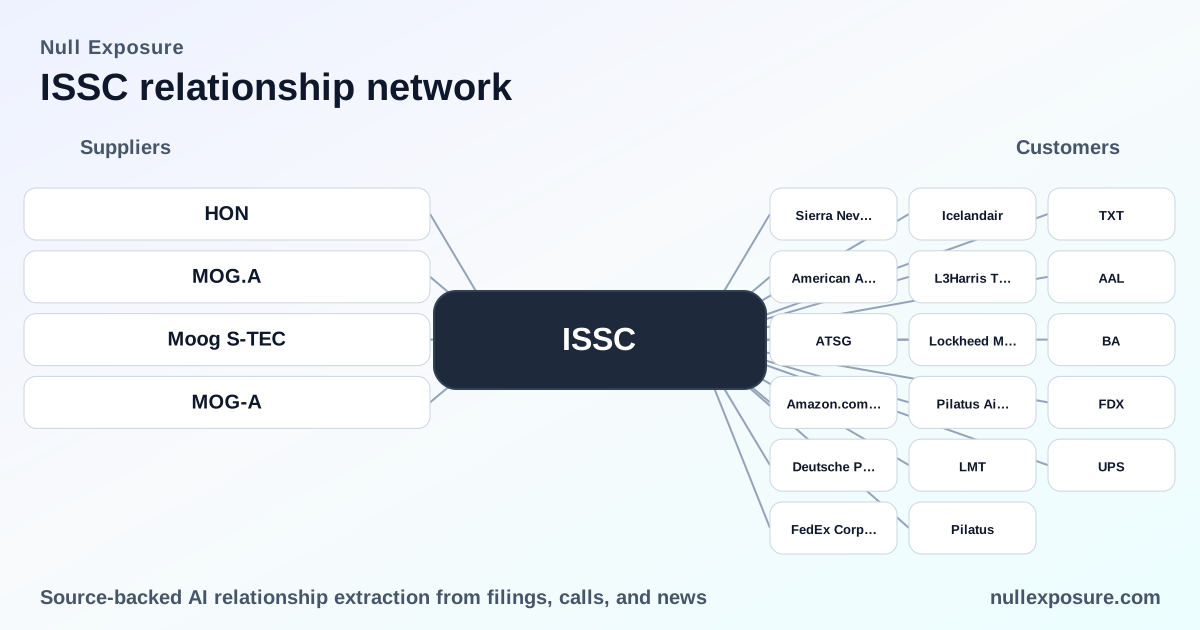
Innovative Solutions and Support: customer map and commercial implications
Innovative Solutions and Support (ISSC) is a systems integrator that designs, manufactures and services flight‑critical cockpit systems—from flight guidance and digital flight control computers to ThrustSense® autothrottles—and monetizes through hardware sales to OEMs and retrofit customers plus recurring service and engineering support. Revenue concentration on a handful of large aerospace OEMs and government contracts gives ISSC a mix of high-margin aftermarket revenue and program-driven, backlog‑linked revenue that investors should value for predictability and platform exposure. For a quick company overview, visit https://nullexposure.com/.
Why the customer roster matters for value and risk
ISSC’s customer list reads like a who’s who of commercial airlines, global integrators and defense primes. From an investor perspective, that roster signals three structural characteristics:
- Contracting posture — program-level, multi‑year OEM engagements drive the business; ISSC supplies components both for original equipment and retrofit applications, which translates to a mix of discrete program revenue and recurring aftermarket service revenue.
- Concentration and criticality — revenue is concentrated among a few large OEMs and primes (Lockheed, Boeing, Pilatus, Textron) and major carriers/cargo operators, making top‑customer wins or delays materially impactful to near‑term results.
- Operating footprint and segment mix — US‑centric manufacturing with both hardware and services: the company generates most sales in North America and reports a single-segment operations model combining product and related EDC (engineering, development and customer) services.
These dynamics explain ISSC’s financial profile: high gross margins from proprietary avionics and stable margins from service offset program backlogs that can be lumpy. If you want a consolidated view of customer exposure and signals, see https://nullexposure.com/.
How ISSC’s customer relationships break down (FY2025–FY2026)
Below I list each named customer relationship in the filings and contemporary coverage, with a plain-English summary and a concise source reference for each.
Sierra Nevada Corporation
ISSC lists Sierra Nevada Corporation among its OEM and contractor customers, indicating program‑level engagement on military or special mission platforms. Source: ISSC FY2025 Form 10‑K.
American Airlines, Inc.
American Airlines is identified as a commercial fleet customer for retrofit and aftermarket upgrades, placing ISSC squarely in the airline retrofit market. Source: ISSC FY2025 Form 10‑K.
Air Transport Services Group (ATSG)
ATSG is named among commercial fleet customers—reflecting ISSC’s exposure to air‑cargo operators who pursue aftermarket avionics upgrades. Source: ISSC FY2025 Form 10‑K.
Amazon.com, Inc.
Amazon appears on the customer list, showing ISSC’s components and services reach large logistics/customer platforms through integrators or cargo operators. Source: ISSC FY2025 Form 10‑K.
Deutsche Post DHL Group
Deutsche Post DHL Group is listed as a customer, representing global freight integrator exposure in ISSC’s commercial aftermarket and retrofit market. Source: ISSC FY2025 Form 10‑K.
FedEx Corporation
FedEx is named as a commercial fleet customer for upgrades and retrofit work, reinforcing ISSC’s position in the express cargo vertical. Source: ISSC FY2025 Form 10‑K and TradingView coverage summarizing the 10‑K (FY2025).
Icelandair
Icelandair is documented as a commercial fleet customer, an example of ISSC’s regional airline aftermarket relationships. Source: ISSC FY2025 Form 10‑K.
L3Harris Technologies, Inc.
L3Harris is included among government and prime contractor customers, indicating ISSC supplies components to larger systems integrators in defense programs. Source: ISSC FY2025 Form 10‑K.
Lockheed Martin Corporation
Lockheed Martin is a top OEM customer and recipient of full loads of digital flight control computers; ISSC explicitly delivered a full load to Lockheed in Q1 FY2026 and cites Lockheed platforms in backlog disclosures. Sources: Q1 FY2026 earnings call transcript (reported by InsiderMonkey) and ISSC FY2025 results release (December 2025).
Pilatus Aircraft
Pilatus is a strategic OEM partner: ISSC supports the Pilatus PC‑24 platform, has completed test flights for the PC‑24 variant and expects deliveries of a new version in mid‑2026. Pilatus is also cited among top revenue contributors in 2025. Sources: Q4 FY2025 earnings commentary and Q1 FY2026 remarks (InsiderMonkey and company FY2025 release).
Textron (TXT)
ISSC has an explicit multi‑year agreement with Textron to supply ThrustSense® autothrottles for King Air 260/360 production aircraft, a program contract that creates multi‑year production revenue. Source: ISSC FY2025 Form 10‑K (contract excerpt).
Boeing (BA)
Boeing is identified as a major OEM customer across multiple platforms (KC‑46A, KC‑767, T‑7A Red Hawk) and is named among the backlog contributors for ISSC’s OEM programs. Source: ISSC FY2025 Form 10‑K and FY2025 results commentary (December 2025).
UPS
UPS is cited indirectly through commentary on stronger aftermarket product upgrade volumes to commercial markets that include UPS and air transport, signaling UPS participation in ISSC’s retrofit revenue. Source: Q1 FY2026 earnings call summary (InsiderMonkey).
Program backlog and platform concentration
ISSC’s public commentary and press releases show a backlog that explicitly references major OEM platforms—Lockheed F‑16, Boeing KC‑46A and T‑7 Red Hawk, Pilatus PC‑24 and Textron King Air—confirming that a meaningful portion of near‑term revenue is backlog‑driven and tied to a limited set of platforms. Source: FY2025 results release (December 18, 2025) and ISSC FY2025 Form 10‑K.
Investment implications and risk signals
- Upside drivers: platform wins (e.g., repeat awards from Lockheed or Boeing) and expansion of multi‑year OEM programs (Textron autothrottle deal) scale revenue at attractive margins.
- Key risks: customer concentration and program timing create revenue volatility; government contracting complexity and OEM production cadence determine delivery schedules.
- Structural strengths: combined hardware plus service model gives ISSC recurring revenue and aftermarket margin leverage, while the North American manufacturing base supports defense and export compliance.
Bottom line for portfolio managers
ISSC is a focused avionics supplier whose value is driven by a small number of high‑quality OEM and government relationships and a program backlog tied to recognizable platforms. For investors prioritizing predictable cash flow, the mix of multi‑year OEM contracts (notably Textron), recurring service revenue, and defense prime relationships (Lockheed, Boeing) makes ISSC a defensible small‑cap aerospace play—but one where program execution and customer concentration are the principal watch items.
If you want a consolidated view of ISSC’s customers and program disclosures, explore the company overview at https://nullexposure.com/.