Integer Holdings (ITGR): Customer relationships that drive manufacturing leverage and concentration risk
Integer Holdings operates as a contract development and manufacturing organization (CDMO) for medical devices, monetizing through long-term manufacturing, design-for-manufacture services, and program supply agreements with large OEMs across cardiac rhythm management, neuromodulation and vascular markets. Revenue is driven by high-volume, multi-year OEM contracts, material customer concentration, and backlog visibility that converts into near-term manufacturing throughput. For deeper context on data sources and relationship mapping, visit https://nullexposure.com/.
What investors need to know up front
Integer’s business model is fundamentally B2B manufacturing: it signs multi-year supply agreements with large medical device OEMs, invests in capacity and regulatory controls, and earns margins from scale and complexity of product assembly. This creates a profile of high gross-profit defensibility on complex devices but also concentration risk where a handful of OEMs represent an outsized share of sales. Order backlog and long-term contracts underpin visibility, while divestitures and winding-down product lines reallocate capital to core medical manufacturing.
Active corporate relationships — concise operating takeaways
Below I cover every customer-related relationship surfaced in the monitoring results and what each implies for Integer’s operating posture.
-
Ultralife Corporation (ULBI) — Integer completed the sale of its Electrochem non-medical business for $50 million in cash; post-close Integer will continue to supply certain products to Electrochem under transitional arrangements. According to a GlobeNewswire release (Nov 1, 2024) and subsequent local coverage, the transaction disposes non-core energy/military battery activity while preserving limited supplier obligations, converting lower-margin or non-strategic assets into cash. (Sources: GlobeNewswire, Dallas Innovates, FingerLakesDailyNews)
-
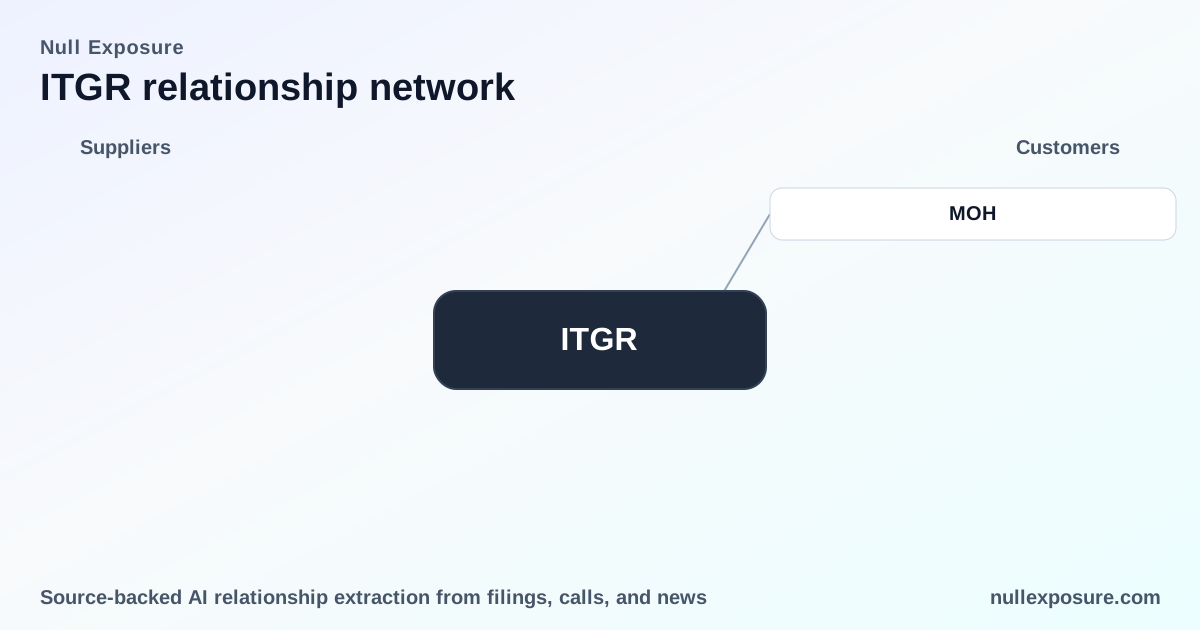
Molina Healthcare (MOH / Molina Healthcare) — Public reporting states Molina Healthcare agreed to acquire all outstanding shares of Integer for $85 per share in cash under a definitive agreement. A news notice in March 2026 detailed the proposed cash acquisition, which, if completed, would turn Integer into a private asset within Molina’s portfolio and materially change counterparty dynamics and disclosure. (Source: National Today, March 1, 2026)
-
Tractor Supply (TSCO) — A SimplyWallSt article references Tractor Supply partnering with an entity labeled “ITG” and adopting Storyteq marketing automation; the item cites a technology/marketing partnership rather than a manufacturing or supplier relationship with Integer Holdings. This mention does not establish a documented OEM supply relationship between Tractor Supply and Integer. (Source: SimplyWallSt, May 2026)
-
Trump Media / DJT-related partnership (DJT) — A TradingView note mentions Yorkville America Equities and “ITG” delivering thematic portfolios; this is a financial services/product partnership referencing an “ITG” entity and does not provide evidence of a customer-supplier relationship with Integer Holdings. The reference should be treated as unrelated to Integer’s CDMO operations absent corroboration. (Source: TradingView, March 2026)
How these relationships map to Integer’s operating constraints
The monitored signals support a clear operating profile:
-
Long-term contracting posture: Integer states it has emphasized long-term agreements with OEM customers to secure revenue and incentivize growth; this underpins backlog conversion and capital planning rather than transactional spot manufacturing.
-
Large-enterprise counterparties: The company explicitly targets large, multi-national OEMs and their affiliates, aligning revenue with high-credit counterparties but also concentrating risk among a few big names.
-
Global footprint and geographic diversification: Sales are booked across the United States, Puerto Rico, Costa Rica and the rest of the world, demonstrating global shipment allocation and manufacturing locations that support multinational clients.
-
Material customer concentration: Integer disclosed that three customers (unnamed in the constraint excerpt) each exceeded 10% of total sales in 2024 and collectively accounted for 47% of sales — a significant concentration that creates both revenue visibility and single-counterparty exposure.
-
Buyer / supplier dynamics: Integer functions as the manufacturer/supplier to OEMs (i.e., the buyer-seller relationship is supplier-focused), which informs cash-conversion cycles, working capital needs, and the criticality of maintaining quality and regulatory compliance for customers’ end-products.
-
Active and winding-down relationships: Evidence shows Integer will continue to supply certain products to the divested Electrochem business (active transitional supply), while Portable Medical sales are expected to wind down with market exit planned in 2025 — a mix of continuing obligations and intentional portfolio rationalization.
-
Manufacturing-led segment focus and scale: Integer’s primary segment is manufacturing for cardiac rhythm, neuromodulation and vascular markets; scale and technical complexity are core competitive advantages.
-
Backlog magnitude as a spend signal: Firm backlog reported near $728 million at December 31, 2024, implying large deal sizes and validating the classification of spend-band at $100M+. Backlog supports near- to medium-term revenue visibility and capital allocation decisions.
Investment implications and risks
Integer’s model delivers durable cashflows when OEM programs scale, but concentration risk and customer dependency are material. Divestitures such as Electrochem reduce non-core exposure and improve cash position, while a change-of-control transaction like Molina’s proposed $85-per-share offer would materially alter governance, public disclosures, and strategic flexibility. Operationally, the combination of long-term contracts and global manufacturing footprint supports resilience, but single-customer impacts can meaningfully influence top-line swings.
Bottom line for investors and operators
- Positive: High-margin, complex manufacturing contracts with large OEMs, substantial backlog, and active portfolio pruning via divestitures strengthen focus on profitable core businesses.
- Negative: Material customer concentration and the potential for major corporate events (e.g., an $85/share acquisition agreement) increase event risk and could compress independent equity upside.
For ongoing monitoring of how these customer relationships evolve and to track deal-level changes that affect valuation and operational risk, visit https://nullexposure.com/ for the original mapping and source links.
If you want a tailored brief on how specific OEM relationships drive Integer’s revenue and margin sensitivity, I can produce a focused sensitivity analysis or a counterparty risk heat map.