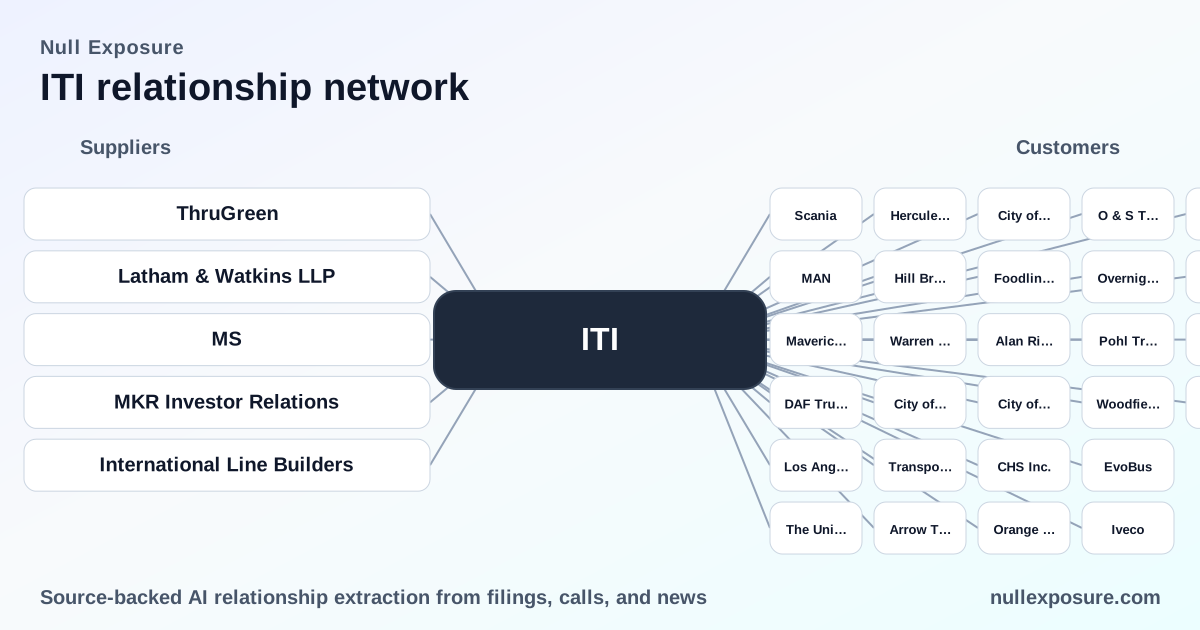
Iteris (ITI) — Customer Map and Contract Signals That Drive Revenue
Iteris monetizes a three-part mobility stack: vehicle safety hardware (Lane Departure Warning — LDW), recurring analytics and SaaS (ClearGuide / ClearData), and multi-year operations/engineering services for transportation agencies. Investors should value Iteris as a hybrid vendor that converts one-time equipment sales into recurring revenue through analytics subscriptions and long-term public-sector support contracts. For an at-a-glance portfolio view, see https://nullexposure.com/.
How Iteris turns customers into predictable cash flow
Iteris sells LDW systems and OEM integration to truck manufacturers and fleets, licenses mobility data and analytics to agencies and private partners, and competes for task-order, IDIQ and managed‑services engagements that produce multi-year revenue streams. The business model mixes transactional hardware with high-margin recurring analytics and mission‑critical support services, a combination that increases revenue visibility when agencies award multi-year contracts.
Operating model and company-level constraints investors should price in
- Contracting posture: Iteris wins a mix of public tenders and private fleet/OEM deals; the prevalence of IDIQ and task-order language in reported wins signals a deliberate push toward recurring professional services and managed operations.
- Concentration: Revenue is concentrated in the transportation and logistics vertical; gains from large DOTs and county transit authorities are material to visibility and pipeline health.
- Criticality: Contracts that cover Regional Transportation Management Centers (RTMCs), transit signal priority (TSP), and analytics for statewide signal trends are operationally critical for customers, which supports stickiness and upsell.
- Maturity and scale: ClearGuide and ClearData show national deployments and early access partnerships with agencies and research institutes, demonstrating product maturity and references that help close larger public contracts.
For a deeper look at the customer list below, visit https://nullexposure.com/.
Customer wins and commercial footprint — the practical picture
Iteris’ customer base splits into three visible cohorts: OEMs and coachbuilders (Scania, DAF, MAN, Mercedes, Iveco, EvoBus, Neoplan) that offer LDW as an option; commercial fleets specifying LDW as standard (Old Dominion, Melton, TMC, Air Liquide, CHS, and multiple regional carriers); and public agencies / transit authorities buying analytics, TSP, ATMS and RTMC support (LA Metro, FDOT District 7, ALDOT, Hillsborough County, Burleson, Downey, Transport Canada, Orange County). Academic and research partnerships (UMTRI, Telenav) complement the commercial pipeline and validate product performance.
Complete relationship log (source-by-source)
- Scania — Scania began purchasing initial production units in July (TruckingInfo, Mar 10, 2026: https://www.truckinginfo.com/news/scania-and-daf-offer-iteris-systems-as-options-on-heavy-trucks).
- Florida Department of Transportation (FDOT) District 7 — FDOT District 7 selected Iteris for comprehensive operations, management, and technical support for its RTMC (GlobeNewswire, Apr 22, 2026: https://www.manilatimes.net/2026/04/22/tmt-newswire/globenewswire/iteris-awarded-31-million-contract-extending-critical-support-for-tampa-area-regional-transportation-management-center/2326305/amp).
- Los Angeles County Metropolitan Transportation Authority (L.A. Metro) — Iteris was selected to implement bus signal priority systems for three Metro Rapid corridors (Metro Magazine, Mar 2026: https://www.metro-magazine.com/news/iteris-wins-l-a-metro-contract).
- DAF Trucks N.V. — DAF will offer Iteris’ LDW system in CF and XF Series models, with initial production noted in the article (TruckingInfo, Mar 10, 2026: https://www.truckinginfo.com/news/scania-and-daf-offer-iteris-systems-as-options-on-heavy-trucks).
- The University of Michigan’s Transportation Research Institute (UMTRI) — UMTRI selected Iteris for a three-year, $20 million smart mobility and safety initiative (dbusiness, reported Mar 2026 referencing FY2022: https://www.dbusiness.com/daily-news/u-m-transportation-research-institute-selects-iteris-for-smart-mobility-initiative/).
- Maverick Transportation Inc. — Maverick will install Iteris’ lane departure warning system on a fleet of 1,000 trucks (TruckingInfo, Mar 2026: https://www.truckinginfo.com/news/maverick-selects-iteris-vitual-rumblestrips).
- Los Angeles County Metropolitan Transportation Authority (LA Metro) — Iteris to provide design, integration, and operational support for a countywide TSP program across 13 corridors (GlobeNewswire, Feb 24, 2026: https://www.globenewswire.com/de/news-release/2026/02/24/3243758/0/en/Iteris-to-Deploy-LA-Metro-s-Countywide-Cloud-Based-Transit-Signal-Priority-Program.html).
- LA Metro (duplicate entry) — Iteris confirmed countywide TSP deployment across major corridors (GlobeNewswire, Mar 10, 2026: https://www.globenewswire.com/news-release/2026/03/18/3258333/0/en/iteris-significantly-expands-alabama-dot-s-traffic-signal-performance-capabilities-with-statewide-clearguide-signal-trends-expansion.html).
- MAN — Iteris’ LDW system was displayed and available on MAN trucks at the IAA show (TruckingInfo, Mar 10, 2026: https://www.truckinginfo.com/news/scania-and-daf-offer-iteris-systems-as-options-on-heavy-trucks).
- Alabama Department of Transportation (ALDOT) — ALDOT expanded ClearGuide Signal Trends to all five regions, a statewide analytics deployment (GlobeNewswire, Mar 18, 2026: https://www.globenewswire.com/news-release/2026/03/18/3258333/0/en/iteris-significantly-expands-alabama-dot-s-traffic-signal-performance-capabilities-with-statewide-clearguide-signal-trends-expansion.html).
- ALDOT (duplicate) — Iteris reiterated ClearGuide expansion across all ALDOT regions (GlobeNewswire, Mar 18, 2026: https://www.globenewswire.com/de/news-release/2026/03/18/3258333/0/en/iteris-significantly-expands-alabama-dot-s-traffic-signal-performance-capabilities-with-statewide-clearguide-signal-trends-expansion.html).
- City of Oxnard — Oxnard commissioned Iteris and Magellan Advisors for a fiber optics master plan (VCStar, Jul 30, 2018; referenced in later summaries: https://www.vcstar.com/story/news/2018/07/30/oxnard-sees-high-speed-internet-expansion-economic-development-tool/788739002/).
- City of Burleson, Texas — Iteris was awarded a $1.7 million ATMS plan contract by Burleson (FinancialContent/BizWire, May 2025: https://markets.financialcontent.com/worldnow.ktul/article/bizwire-2025-5-14-iteris-chosen-to-implement-the-city-of-burlesons-advanced-traffic-management-system-plan).
- Hillsborough County Board of County Commissioners — Iteris received a four-year, task-order based IDIQ contract to support the county’s Traffic Management Center and smart mobility initiatives (FinancialContent/BizWire, May 2025: https://markets.financialcontent.com/worldnow.ktul/article/bizwire-2025-5-6-iteris-selected-by-hillsborough-county-for-traffic-management-center-support-and-smart-mobility-initiatives).
- FDOT District 7 (GlobeNewswire duplicate) — FDOT District 7 chose Iteris for RTMC operations and support (GlobeNewswire, Apr 22, 2026: https://www.globenewswire.com/de/news-release/2026/04/22/3279117/0/en/iteris-awarded-31-million-contract-extending-critical-support-for-tampa-area-regional-transportation-management-center.html).
- FDOT District 7 (another duplicate) — Iteris awarded $31M contract to extend RTMC support (GlobeNewswire, Apr 22, 2026: https://www.globenewswire.com/fr/news-release/2026/04/22/3279117/0/en/iteris-awarded-31-million-contract-extending-critical-support-for-tampa-area-regional-transportation-management-center.html).
- FDOT District 7 (additional duplicate) — Company announcement reiterated the RTMC support award (GlobeNewswire, Apr 22, 2026: https://www.globenewswire.com/news-release/2026/4/22/3279117/0/en/iteris-awarded-31-million-contract-extending-critical-support-for-tampa-area-regional-transportation-management-center.html).
- Transport Canada — Transport Canada used ClearGuide nationwide as an early-access customer (Traffic Technology Today, 2019 referenced in Iteris product launch commentary: https://www.traffictechnologytoday.com/news/event-news/iteris-launches-new-clearguide-transportation-analytics-platform.html).
- Arrow Trucking Inc. — After testing, Arrow purchased 25 additional LDW units and plans to specify LDW on all new trucks ordered (TruckingInfo, Mar 2026: https://www.truckinginfo.com/news/eight-fleets-select-iteris-ldw-technology).
- Foodliner — Foodliner committed to install LDW in more than 200 new trucks as part of a multi-unit order (TruckingInfo, Mar 2026: https://www.truckinginfo.com/news/eight-fleets-select-iteris-ldw-technology).
- Hercules Forwarding — Hercules purchased aftermarket LDW units for nearly 20% of its fleet and plans LDW on future purchases (TruckingInfo, Mar 2026: https://www.truckinginfo.com/news/eight-fleets-select-iteris-ldw-technology).
- Hill Bros — Ordered 140 Kenworth tractors equipped with LDW (TruckingInfo, Mar 2026: https://www.truckinginfo.com/news/eight-fleets-select-iteris-ldw-technology).
- Warren Trucking Company Inc. — Ordered 75 Freightliner trucks with LDW installations (TruckingInfo, Mar 2026: https://www.truckinginfo.com/news/eight-fleets-select-iteris-ldw-technology).
- Melton Truck Lines — Melton will make Iteris LDW standard on ~1,000 new trucks over three years (TruckingInfo, May 2026: https://www.truckinginfo.com/news/melton-makes-iteris-lane-departure-system-standard-on-its-trucks).
- Old Dominion Freight Line (ODFL) — Old Dominion will install LDW on 1,200 tractors and plans to standardize LDW on all new purchases (TruckingInfo, May 2026: https://www.truckinginfo.com/news/old-dominion-installs-iteris-safety-technology).
- TMC Transportation — TMC will make Iteris LDW standard equipment across its fleet of tractors (TruckingInfo, May 2026: https://www.truckinginfo.com/news/tmc-transportation-ads-iteris-system-to-its-fleet).
- O & S Trucking — O & S included in a group of five fleets adding LDW technology on new trucks (TruckingInfo, Mar 2026: https://www.truckinginfo.com/news/five-truck-fleets-add-iteris-lane-departure-warning-technology).
- Overnight Express — Part of the five-fleet roll for LDW installations on new trucks (TruckingInfo, Mar 2026: https://www.truckinginfo.com/news/five-truck-fleets-add-iteris-lane-departure-warning-technology).
- Pohl Transportation — Included in the five-fleet LDW order program (TruckingInfo, Mar 2026: https://www.truckinginfo.com/news/five-truck-fleets-add-iteris-lane-departure-warning-technology).
- Woodfield Inc. — Included in the multi-fleet LDW installations program (TruckingInfo, Mar 2026: https://www.truckinginfo.com/news/five-truck-fleets-add-iteris-lane-departure-warning-technology).
- City of Downey — Iteris was awarded a regional smart mobility project contract by Downey (The Downey Patriot, reporting on contract awards, 2024: https://www.thedowneypatriot.com/articles/downey-link-bus-fleet-to-get-priority-at-intersections).
- EvoBus — Iteris LDW system was showcased as available on EvoBus luxury coaches (TruckingInfo, Mar 2026: https://www.truckinginfo.com/news/scania-and-daf-offer-iteris-systems-as-options-on-heavy-trucks).
- CHS Inc. — CHS had over 40 LDW units deployed with future retrofit plans (TruckingInfo, Mar 2026: https://www.truckinginfo.com/news/eight-fleets-select-iteris-ldw-technology).
- Iveco — Iteris LDW displayed and available on Iveco trucks at IAA (TruckingInfo, Mar 2026: https://www.truckinginfo.com/news/scania-and-daf-offer-iteris-systems-as-options-on-heavy-trucks).
- Neoplan — LDW availability demonstrated on Neoplan luxury coaches at IAA (TruckingInfo, Mar 2026: https://www.truckinginfo.com/news/scania-and-daf-offer-iteris-systems-as-options-on-heavy-trucks).
- Alan Ritchie Inc. — Included in the five-fleet LDW installation announcement (TruckingInfo, Mar 2026: https://www.truckinginfo.com/news/five-truck-fleets-add-iteris-lane-departure-warning-technology).
- Orange County Transportation — Project status was reported as on schedule with revenue recognition against the order (Yahoo Finance / Iteris Q1 2025 commentary referencing FY2024: https://finance.yahoo.com/news/iteris-inc-iti-q1-2025-215320444.html).
- Telenav (TNAV) — Telenav integrated Iteris ClearData into its Scout Maps traffic and travel application (Benzinga partner piece, Feb 2025: https://www.benzinga.com/partner/emerging-markets/25/02/43696203/a-future-with-connected-and-autonomous-vehicles-requires-infrastructure-to-support-it-it).
- TNAV (duplicate) — Benzinga coverage noted the same ClearData integration (Benzinga, Feb 2025: https://www.benzinga.com/partner/emerging-markets/25/02/43696203/a-future-with-connected-and-autonomous-vehicles-requires-infrastructure-to-support-it-it).
- Air Liquide / AIQUF — Air Liquide ordered nearly 180 Freightliner trucks with LDW specified and deployments underway (TruckingInfo, Mar 2026: https://www.truckinginfo.com/news/eight-fleets-select-iteris-ldw-technology).
- Air Liquide (duplicate symbol AIQUF) — Confirmation of near-180 unit order with Freightliner trucks (TruckingInfo, Mar 2026: https://www.truckinginfo.com/news/eight-fleets-select-iteris-ldw-technology).
- Mercedes / DMLRY — Iteris LDW showcased as available on Mercedes trucks at IAA (TruckingInfo, Mar 2026: https://www.truckinginfo.com/news/scania-and-daf-offer-iteris-systems-as-options-on-heavy-trucks).
- DMLRY (duplicate) — Reporting duplicated the Mercedes availability point (TruckingInfo, Mar 2026: https://www.truckinginfo.com/news/scania-and-daf-offer-iteris-systems-as-options-on-heavy-trucks).
Investment implications: why customer wins matter and what to watch
- Positive: Large public contracts (RTMC and county TMC support) and county‑level TSP/ATMS deployments create multi-year service revenue and high retention potential; OEM and fleet LDW adoption opens a hardware + recurring upgrade path.
- Risks: Concentration in transportation verticals and reliance on public procurement cycles create timing volatility; hardware sales are lumpy and dependent on fleet replacement cycles and OEM option take rates.
- Key metric to monitor: announced IDIQ/task-order awards, ClearGuide analytics subscription growth, and the cadence of OEM option adoption across the European and North American truck builders.
For a concise roll-up of Iteris customer signals and contract trends, visit https://nullexposure.com/.
Bottom line: Iteris converts fleet and agency footprints into recurring revenue through analytics and managed services while OEM LDW wins expand market reach — investors should value both growth and public‑contract durability when modeling ITI.