IT Tech Packaging (ITP): Customer Concentration, Contracts, and What Dongfang Paper Reveals
IT Tech Packaging monetizes by manufacturing and selling paper products — primarily corrugating medium paper — to corporate buyers in the People’s Republic of China, recognizing revenue on delivery and collecting receivables on short payment cycles. The company’s economics are driven by high volumetric exposure to a narrow set of end markets, a seller-delivered logistics model, and regional concentration in Hebei and Shandong provinces; these factors determine cash conversion, working capital stress, and counterparty risk for investors and operators alike. For a deeper look at the customer footprint and contractual posture, review Null Exposure’s coverage at https://nullexposure.com/.
One clear customer mention — and why it matters
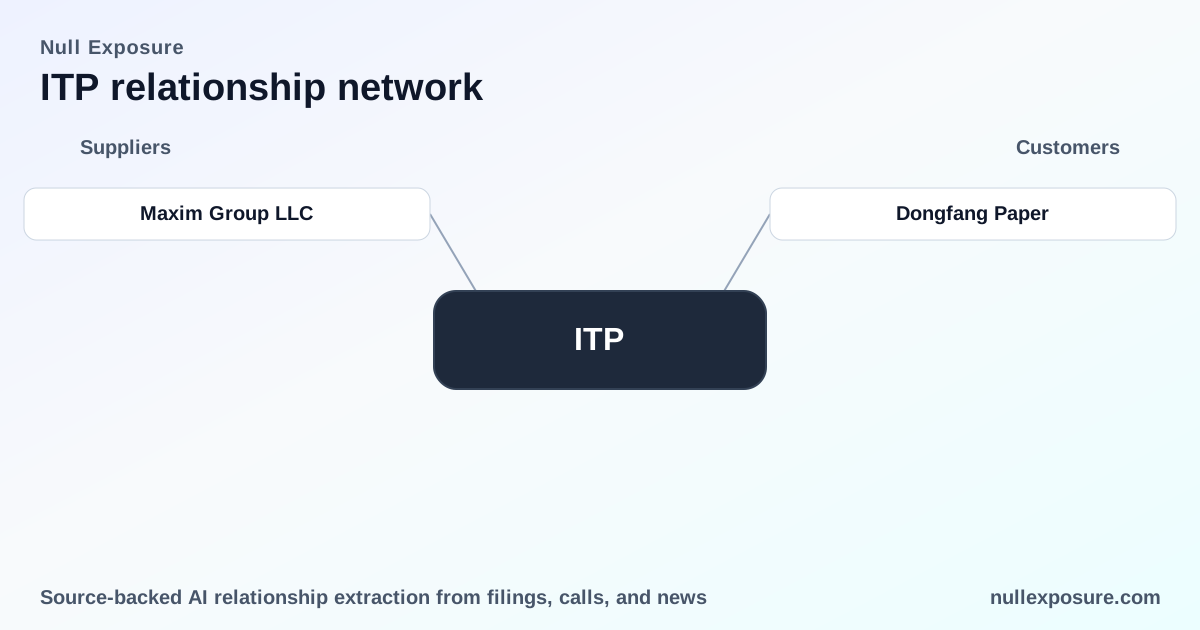
Dongfang Paper: a headline customer relationship
IT Tech Packaging’s external signal set includes a single, high-confidence news mention that Dongfang Paper accounted for 100% of reported sales in an FY2026 excerpt, equivalent to $10.90 million in that specific reporting instance. This point comes from a market data/news extraction source referencing ITP financials in March 2026. (Source: Intellectia financials capture, March 10, 2026 — https://intellectia.ai/en/stock/ITP/financials)
Although the company’s own filings for 2024 indicate a more diversified base of major customers, the Dongfang Paper mention is material for short-window revenue analyses and highlights how single-counterparty flows can dominate short-period disclosures. (Source: company filings for the year ended December 31, 2024 — excerpts in company disclosures.)
What the company-level signals tell investors about the operating model
IT Tech Packaging’s disclosure set generates several clear, company-level signals that affect credit and revenue risk. These are not tied to any named counterparty unless explicitly stated in an excerpt.
- Contracting posture — short-term, cash-sensitive: The company explicitly states it “usually collect[s] accounts receivable within 30 days of delivery,” establishing a short receivable cycle that improves cash turn but increases vulnerability to sudden demand shocks or logistics interruptions. (Source: company filing for year ended December 31, 2024.)
- Counterparty profile — mid-market corporate buyers: Management targets middle-market corporate customers for CMP and offset printing paper, implying the customer base skews toward domestic manufacturers and printers rather than multinational retailers. This positioning supports volume growth but concentrates credit risk in regional industrial segments. (Source: company filing for year ended December 31, 2024.)
- Geographic concentration — APAC, PRC focus: Sales are localized: customers are in Hebei and Shandong provinces and all sales are within the PRC. This tight geography reduces currency and cross-border execution risk but raises exposure to regional demand cycles and local policy shifts. (Source: company filing for year ended December 31, 2024.)
- Relationship lifecycle — active, production-driven: The company lists “10 major customers who individually accounted for more than 5% of total sales” for 2024, indicating active, repeat buyer relationships rather than transient one-off sales. (Source: company filing for year ended December 31, 2024.)
Product concentration and commercial criticality
IT Tech Packaging is effectively a single-product operator in practice: corrugating medium paper comprised ~100% of production volume and ~99.82% of revenue in the most recent annual disclosure, making CMP the business. That concentration drives both margin leverage and single-product risk; any ASP pressure or supply dislocation in CMP will directly translate into top-line and profitability swings. (Source: company filing for year ended December 31, 2024.)
The company’s go-to-market is straightforward: goods are considered delivered when the customer’s truck picks up inventory at ITP’s warehouse and revenue recognition follows delivery, placing the company in a seller-delivery posture with immediate recognition and quick pay expectations. (Source: company filing for year ended December 31, 2024.)
Reconciling materiality signals — concentration is nuanced
Two company-level excerpts present different facets of concentration that are complementary rather than contradictory:
- Management states that “no single customer contributed over 10% of total sales” for the stated period, indicating no outsized single-customer dominance across the full year. (Source: company filing for year ended December 31, 2024.)
- Separately, the company reports “Total Major Customers 48,236,923 63.59%,” which means a small roster of major customers collectively accounted for the majority of revenue (about 63.6%). (Source: company filing for year ended December 31, 2024.)
The combined signal is clear: the firm is materially concentrated among several large customers rather than a single single-customer dependency, and that multi-customer concentration constitutes the primary counterparty risk vector.
Financial context that shapes credit and operational decisions
From the financial snapshot available, ITP posts TTM revenue of ~$78.9M with negative EPS (-$0.87) and negative profit margin (-13.9%), while showing a low valuation multiple profile (EV/EBITDA ~1.19). Those metrics frame the customer and contract signals: short receivable days are essential to fund working capital in a negative-margin environment, and any deterioration among major buyers can rapidly compress liquidity. (Source: company financial summary; latest quarter 2025-09-30.)
Practical implications for investors and operators
- Operational priority: Maintain tight credit oversight and monitor days-sales-outstanding given the 30-day collection norm; any slippage will stress liquidity fast. (Source: company filing for year ended December 31, 2024.)
- Counterparty monitoring: Watch the payment behavior of the top 10 customers collectively — their aggregated ~63.6% revenue share is the primary concentration risk. (Source: company filing for year ended December 31, 2024.)
- Geographic risk management: Given the PRC regional concentration, incorporate local demand indicators (construction, manufacturing packaging demand in Hebei/Shandong) into short-term revenue forecasting. (Source: company filing for year ended December 31, 2024.)
- Product risk: Hedging or diversification strategies away from CMP would materially change the enterprise risk profile; currently, CMP drives nearly all volume and revenue. (Source: company filing for year ended December 31, 2024.)
For ongoing monitoring and a consolidated view of customer exposure across small-cap industrials, see Null Exposure’s research hub: https://nullexposure.com/.
Conclusion — where the risk-reward line sits
IT Tech Packaging is a regional, product-concentrated paper manufacturer operating on short payment cycles and heavy reliance on a set of major domestic customers. The one-off FY2026 mention that Dongfang Paper accounted for $10.9M underlines how quickly short-window disclosures can change perceived exposure, but the company’s filings show that concentration is more accurately expressed as a small group of large customers rather than a single counterparty. For investors, the principal trade-off is volume-driven scale and low valuation multiples versus concentrated revenue and margin pressure; for operators, the priority is liquidity management and customer credit discipline.