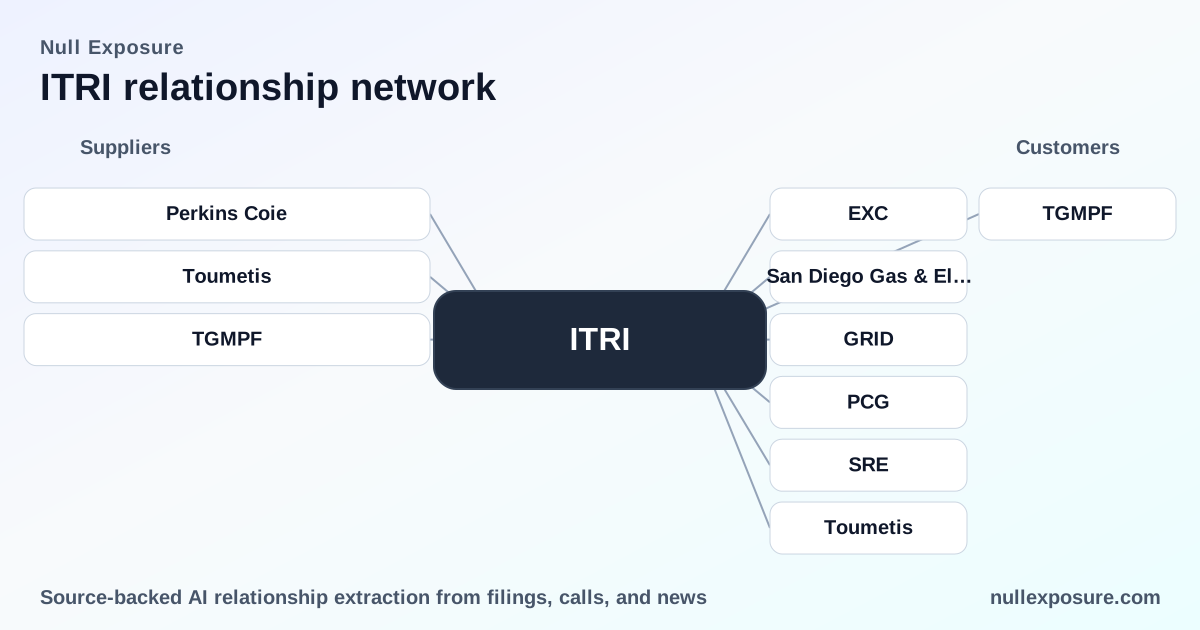
Itron (ITRI) — Customer relationships that convert hardware into recurring utility revenue
Itron sells measurement hardware, network infrastructure and analytics-driven services to utilities and municipalities, then monetizes through a mix of product sales, multi-year infrastructure contracts and subscription-like SaaS/NaaS offerings tied to grid operations. Its commercial model converts one-time device and network deployments into recurring Outcomes revenues and managed services, creating a pathway to higher-margin, software-led revenue over time. For an investor evaluating partner and customer exposure, the relationships documented in FY2026 demonstrate how Itron is executing that conversion in practice. Learn more about coverage and signals at https://nullexposure.com/.
How Itron’s commercial engine works in practice
Itron operates across three integrated segments—Device Solutions (hardware), Networked Solutions (infrastructure) and Outcomes (software and services)—and monetizes both at point-of-sale and as ongoing contracts. Key operational characteristics investors should weigh:
- Contract mix: Itron runs both short-term and long-term engagements; the company disclosed approximately $1.3 billion of remaining performance obligations in the next 12 months and ~$1.1 billion beyond 12 months, underlining meaningful near-term booked revenue alongside longer tails.
- Recurring orientation: The company explicitly offers managed services, SaaS and cloud-hosted software (NaaS), shifting revenue toward recurring streams that capture more lifetime value per customer.
- Counterparty and geography: Utilities and municipalities (including government customers) are core buyers; revenues are concentrated in North America with meaningful EMEA and APAC footprints, supporting a global go-to-market that balances regional concentration with international opportunity.
- Role and criticality: Itron functions both as a seller of devices and as a service provider for grid-management and analytics—contracts frequently bundle hardware, network, software and professional services, increasing switching costs for customers.
- Portfolio balance: Hardware sales remain important for Device Solutions, while Networked and Outcomes offerings are increasingly critical to the company’s margin and growth profile.
These signals point to a hybrid hardware-to-software transition: hardware drives deployments and near-term cash, while subscription and services capture recurring margin. For a deeper view of Itron’s positioning, visit https://nullexposure.com/.
FY2026 customer and partner mentions — deal-by-deal takeaways
Below are every relationship instance reported in the FY2026 results feed, presented as short, investor-focused summaries with source citations.
Ausgrid — supporting IntelliFLEX LV DERMS rollout (SimplyWallSt, May 3, 2026)
Itron expanded its Australia footprint by supporting Ausgrid’s rollout of the IntelliFLEX LV DERMS low-voltage distributed energy resource management platform, reinforcing Itron’s role in DER orchestration. According to SimplyWallSt coverage (May 3, 2026), the collaboration highlights Outcomes-led deployment in APAC.
Tantalus Systems Holding Inc. — extended ERT license (Newsfile, March 10, 2026)
Tantalus extended a license with Itron to support full ERT compatibility across its TRUConnect AMI platform, preserving interoperability between legacy ERT devices and modern AMI systems. The Newsfile press release (March 10, 2026) documents the license extension.
Pacific Gas and Electric Company (PCG) — expanded grid-edge deployments (Sahm Capital, Feb–Mar 2026)
Multiple reports note expanded deployments with PG&E targeting grid-edge AI and resilience tools, showing Itron’s traction with a major U.S. utility on wildfire mitigation and resilience. Sahm Capital commentary (Feb–Mar 2026) highlights these multi-project engagements.
PCG — expanded deployments (SimplyWallSt, March 10, 2026)
SimplyWallSt also cited expanded deployments with Pacific Gas & Electric, reinforcing that multiple outlets reported the same PG&E expansion in FY2026 (March 2026).
Pacific Gas and Electric Company — AI grid-edge deals and wildfire mitigation (Sahm Capital, Feb 4, 2026)
Sahm Capital detailed Itron’s string of AI-focused grid-edge deals, notably wildfire mitigation work in Southern California and expanded PG&E deployments, showing an outcomes-oriented sales motion (Feb 4, 2026).
Ausgrid — deeper NVIDIA collaboration cited (Sahm Capital, Mar 25 & Mar 28, 2026)
Itron not only supported Ausgrid’s DERMS rollout but also deepened AI collaborations with NVIDIA for real-time grid-edge monitoring and anomaly detection, per Sahm Capital coverage (Mar 25–28, 2026), underscoring a software acceleration theme.
Exelon — multiyear, multi-application expansion (TradingView/Zacks, Mar 10, 2026)
Itron reported a new multiyear, multi-application expansion with Exelon, representing a renewal and upsell of long-standing grid modernization work; TradingView’s earnings roundup cited this booking (Mar 10, 2026).
Tantalus / GRID — ERT license extension coverage (Finviz summary, Mar 10, 2026)
Finviz summarized the Tantalus announcement that extended the ERT license agreement with Itron, highlighting third-party compatibility moves that protect installed bases (Mar 10, 2026).
San Diego Gas & Electric (SDG&E) — EPIC wildfire mitigation collaboration (GlobeNewswire, Feb 3, 2026)
Itron and Toumetis teamed with SDG&E under the EPIC program to reduce wildfire risk and improve reliability, executing field projects that combine analytics and grid-edge monitoring. GlobeNewswire reported the collaboration on Feb 3, 2026.
San Diego Gas & Electric — wildfire mitigation mentioned in coverage (Sahm Capital, Feb 12, 2026)
Sahm Capital also referenced SDG&E’s role in Itron’s wildfire mitigation initiatives, reiterating the strategic importance of Southern California pilots (Feb 12, 2026).
PCG — expanded deployments noted again (Sahm Capital, Feb 12, 2026)
Sahm Capital’s Feb 12 piece repeated the PCG expansion narrative, emphasizing multiple utility engagements across Itron’s grid-edge story.
PCG-P-E — expanded partnership framing (StocksToTrade, May 3, 2026)
A StocksToTrade item characterized the expanded partnership with Itron as delivering safer and more cost-effective grid outcomes for PG&E, reiterating the commercial benefit message (May 3, 2026).
Duquesne Light Company — strategic grid visibility program (TradingView, May 3, 2026)
Itron reported progress on a strategic grid visibility program with Duquesne Light, a win that signals regional U.S. traction for Networked Solutions (TradingView, May 3, 2026).
Snowflake (SNOW) — grid planning built on Snowflake platform (InvestingNews, Mar 10, 2026)
Itron announced an advanced Grid Planning solution built on Snowflake, leveraging cloud data platforms to scale analytics and planning workflows; InvestingNews covered the integration (Mar 10, 2026).
PCG — expanded deployments (SimplyWallSt, Mar 10, 2026)
SimplyWallSt reiterated the PG&E expansion in another FY2026 mention (Mar 10, 2026).
PCG — duplicate mention (SimplyWallSt, Mar 10, 2026)
A second SimplyWallSt entry duplicated the PCG deployment note; the repetition across outlets underscores media attention to the relationship (Mar 10, 2026).
Ausgrid — IntelliFLEX LV DERMS support (SimplyWallSt AMP, May 3, 2026)
An additional SimplyWallSt AMP entry again documented Ausgrid support for IntelliFLEX LV DERMS, reinforcing the APAC deployment (May 3, 2026).
Exelon (EXC) — expansion described on earning call transcript (InsiderMonkey, Mar 10, 2026)
Earnings call transcripts cited on InsiderMonkey detail the expansion of a long-standing relationship with Exelon, confirming management commentary on the deal (Mar 10, 2026).
Exelon — duplicate earnings mention (InsiderMonkey, Mar 10, 2026)
InsiderMonkey’s duplicate listing reiterates the Exelon expansion announced in the quarter (Mar 10, 2026).
Toumetis — wildfire mitigation partner in Southern California (Sahm Capital & SimplyWallSt, Feb–Mar 2026)
Toumetis is a named partner in wildfire mitigation pilots with Itron in Southern California, signaling Itron’s approach to partnering with regional software firms for outcomes work (Sahm Capital & SimplyWallSt, Feb–Mar 2026).
Toumetis — repeated mention in Sahm Capital (Feb 12, 2026)
A second Sahm Capital mention again ties Toumetis to Itron’s wildfire and resilience projects in FY2026.
Toumetis — SimplyWallSt note on wildfire mitigation (Mar 10, 2026)
SimplyWallSt referenced the Toumetis partnership in its coverage of Itron’s AI grid-edge deals (Mar 10, 2026).
TGMPF / Tantalus — headline in Finviz summary (Mar 10, 2026)
Finviz’s news summary listed the Tantalus ERT license extension, reinforcing the licensing and compatibility narrative for legacy AMI technology (Mar 10, 2026).
Investment implications and risk framing
- Revenue durability: The disclosed remaining performance obligations and explicit subscription/SaaS positioning indicate a deliberate move to increase recurring revenue; this reduces revenue cyclicality from pure hardware cycles.
- Concentration and criticality: Large utility relationships (PG&E, Exelon, SDG&E) are material for bookings and validation of Outcomes products; loss or slowdown in these accounts would bend near-term bookings materially.
- Contract posture: Contracts contain a mix of short- and long-term obligations and bundled deliverables, increasing implementation risk but improving lifetime value when deployments scale.
- Geographic balance: North America is the revenue engine, with EMEA and APAC contributing scale—regional deployment profiles affect growth cadence and FX/execution risk.
For investors tracking utility modernization exposure, these FY2026 relationships demonstrate Itron’s execution on a software-enabled grid strategy while preserving a hardware install base. For ongoing deal flow and signals on counterparties, see full coverage at https://nullexposure.com/.