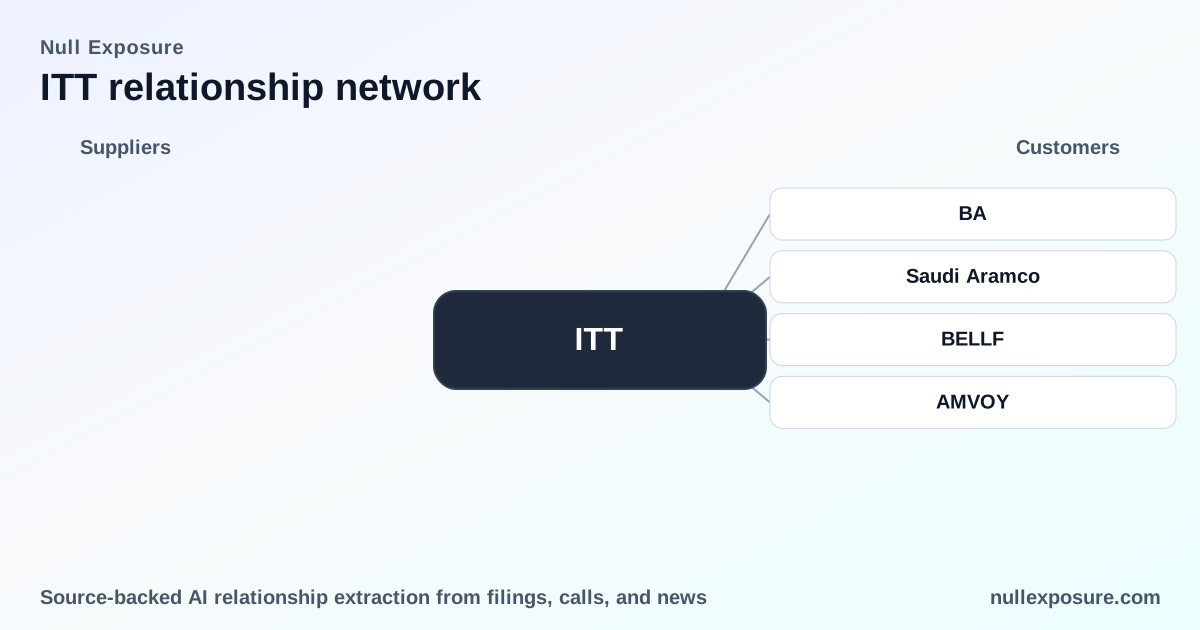
ITT’s customer map: revenue anchors, concentration signals, and what management just confirmed
Thesis — ITT monetizes a portfolio of engineered components and custom technology solutions by selling products and complementary services into energy, transportation and industrial end markets, combining product sales, distributor channels and long‑term design/build contracts to capture higher-margin, mission‑critical work. With roughly $3.94 billion of trailing revenue and an operating margin near 19%, ITT’s commercial strategy blends steady recurring sales through distributors with selective long‑term contracts that lock in engineering margins and aftermarket streams. For a concise view of the full feed behind this note, visit https://nullexposure.com/.
How to read ITT’s customer relationships as an investor
Investors should evaluate ITT’s customers through three operating-model lenses: contracting posture, channel concentration, and end‑market criticality.
- Contracting posture: ITT records revenue both on a spot basis for shipped products and under the percentage‑of‑completion method for highly customized long‑term projects, indicating dual revenue streams — transactional sales that drive volume and multi‑year engineered contracts that drive margin and predictability (company 10‑K disclosures).
- Channel structure and concentration: Distributors are an important route to market — roughly one‑third of the Industrial Products segment and about 20% of CCT flowed through distributors in 2025 — signaling reliance on intermediary relationships for end‑user reach rather than purely OEM direct sales.
- Geographic footprint and criticality: Revenue is generated globally, with foreign‑exchange hedging practices called out in filings, and ITT serves strategic customers in aerospace and energy where components and systems are mission‑critical rather than commodityized.
These are company‑level signals drawn from ITT’s disclosures and the recent earnings commentary; they explain why a mix of long‑term contracts and spot product sales coexist in the revenue base and why customer concentration is worth monitoring.
Relationship feed — every reported entry from the results
Below are the specific customer mentions pulled from the feed. Each entry is treated as reported; duplicates from different sources are preserved to reflect how the relationship was surfaced.
-
Boeing (BA) — In Q4 commentary, management confirmed renewal of a multiyear contract to support aerospace controls for Boeing’s growth plans, signaling ongoing aerospace program exposure and a locked‑in aerospace revenue stream. (InsiderMonkey earnings call transcript, Mar 10, 2026: https://www.insidermonkey.com/blog/itt-inc-nyseitt-q4-2025-earnings-call-transcript-1690217/)
-
BA (duplicate feed entry) — The same Q4 earnings call transcript reiterated the multiyear aerospace controls renewal with Boeing, reinforcing the point that Boeing continues to be a program customer rather than one‑off spot business. (InsiderMonkey, Mar 10, 2026: https://www.insidermonkey.com/blog/itt-inc-nyseitt-q4-2025-earnings-call-transcript-1690217/)
-
Saudi Aramco — Management noted positive feedback from Saudi Aramco during facility expansion activity in Saudi Arabia and described customer sentiment that 2026 investment activity would be stronger than 2025, underlining ITT’s energy market exposure and relevance to large upstream/OEM projects. (InsiderMonkey earnings call transcript, Mar 10, 2026: https://www.insidermonkey.com/blog/itt-inc-nyseitt-q4-2025-earnings-call-transcript-1690217/)
-
Bell (BELLF) — ITT disclosed selection by Bell for the development of a FLARA energy absorption system, indicating participation in aircraft/rotorcraft subsystem development and incremental program work in the U.S. defense/aerospace supply chain. (InsiderMonkey earnings call transcript, Mar 10, 2026: https://www.insidermonkey.com/blog/itt-inc-nyseitt-q4-2025-earnings-call-transcript-1690217/)
-
BELLF (duplicate feed entry) — The duplication corroborates the Bell award reference in the same earnings transcript, showing the message was repeated in the feed capture. (InsiderMonkey, Mar 10, 2026: https://www.insidermonkey.com/blog/itt-inc-nyseitt-q4-2025-earnings-call-transcript-1690217/)
-
Aumovio SE (AMVOY) — TradingView’s coverage of ITT’s 10‑K called out customer dependence on Aumovio SE, which represented approximately 6% of total revenue, identifying Aumovio as ITT’s largest single customer in the automotive supply channel for 2025. (TradingView summary of ITT 10‑K, Mar 10, 2026: https://www.tradingview.com/news/tradingview:d76b196fb7949:0-itt-inc-sec-10-k-report/)
-
Aumovio SE (10‑K disclosure) — ITT’s Form 10‑K for the year ended Dec 31, 2025 explicitly states that sales to Aumovio SE were approximately 6% of total revenue in 2025, making this a material single‑customer relationship disclosed in regulatory filings. (ITT Form 10‑K, fiscal 2025)
-
AMVOY (TradingView duplicate) — The trading coverage repeated the 6% customer concentration observation, reflecting how sell‑side and market aggregators treated the 10‑K disclosure in commentary. (TradingView, Mar 10, 2026: https://www.tradingview.com/news/tradingview:d76b196fb7949:0-itt-inc-sec-10-k-report/)
-
AMVOY (10‑K duplicate) — The 10‑K entry appears again in the feed extract, underscoring that the Aumovio disclosure is present in the formal filing and cited by multiple downstream sources. (ITT Form 10‑K, fiscal 2025)
What these relationships mean for returns and risk
- Concentration risk is real but bounded. Aumovio’s ~6% share of revenue is material enough to require monitoring; it is not a majority risk but it is the single largest customer disclosure and increases sensitivity to automotive cycle dynamics (ITT 10‑K, 2025).
- Aerospace exposure is contractual and programmatic. Multiyear renewals with Boeing and program awards with Bell point to multi‑year engineering backlogs and aftermarket potential, supporting the company’s above‑industry operating margins.
- Energy engagement is strategic. Management’s on‑the‑ground discussions with Saudi Aramco and facility expansion in Saudi Arabia indicate positioning for higher capex cycles in energy markets and cross‑border execution capability.
- Channel structure offsets some direct concentration. Distributor sales — a meaningful share of IP and CCT segment revenue — provide diversification of end customers but also introduce margin pressure and distributor credit/volume risk as second‑order effects.
- Mix matters for cash conversion. The coexistence of spot product shipments and long‑term cost‑to‑cost contracts means free‑cash‑flow volatility will depend on the timing of project milestones and working‑capital swings associated with global deliveries.
Bottom line for investors
ITT combines stable distributor‑fed product sales with selective, higher‑margin long‑term engineering contracts in aerospace and energy. The company’s fiscal disclosures and recent earnings commentary confirm active program wins (Boeing, Bell), material energy customer engagement (Saudi Aramco), and a single disclosed largest customer (Aumovio ~6% of revenue). That mix creates an attractive margin profile with identifiable concentration and working‑capital risks that analyst models should stress‑test. For further analysis and continuous tracking of customer relationship signals, visit https://nullexposure.com/.
Key takeaway: investors should underwrite ITT’s margin durability against both program execution in aerospace/energy and the revenue concentration represented by its largest disclosed customer.