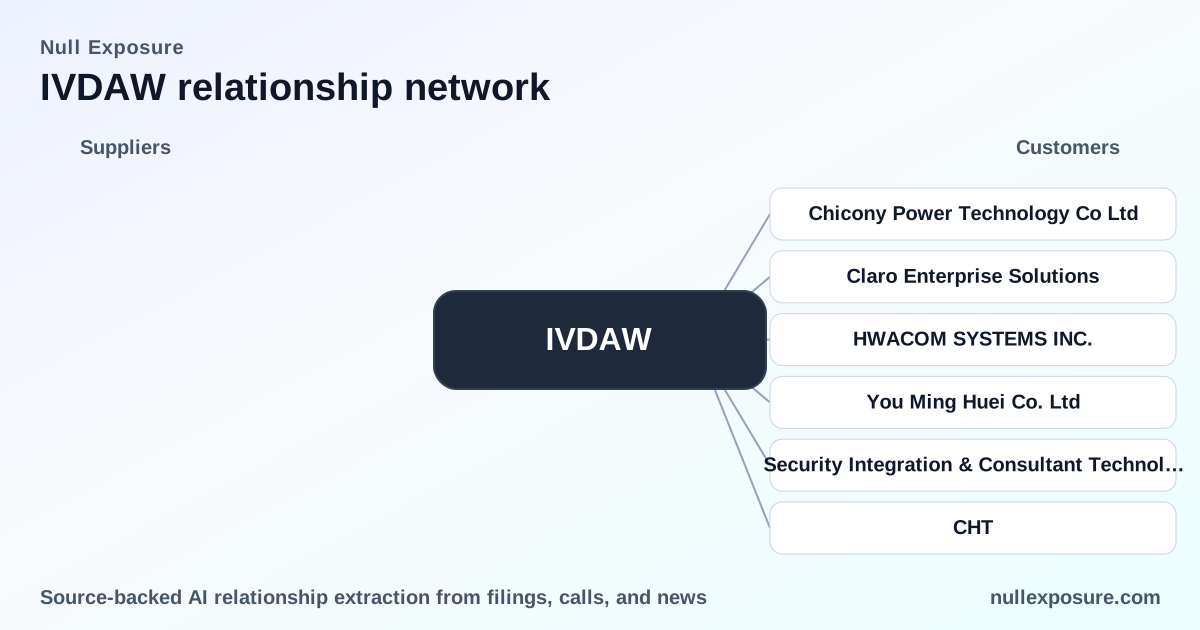
Iveda Solutions (IVDAW) — customer map, concentration and commercial posture
Iveda Solutions sells cloud-enabled video surveillance, analytics and related IoT systems to municipalities, commercial customers and integrators; it monetizes through hardware sales, software licensing and recurring subscription or maintenance fees, with a material portion of revenue booked from a small set of large customers. For investors and operators, the essential thesis is straightforward: revenues are concentrated, largely APAC‑driven, and a handful of long‑standing customers account for the majority of cashflow — which creates both margin leverage and concentrated counterparty risk. For a quick operational vendor intelligence view visit https://nullexposure.com/.
What the customer disclosures mean for value and risk
Iveda reported $5.28M in trailing‑twelve‑month revenue and a gross profit of $1.27M, while operating and net margins are negative, reflecting the company’s ongoing investment and small scale. The FY2024 10‑K discloses that five customers accounted for roughly 67% of revenue, an explicit concentration that turns customer renewals into a core driver of near‑term financial outcomes. The company’s commercial model combines:
- Licensing and subscription revenues: certain software products are licensed per device with monthly subscription requirements for cloud AI access, and maintenance is sold on an annual basis. (FY2024 10‑K)
- Project and hardware sales: a large share of sales arises from project work and hardware deployments, particularly through Iveda Taiwan. (FY2024 10‑K)
- Government and municipal customers: the customer mix includes government contracts and Safe City projects, increasing contract size and procurement complexity. (FY2024 10‑K)
These signals produce clear operating constraints: high customer concentration, APAC revenue concentration (Iveda Taiwan ~85% of revenue in 2024), a mix of one‑off hardware projects and recurring software/subscription income, and mature, long‑standing customer relationships that are described as collectible. These are company‑level characteristics drawn from the filing and should guide underwriting, pricing and retention strategies.
Line‑by‑line: every named customer in the filing
Below are the customer entries pulled directly from the FY2024 Form 10‑K; each item includes a concise plain‑English note and the filing reference.
YOU MING HUEI CO. LTD
Iveda’s filing lists YOU MING HUEI CO. LTD as accounting for 25% of revenue in FY2024, making it the single largest customer by percentage. This customer is presented as a major contributor to consolidated revenue in the FY2024 10‑K.
Source: FY2024 Form 10‑K (Iveda Solutions — customer concentration disclosure).
You Ming Huei Co. Ltd
The filing repeats the You Ming Huei name in a separate entry showing the same 25% figure, confirming the company’s prominence in Iveda’s customer roster. The duplicate appearance in the 10‑K underscores the single‑customer impact on financials.
Source: FY2024 Form 10‑K.
Chicony Power Technology Co Ltd (23%)
Chicony Power Technology is listed in the 10‑K as representing 23% of revenue in one disclosure line, indicating a substantial commercial relationship with Iveda. The name appears multiple times across the customer list.
Source: FY2024 Form 10‑K.
Chicony Power Technology Co Ltd (11%)
The same Chicony name also appears again with an 11% attribution in the filing, suggesting either multiple contract lines or different product/program allocations tied to the same counterparty. The 10‑K records both figures in the customer schedule.
Source: FY2024 Form 10‑K.
CHT
The filing identifies CHT (Chunghwa Telecom) as accounting for 18% of Iveda’s revenue in FY2024; Chunghwa Telecom is a significant telecom customer and channel for Smart City and surveillance deployments.
Source: FY2024 Form 10‑K.
Chunghwa Telecom
Chunghwa Telecom is also listed separately under its full name with the same 18% share in the customer list, reinforcing its standing as a top counterparty in the FY2024 disclosure.
Source: FY2024 Form 10‑K.
Security Integration & Consultant Technology Co., Ltd.
Security Integration & Consultant Technology Co., Ltd. is reported as representing 16% of revenue in FY2024, a material account in the top five customers that contributes to the company’s concentrated revenue mix.
Source: FY2024 Form 10‑K.
SECURITY INTEGRATION & CONSULTANT TECHNOLOGY CO., LTD.
The filing contains a second entry with identical capitalization and the same 16% figure; the repetition confirms inclusion in the top customer cohort disclosed for FY2024.
Source: FY2024 Form 10‑K.
Claro Enterprise Solutions
The FY2024 10‑K shows Claro Enterprise Solutions (U.S.) at 12% of revenue, reflecting Iveda’s commercial reach into enterprise telecom/solution providers outside Taiwan and the presence of cross‑border customers on the roster.
Source: FY2024 Form 10‑K.
HWACOM SYSTEMS INC.
HWACOM SYSTEMS INC. appears in the FY2024 customer list at 10% of revenue, completing the set of large counterparties that together represent approximately two‑thirds of total revenue for the year.
Source: FY2024 Form 10‑K.
How the relationships shape underwriting and operational priorities
The firm’s disclosures create a clear operational playbook for investors and operators:
- Concentration as a lever and a risk: with five customers producing ~67% of revenue, contract renewals and payment performance at those accounts are the dominant earnings levers. Pricing, retention incentives, and warranty/maintenance terms need active management.
- Contracting posture — mix of licensing and subscription plus project sales: product monetization blends one‑time hardware revenues with recurring licensing/subscription and annual maintenance, which affects revenue visibility and cash conversion cycles. The 10‑K specifically references device licensing with monthly cloud access and annual maintenance fee treatment.
- Geographic and counterparty concentration: Iveda Taiwan accounted for the majority of revenue in 2024 (~85%), and government/municipal customers form a meaningful portion of the buyer base, increasing procurement and payment‑cycle complexity.
- Maturity and collectability: major customers are described as longtime customers and collectible, indicating stable contractual relationships rather than early‑stage commercial experiments.
Practical monitoring checklist for investors and operators
- Track renewal dates, contract terms, and deferred revenue roll‑off for the top five customers.
- Monitor APAC/Taiwan revenue share and any sales diversification outside Taiwan.
- Separate hardware‑project timing from recurring SaaS/licensing flows to model cash conversion and margin expansion.
- Validate counterparty payment performance and procurement dependencies (government vs commercial).
Bottom line
Iveda’s business is high‑variance but structurally coherent: concentrated top customers provide scale for software monetization, while APAC project sales and hardware deliveries compress margins and heighten counterparty risk. For active investors and operators the focus should be on contract renewal cadence, diversification of revenue geography and expansion of recurring licensing income to improve margins. For further operational and counterparty intelligence, see https://nullexposure.com/.
Sources: Iveda Solutions Inc., FY2024 Form 10‑K (customer concentration and contract disclosures); company financials summarized from the Iveda investor filing (trailing‑twelve‑month revenue, gross profit, and margin metrics).