Invesco Mortgage Capital (IVR): Where the GSEs Sit in the Capital Stack
Invesco Mortgage Capital operates as a mortgage REIT that acquires, finances and manages mortgage-backed securities and related assets, monetizing through net interest income, leverage and dividend distributions to shareholders. The company funds asset purchases with capital markets activity—equity and preferred offerings—and relies on demand from large institutional buyers to rotate or hold mortgage securities. For investors, IVR’s economic performance is tightly linked to mortgage spread dynamics, funding liquidity and the buying behavior of government-sponsored enterprises. Learn more about our coverage at https://nullexposure.com/.
How IVR’s commercial model translates into revenue
IVR buys mortgage assets and generates recurring income primarily via net interest margin and duration management. The firm amplifies returns with financial leverage and periodically uses equity raises to acquire target assets, an operating pattern management disclosed in its corporate materials. That posture makes IVR fundamentally a capital-markets-driven vehicle: asset returns are amplified by funding conditions, and distributions to equity holders are a direct function of spread capture and financing cost. Concentration of funding sources and buyer demand therefore materially influences earnings and book value trajectory.
A company-level constraint worth noting
The company-level signal in filings states that IVR has actively used net proceeds from common and preferred stock offerings to purchase targeted assets. This disclosure implies a contracting posture that is opportunistic and market-dependent—IVR is comfortable accessing public equity when conditions allow and deploying proceeds into mortgage assets. This characteristic signals higher sensitivity to capital market windows, investor appetite and execution risk around equity raises, which investors should treat as a core operating constraint rather than an isolated statistic.
The GSE relationships that matter to IVR
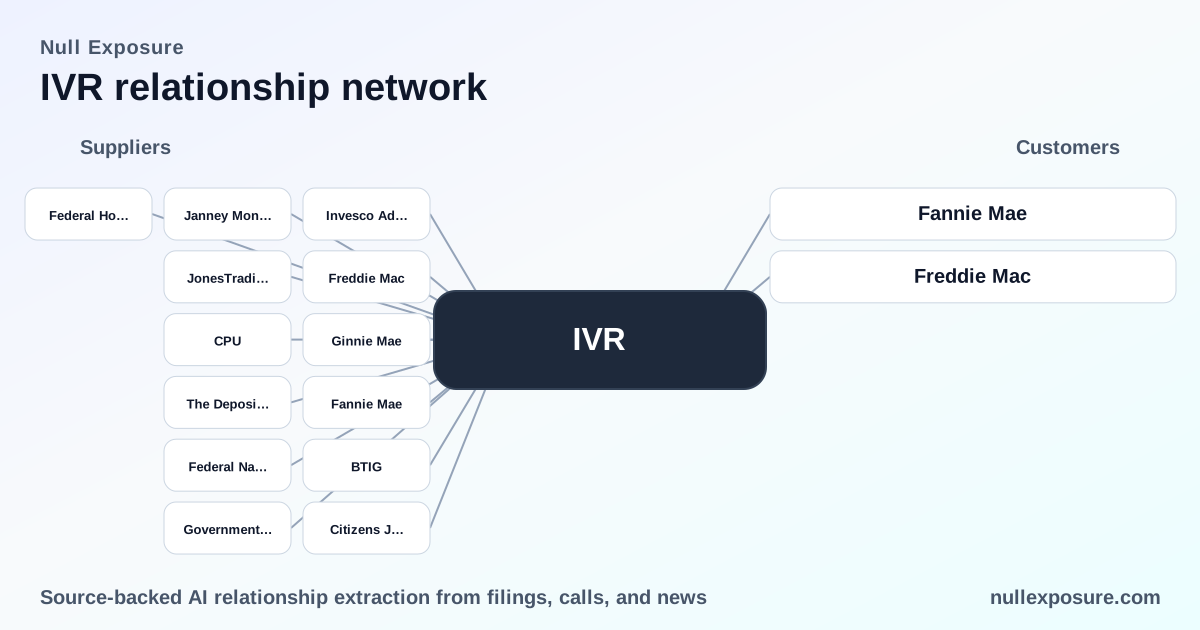
IVR’s public commentary and earnings transcripts consistently identify Fannie Mae and Freddie Mac as meaningful buyers of mortgage securities and as backstops in periods of elevated supply-demand imbalances. Below I summarize each counterparty relationship reported in analyst and press coverage.
Fannie Mae — a reliable buyer and occasional market backstop
Management has explicitly attributed part of the demand supporting IVR’s MBS positions to Fannie Mae’s investment activity. In March and in subsequent Q4 commentary, IVR executives said Fannie Mae stepped in as a buyer and provided liquidity support—management noted an $18 billion add by Fannie Mae in March during an earnings call—underscoring Fannie Mae’s role as a stabilizer for MBS demand. Source: InsiderMonkey earnings-call transcript excerpts (Q1/Q4 2026 commentary, March–May 2026) and Investing.com coverage (May 2026).
Freddie Mac — parallel demand driver alongside Fannie Mae
Freddie Mac is repeatedly cited alongside Fannie Mae as a material source of demand for mortgage securities that IVR holds or sells. IVR’s public remarks and earnings slides describe increased portfolio demand from Freddie Mac, which reduced asset sales pressure and supported IVR’s book value recovery in recent periods. Source: Investing.com earnings coverage and InsiderMonkey transcript excerpts covering IVR’s FY2026 commentary (March–May 2026).
What these GSE ties imply for investors
- Demand Concentration: The prominence of Fannie Mae and Freddie Mac as buyers creates meaningful demand concentration. That concentration is positive when GSEs are active, but it compresses IVR’s diversification of exit liquidity.
- Cyclicality & Criticality: GSE activity is cyclical and policy-dependent, so IVR’s earnings are critically linked to macro policy and GSE investment programs rather than purely to private institutional flows.
- Execution Sensitivity: Because IVR uses capital markets to fund asset purchases, a mismatch between equity issuance windows and GSE buying behavior can amplify volatility in book value and distributions.
How the public evidence supports these points
Public reporting and press coverage across Q4 2025 and Q1 2026 repeatedly reference GSE demand as a driver of IVR’s recent book value and dividend performance. An Investing.com earnings recap published in May 2026 highlights management’s view that “continued strong demand, particularly from government-sponsored enterprises like Fannie Mae and Freddie Mac,” underpinned results. Separately, earnings-call transcripts captured by InsiderMonkey in March 2026 recorded management remarks that Fannie Mae acted as a backstop with large purchases in March, illustrating the operational reality on the trading desk. These are direct management statements, not analyst conjecture, and thus should be incorporated into any investment assessment of IVR’s forward prospects.
Investment implications and risks for shareholders
IVR’s risk-reward profile is concentrated along three axes:
- Market access risk: IVR’s strategy of using equity proceeds to buy assets makes it dependent on favorable capital market conditions; equity issuance windows therefore function as operational levers rather than ancillary activities (company filings, corporate disclosures).
- Counterparty demand risk: Heavy reliance on Fannie Mae and Freddie Mac as predictable buyers means policy shifts or reduced GSE investment activity will quickly change IVR’s liquidity dynamics.
- Interest-rate and spread sensitivity: As a mortgage REIT, IVR’s earnings and book value are highly sensitive to interest rate volatility and mortgage spread movements; recent commentary ties improved outcomes to declining rate volatility and inflows into fixed income (InsiderMonkey Q4 2025 transcript).
Bold takeaway: IVR’s short-term performance is more a function of buyer behavior and capital markets access than of pure credit performance on the underlying mortgages.
Where investors should look next
- Monitor GSE investment programs and public statements from Fannie Mae and Freddie Mac for shifts in portfolio buying.
- Watch IVR’s equity issuance cadence and wording around capital deployment in quarterly filings and earnings calls; these are direct signals of the firm’s intended growth trajectory.
- Track interest-rate volatility and spread compression events, which historically correlate with IVR’s book-value moves.
If you want regular, structured coverage that links counterparty flow signals to single-name REIT positioning, visit our homepage: https://nullexposure.com/.
Bottom line
IVR is a capital-markets-driven mortgage REIT that profits by buying mortgage securities and managing funding and leverage, with Fannie Mae and Freddie Mac acting as important demand anchors in recent periods. The company’s disclosure that it uses equity proceeds to acquire target assets is a company-level operating constraint: it elevates sensitivity to public markets and buyer behavior. For investors, the central question is whether GSE demand remains consistent enough to underwrite IVR’s strategy in less favorable funding environments.
For ongoing intelligence on counterparty flows and how they translate into security-level risk for mortgage REITs, see our research hub at https://nullexposure.com/.