Invesco (IVZ): client relationships that drive fee-bearing assets and distribution
Invesco operates as an independent global investment manager that monetizes through management and advisory fees, ETF sponsorship, sub-advisory mandates and external management agreements. Its revenue base is concentrated in investment management services delivered to a mix of retail and institutional clients, with distribution and sub-advisory arrangements that translate product design and portfolio management into recurring fees.
How these relationships map to Invesco’s operating model
Invesco’s commercial posture is defined by a few structural signals that shape revenue durability and execution risk. Investment management contracts are often short-term and terminable on relatively brief notice, which increases investor sensitivity to asset outflows and distribution effectiveness (company disclosures, FY2024–FY2025). At the same time, the firm services a diverse client universe — individuals, large enterprises, non-profits and government bodies — across North America, EMEA and APAC, supporting a truly global footprint (company filings). The firm’s single operating segment is investment management; Invesco therefore functions primarily as a service provider whose performance depends on AUM retention, product relevance and distribution partnerships.
- Key operational implications: short contract notice periods increase churn risk; global distribution breadth reduces single-market concentration; outsourced/external management relationships (where Invesco is paid to manage another entity’s assets) create margin-bearing revenue that is sensitive to asset mix and flows.
If you want a consolidated view of Invesco’s client exposures and partner dynamics, visit the NullExposure homepage for the dataset and analytical tools: https://nullexposure.com/
Relationships reported in news and filings — line by line
Below are all relationships extracted from public news and filing sources. Each entry is a concise, plain-English summary with the original reporting cited.
CI (InsiderMonkey — Q1 2026 earnings call transcript)
Invesco is actively executing and expanding a sub‑advisory relationship with CI, signaling ongoing collaboration on delegated portfolio management responsibilities. Source: InsiderMonkey transcript of Invesco’s Q1 2026 earnings call (reported May 3, 2026).
CI Global Asset Management (CI GAM) (TradingView / Yahoo Singapore — May 2026 reporting on January 2026 deal)
In January 2026 CI GAM agreed to acquire the management agreements for Invesco’s Canadian fund business (about C$26 billion), while Invesco will continue to provide sub‑advisory portfolio management on 63 funds covering roughly C$13 billion — a transaction that converts some direct management revenue into longer-term sub‑advisory fees. Source: TradingView coverage of the CI GAM transaction and Yahoo Singapore summary (reported May 2026, referencing Jan 2026 agreement).
Bank of America Corp (DefenseWorld — March 2026)
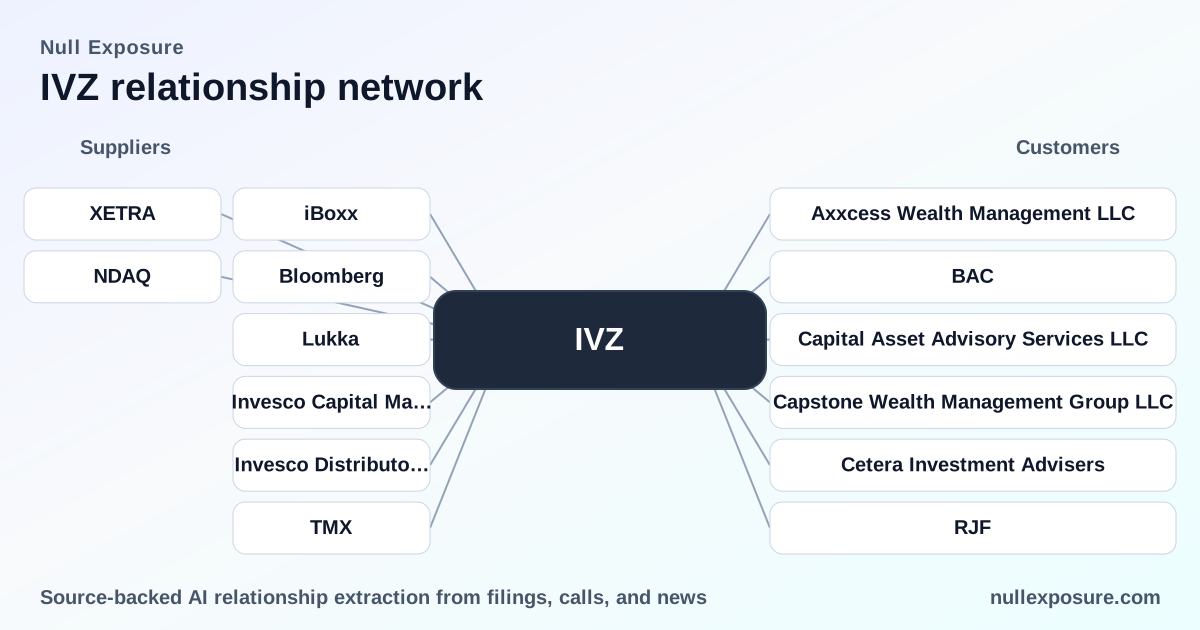
Bank of America increased its holdings in the Invesco Ultra Short Duration ETF (GSY) by 35.3% in the second quarter, reflecting distributor or institutional positioning in Invesco’s short-duration product line. Source: DefenseWorld article referencing 13F/holdings activity (published March 3, 2026).
Bank of America Corp DE (DefenseWorld — March 2026)
A separate reporting entry reiterates that Bank of America Corp DE materially expanded its GSY ETF position in Q2, underlining multi‑channel distribution and institutional client interest in Invesco’s cash-management ETF. Source: DefenseWorld (March 3, 2026).
Capital Asset Advisory Services LLC (DefenseWorld — March 2026)
Capital Asset Advisory Services lifted its position in the Invesco Ultra Short Duration ETF by 3.6% in the third quarter, indicative of advisor-level reallocations into Invesco’s fixed‑income ETF suite. Source: DefenseWorld (March 3, 2026).
Corebridge Financial (CRBG) — product partnership (401kSpecialistMag — March 2026)
Invesco designed the Invesco New Economy Index as a tailored solution for Corebridge Financial, combining Invesco’s capabilities into a bespoke investment offering for an insurance/annuity partner. Source: 401kSpecialistMag interview with Invesco’s client solutions lead (reported March 9, 2026).
Corebridge Financial (CRBG) — additional reporting (401kSpecialistMag AMP — May 2026)
The firm reiterated that Invesco brought two high‑demand investment capabilities together for Corebridge, underscoring product innovation and white‑label index licensing as revenue channels. Source: 401kSpecialistMag (May 2–3, 2026 coverage).
Corebridge Financial (lifehealth.com — March 2026)
Invesco’s New Economy Index dynamically allocates between Invesco QQQ ETF (QQQ) and Invesco Galaxy Bitcoin ETF (BTCO) for Corebridge products, demonstrating how Invesco packages existing ETFs into bespoke solutions for institutional clients. Source: lifehealth.com (March 9, 2026).
Cetera Investment Advisers (DefenseWorld — March 2026)
Cetera increased its weight in the GSY ultra-short ETF by 5.5% in Q2, showing continued advisor channel demand for Invesco cash and short-duration products. Source: DefenseWorld (March 3, 2026).
Raymond James Financial Inc. (DefenseWorld — March 2026)
Raymond James raised its position in the Invesco ultra-short ETF by 16.7% in the second quarter, another distribution partner increasing exposure to Invesco’s ETF inventory. Source: DefenseWorld (March 3, 2026).
Capstone Wealth Management Group LLC (DefenseWorld / SEC filings — March 2026)
Capstone initiated a new position in the Invesco Ultra Short Duration ETF during the third quarter, as reported in a Form 13F filing — an indicator of adviser appetite among smaller wealth managers for the product. Source: DefenseWorld summary of 13F filings (March 3, 2026).
Axxcess Wealth Management LLC (DefenseWorld — March 2026)
Axxcess incrementally increased its stake in the GSY ETF by 2.7% in Q3, reflecting a broad set of wealth managers modestly scaling allocations to Invesco’s short-duration strategy. Source: DefenseWorld (March 3, 2026).
Invesco Mortgage Capital Inc (IVR) — external management (InsiderMonkey — Q1 2026 call)
Management transitions at Invesco Mortgage Capital highlight the benefits of its external manager relationship with Invesco, with the manager’s resources and bench supporting portfolio management. Source: InsiderMonkey transcript of IVR’s Q1 2026 earnings call (May 3, 2026).
Invesco Mortgage Capital Inc (IVR) — external manager note (Investing.com — FY2025)
Investing.com reported that Invesco Mortgage Capital is externally managed by Invesco Advisers, Inc., a subsidiary of Invesco Ltd., directly tying IVR’s operating model to Invesco’s fee‑generating advisory business. Source: Investing.com company news (reported May 2026, referencing FY2025 disclosures).
What investors should take away
- Distribution partnerships matter. Multiple wealth managers and broker-dealers (Bank of America, Raymond James, Cetera, Capstone, Axxcess) are increasing allocations to Invesco’s short-duration ETF, which supports fee revenue and product credibility.
- Sub‑advisory and external management smooth revenue but create dependency. The CI GAM deal converts direct Canadian management relationships into sub‑advisory mandates worth roughly C$13 billion of managed assets for Invesco, preserving fee income but shifting contract economics.
- Contracts are short and relationships are global. Short termination windows mean AUM flows translate quickly into revenue volatility; however, a globally diversified client base reduces single-market exposure.
- Product innovation is a commercial lever. The Corebridge index example demonstrates Invesco’s ability to package ETF building blocks into bespoke solutions, enhancing margins through licensing and index services.
For a centralized analytics view of these partner linkages and their historic impact on flows, check our platform: https://nullexposure.com/
In sum, Invesco’s commercial profile is built on fee-bearing portfolio management, ETF distribution and bespoke sub‑advisory relationships. These dynamics provide recurring revenue but keep the company exposed to distribution cycles and the short-term termination characteristics of investment management contracts — factors investors must monitor alongside AUM trends and product adoption.