Janus Henderson’s DeFi Pivot: Customer Relationships That Reframe an Asset Manager
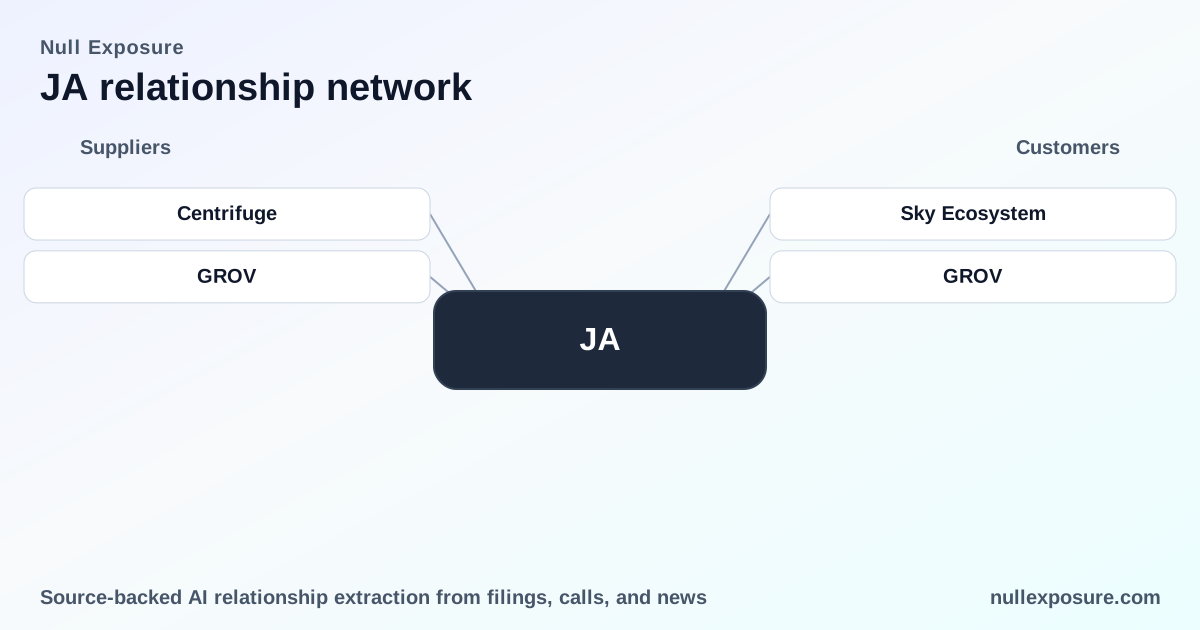
Janus Henderson operates as a traditional asset manager that earns management and performance fees on pooled credit strategies, and it has begun monetizing a new distribution channel by tokenizing a AAA CLO strategy (JAAA) for on-chain investors. The firm’s recent customer relationships with crypto-native counterparties create new fee capture and capital-raising pathways, but they also concentrate counterparty and operational risk into a nascent, fast-moving part of the market. For background on how we track these linkages, visit https://nullexposure.com/.
Why the JAAA initiative matters for investors
Janus Henderson’s move to tokenize an AAA CLO is a strategic broadening of its addressable investor base: traditional fee revenue meets crypto liquidity and programmable distribution. Tokenization can accelerate inflows and enable secondary trading of interests that were previously held in slower, institutional wrappers, increasing assets under management and potential ancillary fee streams for distribution and servicing.
At the same time, this operating change shifts some of the company’s contracting posture from solely institutional bilateral arrangements to complex, protocol-mediated counterparties that demand specialized custody, legal constructs, and compliance capabilities — a structural change to the business that investors must price into growth and risk projections.
Counterparty inventory: the customer relationships you need to know
Sky Ecosystem (formerly MakerDAO)
Sky Ecosystem provided a capital allocation into Janus Henderson’s tokenized JAAA position using Grove’s protocol, representing a sizable crypto-native capital inflow into the manager’s on-chain CLO product. According to Alternatives Watch (June 25, 2025), the allocation was routed from Sky into JAAA via Grove’s mechanism: https://www.alternativeswatch.com/2025/06/25/new-defi-protocol-grove-provides-1bn-inflows-for-janus-henderson-onchain/.
Centrifuge (CFG)
Centrifuge launched a deJAAA token that acts as a wrapper for Janus Henderson’s AAA CLO fund and is already trading on several crypto exchanges and venues, expanding secondary market access for the strategy. The Defiant reported that Centrifuge’s deJAAA is live on Aerodrome, Coinbase and others, with cross-chain plans noted (May 3, 2026): https://thedefiant.io/news/research-and-opinion/tokenized-assets-shift-from-wrappers-to-building-blocks-in-defi.
GROV (protocol ticker)
GROV — the token/ticker associated with the Grove credit infrastructure protocol — is linked to the launch that facilitated a large allocation into JAAA, underscoring Grove’s role as the technical pipeline for the transaction. Blockworks covered Grove’s announcement and the $1 billion allocation from Sky into the tokenized Janus Henderson CLO strategy (March 10, 2026): https://blockworks.co/news/janus-henderson-clo-token-1b.
Grove (protocol / platform)
Grove, the credit infrastructure protocol referenced in the transaction, executed the mechanics that allowed Sky Ecosystem capital to be deployed into the JAAA tokenized vehicle, signaling Janus Henderson’s reliance on protocol-level plumbing to reach on-chain liquidity. Blockworks’ coverage of Grove’s launch described the protocol’s allocation into Janus Henderson’s newly tokenized strategy (March 10, 2026): https://blockworks.co/news/janus-henderson-clo-token-1b.
What the relationships imply about JA’s operating model
- Contracting posture: Janus Henderson is shifting into bilateral and protocol-mediated contracts with crypto-native counterparties; this requires governance, legal and treasury functions to operate across two very different counterparty ecosystems.
- Concentration: Early activity shows material capital flows concentrated through a small set of counterparties (Sky/Grove/Centrifuge), which amplifies idiosyncratic counterparty risk relative to a broad institutional distribution model.
- Criticality: The tokenization initiative is strategically critical as a growth lever — it converts previously illiquid institutional inventory into tradable on-chain instruments that can attract new fee-paying capital.
- Maturity: These relationships are nascent and experimental (activity clustered in FY2025–FY2026), indicating operational processes, controls, and regulatory frameworks are still evolving.
Because the constraints dataset contains no explicit contractual restrictions, these observations serve as company-level signals about how Janus Henderson is being operationally and commercially repositioned by its customer engagements rather than evidence of specific, binding limits.
Investment implications — upside and downside
Janus Henderson’s on-chain partnerships offer clear upside: faster capital formation, broader investor reach, and potential incremental fees from token servicing and secondary markets. For investors, that translates into a credible growth runway beyond traditional channels if the firm can scale governance and custody safely.
Risks are equally tangible: customer concentration within crypto ecosystems, counterparty insolvency or protocol failure, and regulatory scrutiny of tokenized credit products can compress fees, generate mark-to-market volatility, or create reputational losses. These outcomes would materially affect AUM growth projections and the predictability of fee revenue.
Key takeaways:
- High-reward but high-tail risk: Tokenized CLO distribution can accelerate AUM but concentrates exposure to crypto-native counterparties.
- Control and custody are the fulcrum: Operational execution — custody, legal delivery-versus-payment, and compliance — determines whether tokenization is accretive or a source of write-down risk.
- Regulatory vector is active: Expect heightened regulatory attention on tokenized credit instruments; that will influence commercial adoption and margin capture.
Due diligence checklist for analysts and managers
- Validate revenue recognition mechanics for tokenized products and confirm where fee income posts on the P&L.
- Inspect custody arrangements, segregation of assets, and legal opinion packages supporting tokenized CLO ownership.
- Quantify counterparty concentration and stress-test scenarios where one large crypto counterparty withdraws or defaults.
- Monitor disclosures and ongoing reporting for on-chain positions, and track secondary market liquidity metrics for deJAAA and related tokens.
For a concise monitoring playbook and ongoing signals on these relationships, see our research hub at https://nullexposure.com/.
Conclusion: a calibrated opportunity
Janus Henderson’s customer relationships with Sky Ecosystem, Centrifuge and the Grove protocol reposition the firm at the intersection of traditional credit investing and crypto-native capital. This is a material strategic pivot that expands monetization pathways while introducing concentrated counterparty and operational risk. Investors should treat the JAAA initiative as a growth engine that requires active oversight: the upside is significant, but successful execution depends on governance, custody, and regulatory navigation as much as on market demand.