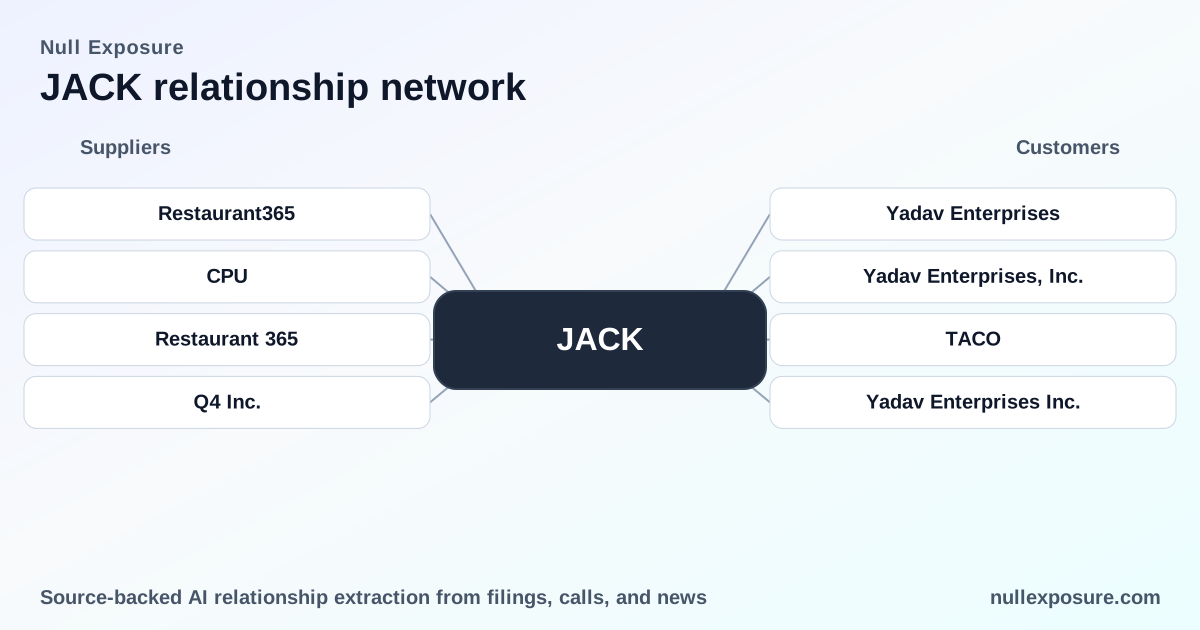
JACK: Post-Del Taco Repositioning — customer relationships and contract signals investors need
Jack in the Box (JACK) operates and franchises quick‑service restaurants and monetizes through two principal channels: company‑operated restaurant sales and franchise economics—initial franchise fees and ongoing royalty/marketing percentages on gross sales. The company recently executed a strategic divestiture of the Del Taco chain, converting an operating segment into a counterparty relationship (sale + transition services), which alters cash flow composition from operating profits toward one‑time proceeds and contractually defined service income. For a concise operational map and customer‑level coverage, see https://nullexposure.com/.
High‑level thesis for investors
Jack in the Box is shifting from a two‑brand operator/franchisor model to a narrower operating footprint while preserving recurring, fee‑based income through franchise contracts and a small transition services agreement (TSA) after the Del Taco sale. The Del Taco disposal generated immediate cash (~$119 million) and a TSA that delivered measurable, if modest, services revenue in Q1 FY2026, but it also removes a previously core revenue stream and reframes counterparty exposure toward franchisees and strategic buyers. Investors should treat JACK as a franchisor with long‑dated contractual cash flows and one‑off asset‑sale proceeds altering near‑term leverage and liquidity profiles.
For a deeper customer relationship mapping and contract signals, visit https://nullexposure.com/.
What the Del Taco sale changes for JACK's revenue mix
On October 15, 2025 Jack entered a definitive agreement to sell Del Taco and completed that sale on December 22, 2025, to Yadav Enterprises (with a buyer guarantor identified in filings). The transaction produced approximately $119 million in proceeds and established a Transition Services Agreement that generated roughly $0.9 million of income in Q1 FY2026 as JACK recognized TSA fees. This transaction converts an operating asset into discrete contractual revenue and reduces company‑operated sales while boosting liquidity. (See Franchising.com Feb 19, 2026 and InsiderMonkey Q1 FY2026 earnings call transcript.)
Operating model constraints that matter to counterparties and investors
- Long‑term contracting posture: Jack’s franchise agreements are structured for durability—20‑year franchise terms, a standard initial fee (commonly cited as $50,000 per restaurant), and royalty/marketing payments generally set around 5.0% of gross sales. That design produces predictable, percentage‑based recurring cash flows that scale with system sales and provide downside protection via long terms and fee schedules.
- Product and service mix: The company’s business comprises core product brands (Jack in the Box and formerly Del Taco) and services related to restaurant development, operations, and franchising; this dual profile creates both operating revenue and franchisor fee revenue streams. The constraints explicitly identify Del Taco as a core product in the company’s portfolio prior to sale.
- Geographic concentration: Operations are concentrated in the western and southern United States (with limited exposure to Guam and Mexico), signaling regional concentration risk in system sales and same‑store performance.
- Counterparty profile: Franchise relationships and buyer/guarantor arrangements include corporate and individual counterparties; company filings and transaction documents document both corporate buyers and individual guarantors in material deals.
- Role clarity: Jack recognizes “company restaurant sales” as revenue when the obligation to perform is satisfied, consistent with seller/operator accounting and confirming that company‑operated locations remain meaningful to headline revenue until divested.
Collectively, these signals point to a mature franchisor with durable contractual cash flows but regional concentration and some counterparty heterogeneity that require active monitoring.
Relationship log — every result in the file, with sources
Yadav Enterprises (NYPost)
A New York Post article reported that JACK completed the sale of Del Taco to Yadav Enterprises for about $119 million as part of its turnaround plan and contemporaneous restaurant closures. This frames Yadav as the acquirer that converted operating locations into a franchised/owned portfolio. (New York Post, Dec 25, 2025: https://nypost.com/2025/12/25/business/jack-in-the-box-shut-down-more-than-70-stores-expecting-more-to-close-amid-financial-struggle/)
Yadav Enterprises, Inc. (Franchising.com)
Franchising.com cited JACK’s Q1 FY2026 disclosure that on Oct 15, 2025 the company entered a definitive agreement to sell Del Taco, and that the sale to Yadav Enterprises, Inc. (with buyer guarantor Anil Yadav) completed on December 22, 2025. The filing language establishes the buyer and guarantor framework for the transaction. (Franchising.com, Feb 19, 2026: https://www.franchising.com/amp/news/20260219_jack_in_the_box_inc_reports_first_quarter_2026_earnings.html)
Del Taco (InsiderMonkey)
Jack reported that post‑sale it generated income from a Transition Services Agreement with Del Taco and recorded approximately $0.9 million of TSA revenue in the first quarter following the transaction, showing the buyer/seller linkage remains a revenue source for JACK. (InsiderMonkey Q1 FY2026 earnings call transcript: https://www.insidermonkey.com/blog/jack-in-the-box-inc-nasdaqjack-q1-2026-earnings-call-transcript-1699050/)
TACO (InsiderMonkey — symbol reference)
The earnings call transcript references the Del Taco entity under symbol TACO in the context of TSA receipts; this duplicate reference underlines that the company continues to extract service income tied to the divested business. The Q1 commentary quantified TSA impact at roughly $0.9 million. (InsiderMonkey Q1 FY2026 earnings call transcript: https://www.insidermonkey.com/blog/jack-in-the-box-inc-nasdaqjack-q1-2026-earnings-call-transcript-1699050/)
Yadav Enterprises Inc. (Newsweek)
Newsweek coverage summarized the same transaction: Del Taco’s sale completed in a $119‑million deal with multi‑brand franchisee Yadav Enterprises Inc., confirming press coverage consistency and the buyer’s profile as an experienced multi‑brand operator. (Newsweek article: https://www.newsweek.com/fast-food-giant-jack-in-the-box-close-restaurants-11271414)
Key takeaways for investors and operators
- Sale monetized a core asset and provided immediate liquidity (~$119M), while converting part of JACK’s operating footprint into contractual service revenue through a TSA (Q1 FY2026 TSA income ≈ $0.9M).
- Franchise economics remain central to recurring cash flows: 20‑year terms, $50,000 initial fees, and ~5% royalties create predictable revenue tied to system sales. These contractual drivers are the primary long‑term cash engine for JACK.
- Concentration and regional exposure create execution risk: the system is concentrated geographically in the western/southern U.S., making same‑store performance and local economic cycles material to royalty income.
- Buyer/guarantor structures matter: the Del Taco sale involved a corporate buyer with an individual guarantor, demonstrating JACK’s use of mixed counterparty types in large transactions and the attendant credit considerations.
Investment implications and next monitoring items
JACK’s repositioning reduces direct operating leverage to a divested brand and increases reliance on franchisor cash flows and disciplined capital deployment of sale proceeds. Key items to monitor: TSA revenue trajectory and duration, system same‑store sales performance (which drive royalties), and franchisee health in concentrated regions. For a systematic view of JACK’s customer and counterparty relationships and contract signals, visit https://nullexposure.com/.
Bold, contract‑driven recurring fees and the one‑time proceeds from Del Taco are the definitive near‑term drivers of JACK’s cash profile; investors should weight durable franchise royalties against geographic concentration and counterparty diversity when sizing exposure.