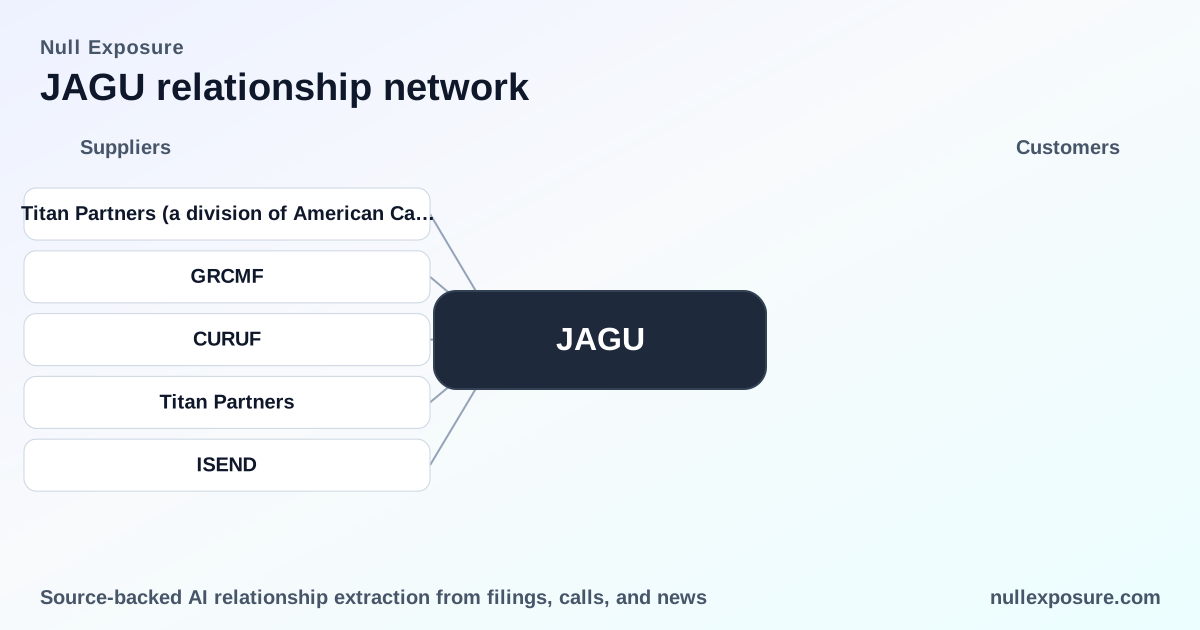
Jaguar Uranium (JAGU): Strategic equity investors, early-stage play, capital-driven path to value
Jaguar Uranium operates as an early-stage uranium exploration company that monetizes primarily through equity financing and asset advancement rather than operating cash flow. The business model centers on acquiring and exploring uranium projects, de-risking targets, and using strategic investor placements and public markets to fund exploration and development. For capital markets investors, the company is a pre-revenue, capital-markets dependent micro-cap where partner relationships and financing cadence are the primary drivers of value creation.
If you want a consolidated view of Jaguar’s investor and customer relationships, visit https://nullexposure.com/ for ongoing coverage and relationship mapping.
How Jaguar runs the business and makes money
Jaguar does not generate operating revenue; its economics are driven by exploration milestones and capital raises. According to Jaguar’s latest financial snapshot (latest quarter 2025-12-31), Revenue TTM is $0, EBITDA is negative $2.325M, and market capitalization is ~$46.0M, underscoring a financing-first posture rather than cash returns from production. The company’s balance between equity dilution and project advancement defines its contracting posture: Jaguar issues equity, attracts strategic investors, and leverages those inflows to fund exploration and corporate overhead.
This is a classic junior-miner model: value accrues when exploration results materially de-risk a project or when strategic partners commit capital, not through operating margin expansion. The market prices Jaguar accordingly: high insider ownership (36.6%) and minimal institutional stakes (1.1%) reflect concentrated control and limited sell-side coverage, compressing short-term liquidity and magnifying the impact of each financing event.
Customer and investor relationships: who matters
Jaguar’s public relationship map is compact but consequential. Below are the relationships surfaced in recent coverage.
- IsoEnergy — IsoEnergy participated as a strategic investor in Jaguar’s equity offering; this positions IsoEnergy as a sector peer-investor supporting Jaguar’s capital raise. According to multiple Investing.com reports dated May 3, 2026, IsoEnergy (ISOU) joined other critical-mineral-focused investors in Jaguar’s offering (Investing.com, May 3, 2026).
Source: Investing.com coverage of Jaguar closing its offering (May 3, 2026).
(Note: the public coverage of the offering was syndicated across regional Investing.com sites; all reports reference IsoEnergy’s participation in Jaguar’s equity raise on May 3, 2026.)
Why the IsoEnergy participation matters
IsoEnergy’s commitment functions as both capital and a credibility signal. For a pre-revenue uranium explorer, having a sector-focused peer invest reduces asymmetric financing risk and signals technical or strategic alignment—the market values those endorsements because they lower the perceived probability of future dilutive financings or technical failure. IsoEnergy’s role is not a commercial customer relationship (no offtake or service agreement disclosed); it is a strategic equity tie that directly underwrites Jaguar’s near-term treasury and exploration runway.
Strategic investors in this context provide three practical benefits:
- Immediate cash to execute planned work programs and maintain listing/compliance;
- Implicit technical validation to other market participants;
- Potential for follow-on collaboration or project-level JV talks if exploration results are compelling.
IsoEnergy’s participation fits that mold: the investment bolsters Jaguar’s ability to advance targets without immediate revenue.
Operating model signals and business constraints
Jaguar’s corporate and financial profile generate a set of company-level operating signals investors must price into any thesis:
-
Contracting posture — equity-led financing is the primary contracting mechanism. The company closed an equity offering, taking cash from strategic investors rather than relying on operating income or debt. This pattern establishes a predictable need to access capital markets to fund exploration and G&A.
-
Concentration and control — insiders hold ~36.6% of shares while institutions hold ~1.1%, indicating concentrated insider control and thin institutional sponsorship. That structure reduces the likelihood of broad analyst coverage and increases governance influence from a limited holder set.
-
Criticality to buyers/partners — Jaguar operates in a strategically sensitive commodity (uranium) that attracts critical-minerals-focused investors and potential industrial partners; this elevates strategic relevance despite the company’s small size.
-
Maturity and financial position — pre-revenue, negative EBITDA, and small market cap (~$46M) place Jaguar squarely in the exploration stage; valuation is highly binary and contingent on technical outcomes and continued financing capability.
Together, these signals describe a company that relies on capital markets and strategic equity partners to progress assets, with concentrated ownership and limited institutional liquidity.
Investment implications: how to size the risk-reward
For investors and operators evaluating Jaguar’s relationships and prospects, the following points are decisive:
-
Catalysts are financing and exploration results. Expect share-price movements to track fundraising announcements and drill results. The IsoEnergy-backed offering eliminates an immediate liquidity shortfall, but ongoing programs will require further capital unless a material discovery accelerates partner commitments.
-
Control and liquidity risk are real. High insider ownership and a low institutional float raise the cost of entering and exiting positions, increasing volatility on news.
-
Valuation is binary and heavily narrative-driven. With no revenue and negative margins, valuation depends on technical progress and the company’s ability to maintain favorable strategic backers. Strategic investor participation—like IsoEnergy’s—improves narrative risk but does not eliminate the need for technical advancement.
-
Partner relationships are primary value levers, not operating customers. IsoEnergy’s role is financial and potentially strategic, not an offtake or service contract; investors should treat such ties as financing signals first.
Where this leaves operators and active allocators
Jaguar is a micro-cap exploration vehicle whose near-term survivability and upside derive from continued access to capital and constructive exploration results. IsoEnergy’s investment is a meaningful stamp of sector confidence that improves Jaguar’s financing runway, but it does not transform Jaguar into a revenue-generating enterprise.
If you manage capital or run operations in the critical-minerals space, monitor these triggers closely:
- Announced drill programs and assay timelines;
- Any technical collaboration or JV language following strategic investments;
- Subsequent financing terms (dilution and pricing).
For a constantly updated map of strategic investor links and customer relationships across junior resource issuers, consult our portal at https://nullexposure.com/ — it aggregates relationship signals that matter for capital allocation.
Final take
Jaguar Uranium is a capital-markets-first explorer whose short-term prospects hinge on exploration upside and continued strategic investor support. IsoEnergy’s participation in the May 2026 offering is a material positive: it provides cash, credibility, and a potential pathway to deeper collaboration—yet the company remains pre-revenue with concentrated ownership and the attendant liquidity and execution risks. Investors should treat Jaguar as a high-beta, binary exploration investment where relationships and financing cadence are the dominant value drivers.