Jaguar Health (JAGX) — customer relationships that drive short-term cash and long-term optionality
Jaguar Health commercializes plant-derived crofelemer for human and veterinary indications and monetizes through product sales, licensing agreements and distributor channels while retaining manufacturing. The company's current strategy converts intellectual property into non-dilutive cash via exclusive U.S. licenses and regional out‑licenses, while keeping supply and manufacturing control, creating a predictable revenue stream from royalties/milestones plus direct sales through distributor networks.
For a compact map of Jaguar’s commercial partners and how they feed Jaguar’s balance sheet, see more at https://nullexposure.com/.
How the partner map fits Jaguar’s business model
Jaguar is a commercial-stage specialty pharma company with modest product revenues (Revenue TTM ~$11.5M, Gross Profit TTM ~$7.7M) and a strategic emphasis on licensing to unlock near-term capital. Recent public announcements show Jaguar trading exclusive marketing rights for Mytesi (human) and Canalevia‑CA1 (canine) while continuing to manufacture the products for licensees — a contracting posture that preserves supply control and downstream margin capture. Jaguar uses distributors for veterinary roll‑out and leverages U.S. licensing to accelerate cash inflows without issuing equity.
Below I cover every reported partner in the public record and the commercial implication for investors.
Relationship-by-relationship: what investors need to know
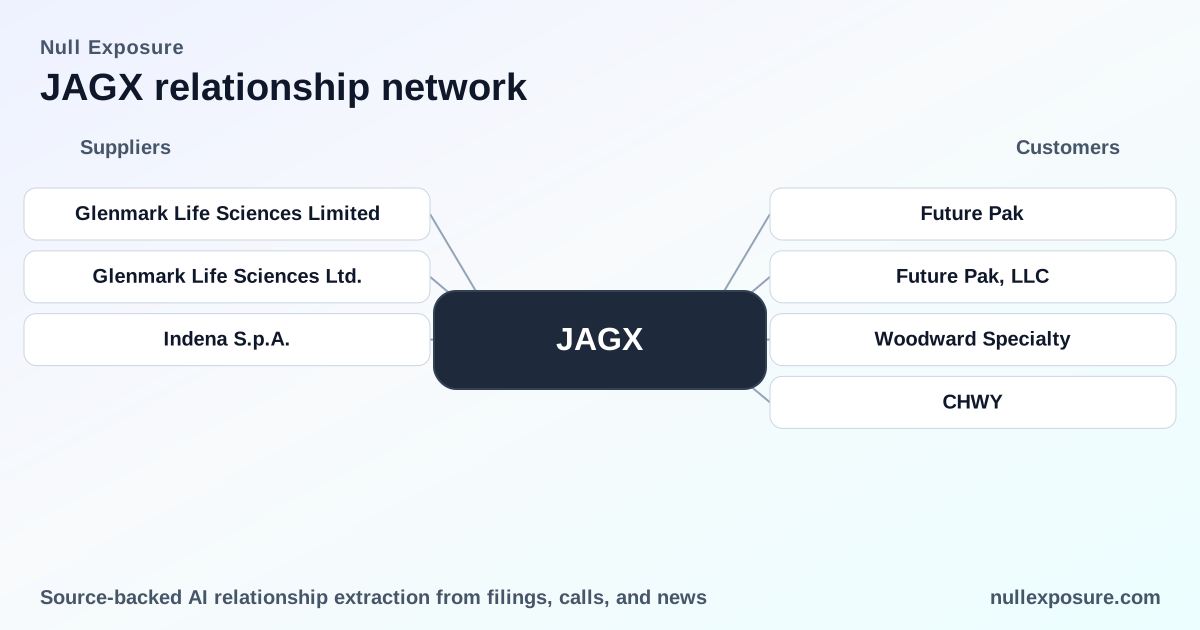
Future Pak / Future Pak, LLC — U.S. exclusive marketer for Mytesi and Canalevia‑CA1
A series of March 10, 2026 press releases reported Jaguar granted Future Pak an exclusive U.S. license to market Mytesi (crofelemer for noninfectious diarrhea in adults with HIV/AIDS) and Canalevia‑CA1 (for chemotherapy‑induced diarrhea in dogs), while Jaguar will continue to manufacture the products; the hardcover deal structure includes upfront and milestone payments described as up to $38 million total. Sources: multiple press releases dated March 10, 2026 (Marconews, News Herald, Jacksonville press release and others), and trading commentary noting the deal size and exclusivity (TradingView / company press releases).
Chewy (CHWY) — veterinary distribution channel
Jaguar has placed Canalevia‑CA1 with major veterinary distributors, explicitly listing Chewy as a retail/distribution channel for the canine formulation, supporting U.S. commercial access to pet owners and clinics. Source: press release reporting product availability through leading veterinary distributors including Chewy (Chieftain, March 10, 2026).
SynWorld — China license activity for Canalevia
Market commentary and equity sites reported a licensing arrangement for Canalevia in China earlier in 2026, with SynWorld noted as the counterparty in coverage that tracked Jaguar’s share movement around the announcement (Simply Wall St, June 29, 2026 reporting on a SynWorld license).
Woodward Specialty — reported Napo Pharmaceuticals licensing transaction
A news summary reported Jaguar’s subsidiary Napo Pharmaceuticals executed a license with Woodward Specialty granting exclusive U.S. commercialization rights for Mytesi and Canalevia and receiving an upfront payment structure described as $18 million (with $16M at signing and $2M contingent within six months). This reporting positions Woodward as another source of non‑dilutive capital tied to Jaguar’s IP. Source: Intellectia.ai summary of the Napo/Woodward arrangement (reported March 2026).
Note: the public record contains multiple licensing announcements in a concentrated time window; investors should reconcile Jaguar’s SEC disclosures for the definitive contractual terms and any affiliate structures referenced in press coverage.
Operational constraints and what they signal for valuation
- Contracting posture — licensing-centric: Jaguar’s financial disclosures and public excerpts show license revenues recognized over multi‑year periods and incremental license payments (company-level signal). Licensing provides non-dilutive cash but transfers marketing responsibility and revenue upside to partners in licensed territories.
- Supply control and criticality: Jaguar retains manufacturing for licensed products per the press excerpts, creating a supplier-critical relationship: licensees depend on Jaguar for supply and Jaguar retains leverage over quality and fulfillment.
- Channel and counterparty mix: The company sells through distributors for veterinary products and uses licensees for marketed rights; third‑party payers include government and managed care for human prescriptions (company-level signal), which implies reimbursement and payer relationships will influence realized human product volumes.
- Concentration and maturity: Recent commercial activity is concentrated among a small set of licensees and distributors; Jaguar is commercial-stage but still small (Revenue TTM ~$11.5M, negative EBITDA) and relies on milestone/upfront license cash to fund operations and R&D.
- Relationship roles are multi-faceted: Jaguar functions as licensor (out‑licensing rights), licensee in other arrangements historically, and supplier to distributors — that complexity is a company-level operating characteristic rather than a single-relationship attribute.
Risk / reward frame for investors and operators
- Upside: material non-dilutive cash infusions from licensing accelerate runway and fund clinical strategy while preserving equity; exclusive licenses expand commercial reach without Jaguar absorbing marketing expense. The company’s retention of manufacturing preserves quality control and potential margin capture on supply agreements.
- Risk: revenue concentration and dependence on a handful of licensees/distributors can amplify downside if a partner underperforms or disputes supply/terms. Reimbursement pressure from government/managed care for human indications and modest institutional investor ownership (PercentInstitutions ~0.52%) add volatility to demand and investor base depth.
- Operational risk for operators: maintaining manufacturing scale and compliance while supporting multiple licensees is operationally demanding for a company of Jaguar’s size; any supply disruption would directly impair licensed revenues and partner relationships.
If you want a concise, machine‑readable map of these partner relationships and contract types for due diligence workflows, NullExposure publishes structured coverage at https://nullexposure.com/.
Bottom line — what to watch next
- Key near-term metric: cash receipts from upfronts and milestones tied to the Future Pak/Woodward transactions and any announced royalties.
- Commercial validation: volume trends through distributors (Chewy and others) for Canalevia and prescription uptake for Mytesi in payer systems.
- Disclosure reconciliation: confirm reported press terms against Jaguar’s SEC filings to resolve overlapping license reports and definitive payment schedules.
Bold takeaway: Jaguar is monetizing IP through exclusive licenses while safeguarding supply — a strategy that provides immediate cash and scales commercial reach, yet concentrates execution risk in a small set of partners.