Janux Therapeutics: Partner-driven commercialization with milestone monetization
Janux Therapeutics operates as a clinical-stage biopharma that builds value by licensing and co-developing tumor‑activated T‑cell engager candidates derived from its TRACTr platform, monetizing through upfronts, near‑term milestone payments and future development and commercial milestones secured in partner collaborations. Revenue today is milestone-driven and lumpy; enterprise value depends on partner execution and regulatory progress rather than product sales. For a concise counterparty map and source-backed relationship summaries, see Janux’s partner activity below. If you want a deeper commercial-risk profile and partner concentration analysis for premium diligence, visit https://nullexposure.com/.
How Janux makes money and how that shapes risk/reward
Janux’s operating model is partner-centric: it invests in early development and then outsources global development and commercialization to large pharma under license/collaboration agreements. That structure creates these characteristics for investors:
- Contracting posture: Janux typically enters exclusive license and collaboration agreements that transfer late‑stage development and commercialization responsibility to the partner while retaining near‑term upside via milestone and supply arrangements. This reduces Janux’s capital intensity for late‑stage programs while concentrating upside on binary clinical and regulatory events.
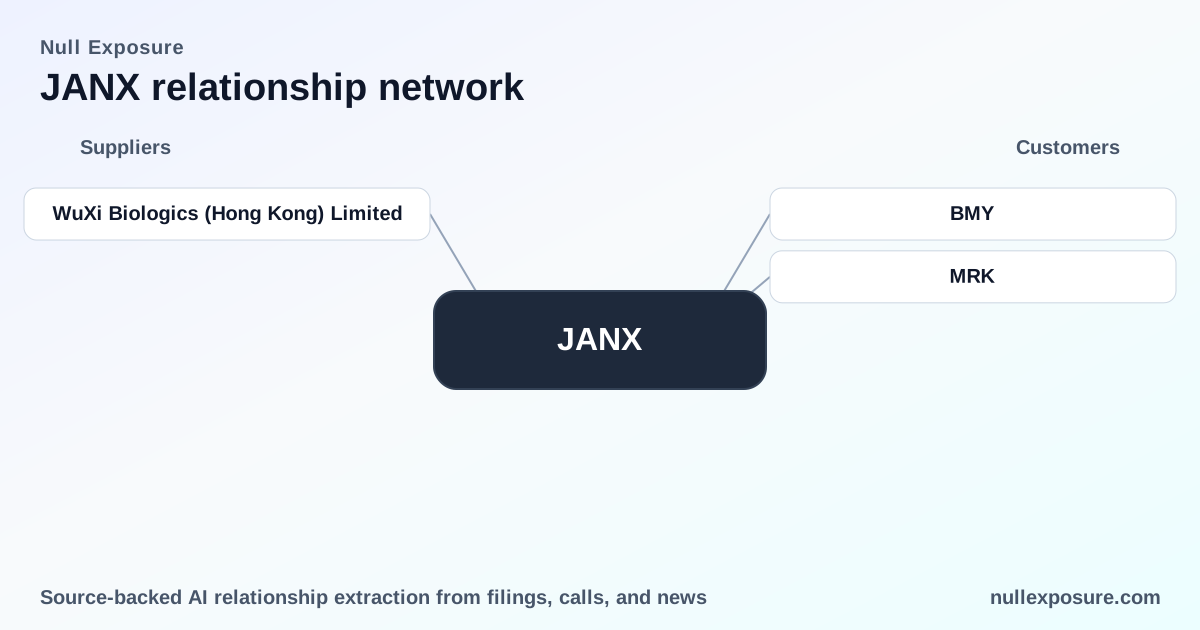
- Concentration: A small number of large partners drive material revenue events; recent news shows Bristol Myers Squibb and Merck as the primary counterparties for near‑term milestones. That concentration amplifies event risk — one partner’s decision can swing revenue materially.
- Criticality: Coverage and reimbursement dynamics are a company‑level constraint: government and commercial payor reimbursement are essential for eventual product uptake and are factored into Janux’s strategic planning, especially for EU/NA markets.
- Maturity: Contracts are structured so Janux supplies early clinical materials and conducts IND‑enabling work, then the partner leads global development — a quasi‑asset‑sale profile that accelerates external validation but limits long‑term revenue share unless major milestones and royalties are realized.
These business model traits justify valuing Janux as a milestone‑option play rather than a recurring‑revenue biotech.
Partner map: what every public result says (no omissions)
Below are the relationships flagged in the monitoring set; each entry includes a concise plain‑English summary and a published source.
Bristol Myers Squibb (BMY)
Janux announced a collaboration and exclusive worldwide license with Bristol Myers Squibb to develop a tumor‑activated therapeutic for validated solid tumor antigens, with headline commercial upside and near‑term milestone structure. Multiple press releases and market reports indicate the deal includes upfront and milestone mechanics that together could total roughly $800 million in potential development/regulatory/commercial milestones, and Janux reported nomination of a development candidate that triggered a $35 million milestone payment under the agreement. According to Janux’s Q4 2025 press release (BioSpace) and widespread market coverage in March–May 2026, BMY will lead global development and commercialization after IND, with Janux supplying early clinical materials and receiving near‑term payments. (Sources: Janux press release on BioSpace, March 2026; market coverage including TradingView/Zacks and The Globe and Mail, March–May 2026.)
Merck & Co., Inc. (MRK)
Janux’s earlier collaboration with Merck produced an operational milestone when the first patient was dosed in a lead program, triggering a $10 million milestone payment to Janux. The underlying Merck agreement dates to December 2020 and is an exclusive, royalty‑bearing license structure under which Janux granted Merck rights to certain patent families and know‑how for collaboration targets. This is a classic licensing monetization event: development progress by the partner converts into cash for Janux without Janux carrying late‑stage development costs. (Sources: Janux announcement via Yahoo Finance on the $10M milestone, August 2025 reporting; company disclosure describing the December 2020 Merck agreement in filings.)
What the partner roster means for investors
- Near‑term cash profile now anchored to milestones. The public reporting of a $35M milestone from BMY and a prior $10M from Merck materially improves Janux’s near‑term cash runway visibility relative to operating burn. These are one‑time, discrete inflows; investors should not treat them as recurring revenue.
- De‑risked commercialization pathway but concentrated counterparty exposure. By ceding global development and commercialization to BMY (for the newly licensed program) Janux transfers execution risk but also concentrates outcome dependence on a small number of large partners.
- Valuation sensitivity to binary events. Stock moves will be correlated to milestone announcements, regulatory readouts and partner investment decisions rather than to revenue growth trends. Analysts’ target prices and buy ratings will therefore reprice quickly on program nominations and dosing events.
Constraints and company‑level signals investors must internalize
- Contracting signal — licensing is central. Janux’s business model relies on exclusive license/collaboration contracts to capture value while outsourcing expensive late‑stage development.
- Payor and reimbursement risk is critical. Public disclosures emphasize reliance on government programs and private payors for patient access; coverage and pricing in NA and EMEA are material determinants of long‑term commercial success.
- Geographic exposure: Reimbursement and regulatory strategy mentions both North America and EMEA, indicating Janux and its partners are planning for global launches that face different payer constraints.
- Materiality: Adequate reimbursement and third‑party coverage are described as essential for patients to access expensive therapies, which makes pricing and health‑economics workstreams critical once clinical efficacy is proven.
Investment implications, risk factors and actionable points
- Upside drivers: further milestone receipts, positive clinical readouts, and successful IND->clinical transitions under partners. BMY’s $35M milestone and potential for larger development/commercial milestones are clear value inflection points.
- Key risks: single‑program concentration under BMY, partner prioritization decisions, and payor reimbursement outcomes in NA/EMEA. A partner deprioritization would significantly delay or eliminate expected milestone streams.
- Due diligence checklist for investors and operators: verify milestone timing and contingent triggers in publicly filed agreement summaries; monitor partner pipelines and leadership statements for prioritization signals; and track payor‑policy developments in the EU and US relevant to tumor‑activated biologics.
For an executive summary and counterparty concentration scorecard tailored to institutional diligence, see our premium briefing at https://nullexposure.com/.
Bottom line
Janux has positioned itself as a partner-enabled value creator: it converts platform innovation into non‑dilutive cash via exclusive licensing and milestone arrangements while limiting its own late‑stage development burden. That model delivers attractive upside on successful nominations and dosing events but exposes investors to concentrated partner execution and reimbursement risk — the very dynamics reflected in the recent BMY and Merck milestone headlines.