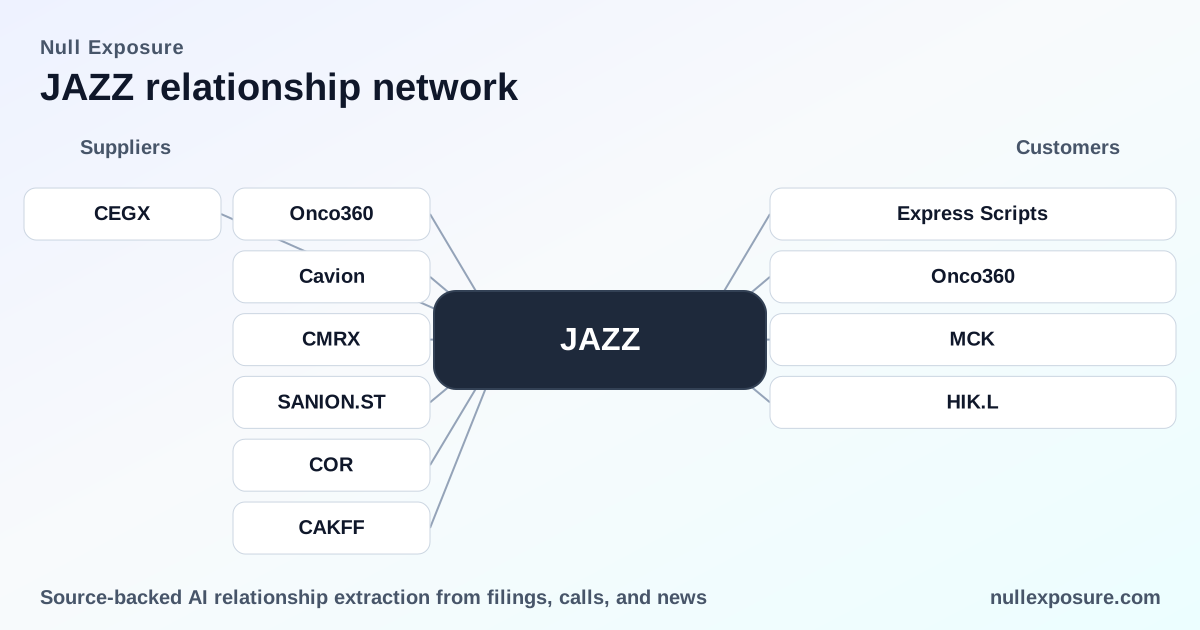
Jazz Pharmaceuticals: customer relationships that drive cash flow and concentration risk
Jazz Pharmaceuticals is a global biopharmaceutical company that generates revenue principally by developing, approving and commercializing specialty medicines—notably sleep and oncology products—and by contracting with distributors, specialty pharmacies and commercial partners to get product to patients. Jazz monetizes through direct product sales (Xywav, Xyrem, ZIIHERA and others), distribution agreements that place revenue at delivery, and collaborations / co-commercial arrangements that broaden market access. Jazz reported roughly $4.27 billion of trailing revenues and a capital structure that reflects both growth investment and portfolio concentration.
If you evaluate Jazz as an investment or counterparty, focus on three dynamics: revenue concentration in a small number of large buyers/distributors, short-term contracting with key distribution partners, and an increasingly global commercial footprint supported by collaborations. For a deeper view of counterparties and documented relationships, visit our research portal at https://nullexposure.com/.
Quick strategic takeaways for investors
- Concentration is real and material: Jazz discloses that a handful of customers account for a very large share of receivables and revenue, which concentrates counterparty credit and operational risk.
- Distribution agreements are short-term and granular: Payment and contract terms skew short (30–65 day payment cycles; many distribution contracts are multi-year but terminable with notice), which creates agility but also renewal risk.
- Commercial partnerships extend reach: Collaborations with other biotech companies support oncology pipeline commercialization and provide product-market fit in new indications.
- If you want to integrate this signals-driven counterparty intelligence into your workflow, explore our platform at https://nullexposure.com/ (research-grade signals and relationship mapping).
Detailed relationship roll call — what Jazz is telling the market
Below I list each relationship item extracted from Jazz public documents and news; each entry includes a concise, plain-English summary and the original source referenced in the record.
Onco360
Jazz describes an exclusive distribution partnership with Onco360 that provides patient-centric support services and supports the launch of Modeyso, with strong payer coverage noted by management. Source: Jazz 2025 Q4 earnings call (management commentary cited in March 2026).
Express Scripts
Jazz reports that through agreements with pharmacy benefit managers and related entities it has benefit coverage for Xywav across about 90% of commercial lives, supporting sustained adoption since launch. Source: Jazz FY2024 Form 10-K (filed for fiscal year ended December 31, 2024).
MCK
Jazz identifies coverage achievements for Xywav and references agreements with large pharmacy/distribution entities that contribute to the ~90% commercial coverage figure; this mention is captured in the FY2024 filing. Source: Jazz FY2024 Form 10-K (MCK match noted in FY2024 disclosure).
McKesson Corporation
A parallel reference to McKesson confirms Jazz’s routing of product and benefit coverage efforts through major wholesale and distribution partners as described in the company’s FY2024 disclosure. Source: Jazz FY2024 Form 10-K (December 31, 2024 filing).
ALXO (ALX Oncology)
Multiple press reports and company releases document a clinical collaboration in oncology: ALX Oncology announced Phase 1b/2 data for evorpacept in combination with Jazz’s ZIIHERA (zanidatamab-hrii) in heavily pretreated metastatic breast cancer patients, indicating Jazz’s ZIIHERA is being evaluated in combination trials. Source: ALX/press releases and third‑party reporting (Finance.Yahoo, InvestingNews, StockTitan and The Globe and Mail coverage in March 2026).
ZYME (Zymeworks / BeOne Medicines reference)
Industry reporting indicates Jazz has been engaged to help commercialize a drug originating from Zymeworks/BeOne Medicines, reflecting Jazz’s role as a commercial partner for externally developed assets. Source: local and industry outlets reporting on Zymeworks / BeOne engagement (BIV.com and Delta-Optimist coverage in 2025–2026).
Hikma (HIK.L)
Jazz disclosed an amendment to an existing supply/partner agreement with Hikma that extends their arrangement by two years, reflecting active contract renewals with contract-manufacturers or commercial partners. Source: Jazz 2025 Q3 earnings call commentary (reported March 2026).
HIK.L (duplicate reference)
A second earnings-call entry reiterates the extension with Hikma, captured under the HIK.L listing for the same quarter. Source: Jazz 2025 Q3 earnings call (March 2026).
What the disclosed constraints signal about Jazz’s operating model
Jazz’s public filings and commentaries provide explicit constraints and operating signals you should model into risk and valuation assumptions:
-
Short-term contracting posture: Jazz discloses multi-year agreements that are nonetheless terminable with relatively short notice (example: agreements expiring Dec 31, 2025 that allow 180 days’ termination notice), and standard payment terms of 30–65 days. This makes Jazz operationally nimble but increases renewal and pricing risk over time. (Company-level signal from FY2024 disclosures.)
-
High counterparty concentration: Jazz reports that five customers accounted for 80% of gross accounts receivable and that one specialty pharmacy relationship (ESSDS) represented ~42% of total revenues, a material concentration that increases credit and operational dependency. Because ESSDS is explicitly named in the filing, treat its relationship as a primary counterparty exposure. (Company-level signal; ESSDS explicitly cited in the FY2024 filing.)
-
Geography: U.S.-centric with global reach: While Jazz is a global biopharma with direct operations in the U.S., Europe, Australia and Canada, the United States represents the majority of revenue (U.S. revenue reported at approximately $3.66 billion of total revenues). Expect regulatory and payer dynamics in the U.S. to disproportionately affect top-line performance. (Company-level signal from FY2024 revenue table.)
-
Material revenue buckets and core product focus: Jazz operates in a single business segment—development and commercialization of pharmaceuticals—and classifies major products as core, indicating maturity for a subset of the portfolio. This supports predictable product sales but also concentrates risk in flagship products. (Company-level signal from segment disclosure.)
-
Large-spend relationships: The existence of customers contributing more than 10% of revenues (including one at ~42%) places Jazz in a large-enterprise counterparty environment, where a small number of partners have meaningful negotiating leverage. (Company-level signal from FY2024 disclosures.)
Investment implications and next steps
- Upside: Strong payer coverage for core sleep franchises and active oncology co-commercial collaborations create a clear revenue runway; ZIIHERA combination studies and external commercialization deals expand addressable markets.
- Downside / monitoring: The ESSDS concentration, short-term terminable distribution agreements, and reliance on a small set of large partners are key items to monitor in diligence — any change in those relationships would have asymmetric impact on cash flow.
For targeted counterparty due diligence, our relationship maps and document-level intelligence streamline assessments. Learn more or request a brief demo at https://nullexposure.com/.
Key takeaway: Jazz’s revenue engine is efficient and commercially proven, but intrinsically concentrated—investors and partners should underwrite both the product-level upside and the measurable counterparty concentration risk before committing capital.