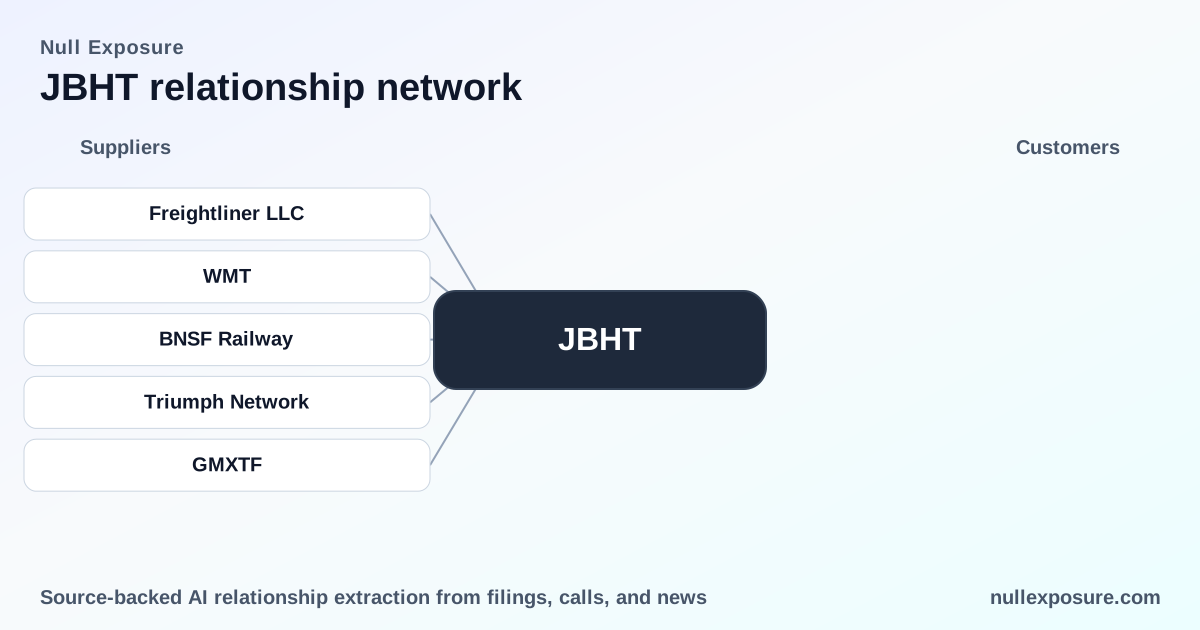
J.B. Hunt: Customer relationships that drive predictable freight revenue and selective innovation upside
J.B. Hunt monetizes a national transportation platform by selling asset-based and asset-light logistics services to large enterprise shippers across North America. Revenue derives from long-term contractual relationships (three to ten years, average roughly five) complemented by spot business and brokerage solutions; the company acts as a principal, invoices customers directly, and retains pricing discretion and operational control. That dual mix—contracted revenue for predictability and spot/brokerage for margin upside—underpins JBHT’s cash flow profile and concentrates economic sensitivity in a relatively small set of large customers. For a closer read on specific customer ties, see the firm-level summary at Null Exposure. https://nullexposure.com/
Two customer threads to watch: captive freight with Bassett, autonomous pilot with Wayfair
Investors evaluating JBHT’s customer exposure should focus on concentration and strategic projects. The firm reports top-10 customers represent roughly 35% of revenue with a single customer at about 11%, signaling meaningful revenue concentration that rewards contract retention and penalizes churn. At the same time, JBHT uses long-term contracts alongside spot quotes, which balances predictable cash flow with pricing flexibility.
Bassett Furniture — captive freight relationship driving supplier cost dynamics
Bassett Furniture’s management explicitly tied rising transport costs to a captive freight relationship with J.B. Hunt, noting that freight surcharges are passed through and fluctuate with diesel prices during Bassett’s Q1 2026 earnings call. According to SupplyChainDive’s May 2026 coverage and the Q1 2026 transcript, Bassett’s retail side is on a captive program with J.B. Hunt and receives weekly surcharges linked to fuel. (SupplyChainDive, May 2026; Q1 2026 earnings call transcript published May 2026.)
Wayfair via Waymo pilot — autonomous trucking delivery collaboration
J.B. Hunt’s relationship touches Wayfair through an autonomous trucking initiative executed with Waymo, where autonomous Class 8 units have been used to deliver goods for Wayfair under the J.B. Hunt-Waymo collaboration. TruckingInfo reported on March 10, 2026 that the collaboration included deliveries to a J.B. Hunt customer, Wayfair, and earlier coverage documents the 2022 pilot that began hauling Wayfair freight. (TruckingInfo, March 10, 2026; TechXplore coverage of the 2022 pilot.)
What these relationships reveal about JBHT’s operating model
The relationship evidence and company disclosures together reveal a deliberate operating posture:
- Contracting posture: JBHT runs a hybrid model—contracts are typically long-term (3–10 years, average about five), providing revenue visibility for core accounts, while the company supplements contract business with spot and one-off quotes to capture demand-driven margin. This design supports stable utilization of assets and contractually backed revenue streams while preserving responsiveness to freight market cycles.
- Customer concentration and materiality: The top-10 customer concentration (≈35%) and a single customer at ≈11% make large- account retention a primary lever for revenue stability; loss or material weakening of one large account would have measurable P&L impact.
- Counterparty profile and criticality: Customers are predominantly large enterprises, including Fortune 500 firms, so JBHT sells into sophisticated procurement organizations where service continuity, reliability, and integrated supply-chain solutions are strategic priorities for the shipper.
- Geographic footprint: Operations are focused across North America—United States, Canada, and Mexico—so JBHT’s commercial exposure and operational risk tracks regional freight volumes, cross-border rules, and fuel/regulatory dynamics.
- Role and revenue recognition: JBHT operates as a principal seller and service provider: the firm invoices customers on a gross basis, controls pricing, and manages fulfillment including selection of third-party carriers when used. That posture supports gross-margin capture but also concentrates liability for service delivery.
- Relationship maturity and spend bands: JBHT emphasizes long-term, mature relationships integrated into customer supply-chain strategies; top customers generate six- and seven-figure annual spend (company-level signals point to spend bands exceeding $100 million for leading accounts).
Investment implications — revenue stability vs. concentration risk
JBHT’s commercial model blends defensive and offensive elements. Key takeaways:
- Revenue predictability is high for core contracted customers. Long-term contracts anchor earnings and support capital allocation toward fleet and technology investments.
- Earnings sensitivity remains concentrated. The top-customer concentration (35% across top ten) introduces downside if major contracts are not renewed on favorable terms or if significant volume migration occurs.
- Pass-through cost dynamics create margin volatility for customers and require agile pricing. The Bassett disclosure shows customers accept fuel-linked surcharges under captive programs, but those mechanisms can compress shipper margins during fuel spikes and complicate renewal negotiations.
- Innovation projects are a differentiator, not a revenue replacement. The Waymo/Wayfair autonomous pilot highlights JBHT’s willingness to experiment with technology to lower unit cost and improve service, but pilots are incremental to core contracted revenue. Autonomous trucking has strategic upside if it scales, yet it does not substitute for the revenue weight carried by large, long-term customers.
Risks and monitoring checklist for investors
Monitor these items to judge customer-side health and revenue durability:
- Contract renewals and disclosed terms for top customers—especially any that could approach or exceed the noted ~11% single-customer concentration.
- Shipper pricing pressure and pass-through mechanisms for fuel and surcharges, which affect both JBHT margins and shipper willingness to renew captive arrangements.
- Deployment progress from pilot collaborations (autonomous trucking) and evidence of cost takeout or new service capabilities that could change competitive dynamics.
- Cross-border freight volumes and regional regulatory changes in the U.S., Canada, and Mexico that could affect network optimization.
Bottom line and next steps
J.B. Hunt combines the stability of long-term contracted freight with selective spot and technology-driven initiatives, creating a predictable cash engine that is nevertheless sensitive to customer concentration and commodity-linked pass-throughs. For investors, the question is not whether JBHT can win business—its customer profile and scale confirm that—but whether it can retain top accounts on favorable terms while monetizing technological pilots into operational advantage.
For additional company-level customer intelligence and relationship analytics, visit Null Exposure to explore JBHT’s customer map and disclosure signals: https://nullexposure.com/