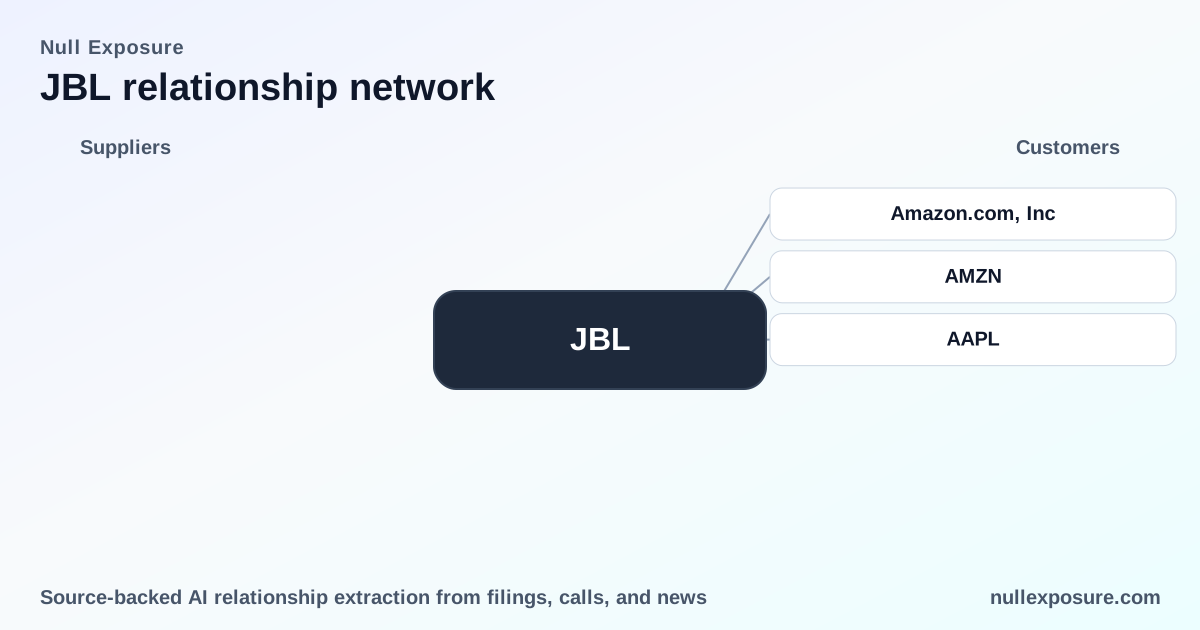
Jabil’s customer map: manufacturing backbone, concentrated exposure, and strategic OEM ties
Thesis — Jabil monetizes by selling global engineering, production and product-management services to OEMs and system integrators, operating largely under framework manufacturing contracts with customer-specific purchase orders and short firm production schedules; revenue is concentrated among a handful of large clients and skewed to international markets, making Jabil a high-volume, contract-manufacturing play exposed to customer capex cycles and platform wins. Investors should value Jabil as a margin-levered infrastructure supplier whose revenue comes from repeat, high-volume manufacturing relationships rather than branded retail sales.
For detailed relationship analytics and coverage, visit the Null Exposure research hub: https://nullexposure.com/
How Jabil makes money and where financial leverage lives
Jabil’s core monetization is straightforward: it charges for design, engineering, production and supply-chain services that produce finished electronic and electromechanical products to customer specifications. Revenue mixes are dominated by production throughput and program scale, with margin expansion tied to automation, vertical integration, and favorable customer mix (higher-margin regulated industries and infrastructure projects). Public filings and commentary show the company operates on a mix of framework agreements and customer purchase orders, which concentrates revenue with large OEMs and compresses predictability because customers frequently limit firm production commitments to short windows. This structure produces cyclical top-line sensitivity to customer capex while preserving recurring, service-based revenue when programs mature.
Operating constraints and business-model signals investors must price
- Contract posture: The 2025 10‑K states that most customers do not commit to firm production schedules for more than one quarter, while the company also enters framework manufacturing service contracts that set the terms and channel purchase orders. This mix results in short-term operational visibility inside a longer-term commercial framework — a key factor for working-capital and capacity planning.
- Customer concentration: Jabil reports its five largest customers accounted for approximately 36% of net revenue in FY2025, and 87 customers accounted for ~90% of revenue; this is a material concentration that creates both platform risk and negotiating leverage when programs scale.
- Global footprint and supply-chain exposure: The company operates in about 30 countries and reported roughly 75% foreign-source revenue for FY2025; geographic diversification is structural but creates exposure to regional supply shocks and trade policy.
- Role and criticality: Jabil’s revenue derives substantially from manufacturing and product management services, and the company positions itself as a comprehensive service provider (design through production) across regulated and high-volume segments.
- Segment orientation: The Intelligent Infrastructure segment accounted for a meaningful share of revenue (reported at 41% in filings), reflecting growth in cloud, data center, and server workloads — areas that amplify cyclicality tied to enterprise capex but also increase strategic stickiness when programs are large and long-lived.
- Relationship maturity: Management emphasizes developing and expanding long-term, mature relationships with leading customers even while many customer engagements start on short firm schedules; investors should model relationships as a pipeline of active programs that mature into larger, recurring production runs.
Explore a deeper breakdown of client exposure and program-level risk at Null Exposure: https://nullexposure.com/
Public record of customer ties — what each mention in our pulls shows
Amazon.com, Inc — manufacturing services for home security (FY2025)
Jabil’s FY2025 Form 10‑K explicitly notes the company provided manufacturing services to Amazon’s home security business during fiscal 2025, confirming a direct manufacturing relationship on that program and demonstrating Jabil’s role as a backend supplier for retail-focused hardware. (Source: Jabil FY2025 10‑K filed August 31, 2025.)
TM (Toyota) — C‑HR model offers JBL premium audio (March 2026, industry coverage)
Automotive coverage of the 2026 Toyota C‑HR lists a JBL® Premium Audio system with a multi‑speaker layout and integrated amplifier as an available option, indicating product placement of JBL-branded audio systems in Toyota vehicles; this shows branded-system OEM integration rather than simple component supply. (Source: Finviz industry news, March 2026.)
TM (Toyota) — Toyota press release notes JBL premium sound in new three-row model (May 2026)
Toyota’s official communications describe a seven‑passenger model equipped with a JBL premium sound system, reinforcing that JBL-branded audio solutions are specified by OEMs across multiple vehicle lines and validating the brand’s role in automotive infotainment packages. (Source: Toyota global newsroom, May 2026.)
UA (Under Armour) — Project Rock over‑ear headphones engineered by JBL (product release)
A Harman press release documents the Under Armour Project Rock Over‑Ear Training Headphones “Engineered by JBL,” showcasing JBL’s OEM partnerships for co‑branded consumer audio accessories and its engineering role in performance-oriented headset products. (Source: Harman product press release, referenced 2026.)
Amazon — third‑party commentary identifying Amazon as a major Jabil client (March 2026)
A market commentary piece profiling Jabil’s business strategy lists Amazon among the major customers Jabil builds hardware for, underlining Amazon’s role in Jabil’s client roster from an investor narrative perspective. (Source: ad-hoc-news analysis, March 2026.)
AAPL — third‑party commentary identifying Apple as a major client (March 2026)
The same market analysis names Apple as a principal OEM client that benefits from Jabil’s scale and manufacturing capabilities, reflecting the common investor framing of Jabil as a tier‑1 manufacturer for large consumer electronics platforms. (Source: ad-hoc-news analysis, March 2026.)
Apple — additional reference to Apple in market commentary (March 2026)
A separate entry duplicating coverage reiterates Apple’s inclusion among Jabil’s high‑profile customers, a reinforcement of the firm’s exposure to the consumer electronics supply chain and to product cycles driven by Apple. (Source: ad-hoc-news analysis, March 2026.)
Amazon (Investing.com context) — analyst commentary links client capex to Jabil outlook (May 2026)
An Investing.com note on Jabil’s dividend and analyst moves cites UBS raising a price target in part due to strong server demand and capital expenditures by major clients like Amazon, tying customer capex behavior directly to Jabil’s near‑term demand outlook. (Source: Investing.com company news, May 2026.)
AMZN — another market commentary variant naming Amazon (March 2026)
An additional reference to ad-hoc analysis lists AMZN among the major clients that benefit from Jabil’s behind‑the‑scenes manufacturing, echoing the same client‑portfolio narrative in investor writeups. (Source: ad-hoc-news analysis, March 2026.)
Johnson & Johnson — press coverage highlights J&J deal as growth driver (May 2026)
A Globe and Mail investment piece calls the Johnson & Johnson deal a major growth driver for Jabil, signaling that wins in regulated industries and healthcare manufacturing are material contributors to top‑line expansion and strategic diversification. (Source: The Globe and Mail investing article, May 2026.)
Investment implications — what to watch and why it matters
- Concentration risk vs. scale advantage: With five customers contributing ~36% of revenue, Jabil’s earnings can swing with program wins or losses; however, winning scale programs yields significant margin upside through fixed-cost absorption. Monitor program maturation and order cadence from top customers.
- Short firm schedules, long frameworks: Operational forecasting requires scenario planning for quarter-to-quarter order variability inside longer-term framework agreements; investors should stress-test working capital and capacity utilization assumptions.
- Sector mix is shifting toward infrastructure and regulated services: The Intelligent Infrastructure segment and recent regulated-industry acquisitions tilt the company toward higher-margin, capital-intensive clients such as cloud and healthcare — a structural improvement in revenue quality if programs scale.
- Geopolitical and supply-chain variability: With ~75% foreign revenue and ~30-country operations, regional disruptions and trade policy remain principal execution risks.
For a program-level sensitivity model and comparative exposure to top OEMs, explore premium relationship analytics at Null Exposure: https://nullexposure.com/
Conclusion — Jabil is a manufacturing and services platform whose value tracks program wins, customer capex, and the company’s ability to convert short-term purchase orders into mature, high-volume production runs; investors should weigh material customer concentration and global operational complexity against the strategic benefits of scale and diversified segment exposure.