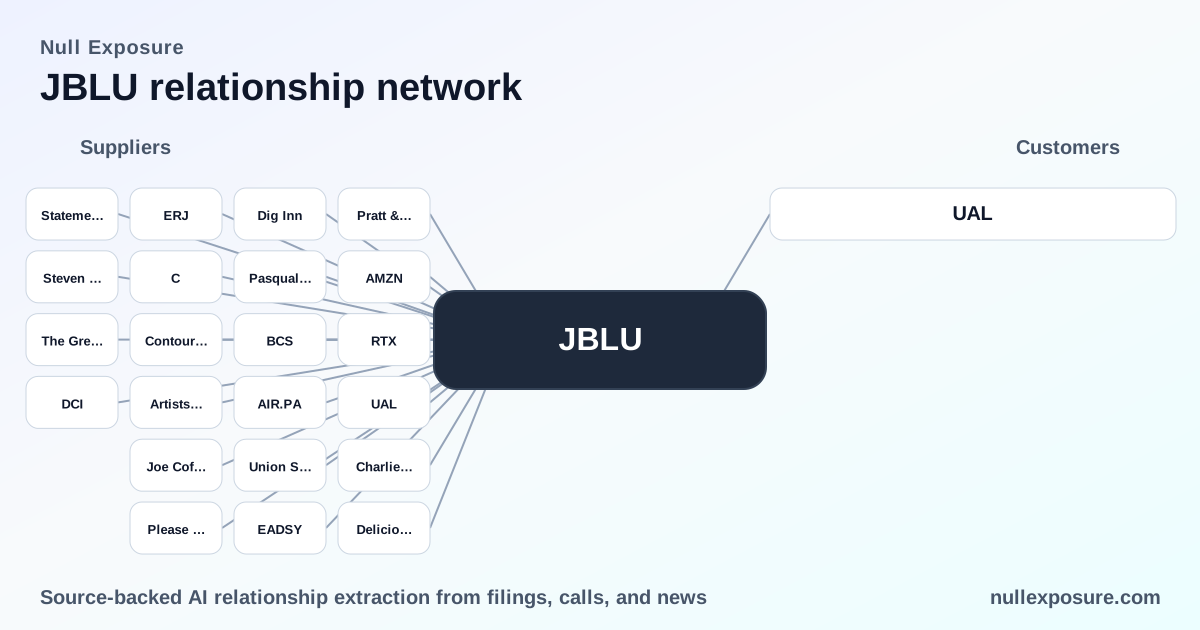
JetBlue (JBLU) — Customer Relationships, Commercial Posture, and Strategic Signals for Investors
Thesis: JetBlue operates as a consumer- and leisure-focused passenger airline that monetizes primarily through seat revenue and ancillary product offerings (baggage, buy-up fares like EvenMore, and vacation packages via Paisly), while selectively leveraging commercial partnerships and slot-sharing arrangements to extract distribution and capacity value. Investors should view JetBlue as a service provider with broad geographic reach and a mixed retail/wholesale go-to-market that drives both top-line passenger revenue and opportunistic commercial income.
For live relationship signals and source-level evidence, visit https://nullexposure.com/
How JetBlue sells its product and where the economics come from
JetBlue’s core business is air transportation: passenger revenue is the primary revenue stream, supplemented by ancillary fees and vacation package sales through its Paisly subsidiary. Company disclosures show a deliberate retail posture where customers can “buy up” to add services — an operational model that prioritizes spot retail transactions with add-on monetization (contract_type signal: spot; confidence ~60%).
Geographic reach is a strategic strength. As of Dec 31, 2025 JetBlue served destinations across North America, Latin America/Caribbean and parts of Europe, producing a global footprint with particular concentration in leisure routes (geography signals: NA, LATAM, EMEA; confidence 0.8–0.85). Operationally, air transportation accounted for substantially all of JetBlue’s activity in recent years, underscoring that third-party commercial deals are an adjunct to — not a replacement for — core flight operations (materiality signal: material; confidence ~80%).
These characteristics translate into a predictable set of investor-level constraints: JetBlue is a retailer of flight experiences, sells modular ancillary services, operates across multiple regions with seasonal leisure concentration, and functions both as a direct seller to consumers and as a service provider to commercial partners.
Key commercial relationships investors need on their radar
Amazon (AMZN)
JetBlue is explicitly listed among Amazon’s commercial agreements in Amazon’s Q4 2025 earnings call, indicating a formal commercial relationship between the two companies. According to Amazon’s Q4 2025 earnings remarks, JetBlue is one of several named commercial partners in an initiative the company discussed publicly. (Source: Amazon Q4 2025 earnings call, referenced 2026-03-07.)
United / United Airlines (UAL)
JetBlue has codified cooperation with United that includes slot access at JFK’s Terminal 6, enabling United up to seven daily roundtrips as early as 2027; the relationship also includes reciprocal commercial sales across both carriers. JetBlue’s investor relations materials and press releases detail this partnership as a capacity- and distribution-oriented arrangement that creates tangible near-term revenue and network effects. (Source: JetBlue investor relations press release and corporate news, March 2026.)
Southwest (LUV)
Market commentary has identified Southwest as a potential strategic acquirer in broader industry consolidation discussions involving JetBlue; coverage highlights suitors such as United, Southwest, and Alaska amid competitive pressures. This is market-sourced M&A speculation rather than a contractual commercial tie, but it signals strategic interest from legacy carriers in JetBlue’s assets and routes. (Source: StockstoTrade news coverage, April–May 2026.)
Alaska Airlines (ALK)
Alaska is likewise named in industry reports as a potential buyer in the context of merger speculation, positioning JetBlue as an asset of strategic value to network carriers seeking growth in key leisure and transcontinental markets. That speculative interest functions as an external validation of JetBlue’s route network value. (Source: StockstoTrade news coverage, April–May 2026.)
Spirit Airlines (SAVE)
In the wake of Spirit’s network disruption, JetBlue implemented tactical commercial moves — including low “rescue fares” — to capture displaced passengers and expand presence in South Florida. This on-the-ground competitive response demonstrates JetBlue’s operational agility and opportunistic revenue capture when a proximate rival is impaired. (Source: TS2.Tech coverage of JetBlue pricing and network actions, May 2026.)
What each relationship implies for revenue, risk, and optionality
- Amazon: Being named among Amazon’s commercial agreements signals JetBlue’s ability to monetize non-ticket commercial deals, which can diversify revenue but are not reported as material compared with air transportation. Investors should treat Amazon-related income as incremental commercial revenue unless disclosed otherwise.
- United: The United partnership is the most consequential from a capacity and distribution perspective — slot-sharing at JFK and cross-sales materially improve JetBlue’s network economics and create revenue upside tied to distribution agreements. This is a structural relationship that affects route profitability and competitive posture.
- Southwest & Alaska (M&A interest): Reported buyer interest in JetBlue by multiple legacy carriers elevates strategic exit optionality and underscores network value, but such headlines are acquisition speculation and should be discounted until filings or direct statements confirm intent.
- Spirit: JetBlue’s rapid fare and route adjustments following Spirit’s operational problems demonstrate demand-capture capability, which supports short-term revenue resilience and market-share gains in contested leisure markets.
Operational constraints and what they mean in practice
From company disclosures and signal extraction, several firm-level constraints shape JetBlue’s commercial behavior:
- Contracting posture: A retail, spot-oriented model with buy-up options drives high-frequency, low-duration customer relationships and levered ancillary revenue (contract_type: spot; confidence ~60%).
- Concentration and maturity: Air transportation remains the dominant business line — JetBlue is a mature network carrier focused on passenger flows rather than diversified enterprise services (materiality signal: material).
- Geographic exposure: Broad coverage across North America, Latin America/Caribbean and selective European routes means revenue is geographically diversified but concentrated on leisure corridors, which increases sensitivity to seasonal and regional demand swings (geography signals: NA, LATAM, EMEA; confidences ~0.8–0.85).
- Role duality: JetBlue operates both as a seller (retailer to passengers) and a service provider (partner to carriers and third parties), creating mixed revenue profiles and multiple counterparties to manage.
For a deeper read on how these relationship signals are sourced and scored, visit https://nullexposure.com/
Bottom line: positioning for investors and operators
JetBlue’s commercial footprint is a hybrid of retail passenger sales and selective commercial partnerships. The United slot-access and cross-sales agreement is the single most strategically material relationship disclosed here, boosting distribution and near-term route economics. Amazon’s inclusion on Amazon’s vendor list and JetBlue’s opportunistic moves against Spirit reflect incremental commercial optionality and operational agility, while market chatter about Southwest and Alaska underscores JetBlue’s asset value in consolidation scenarios.
Investors should weigh JetBlue’s core airline economics — seasonality, ancillary revenue reliance, and route concentration — against the upside from strategic commercial partnerships and potential M&A interest. For primary-source evidence and relationship-level signals, consult the company and press materials aggregated at https://nullexposure.com/ — the source repository used to compile the above relationships and constraints.