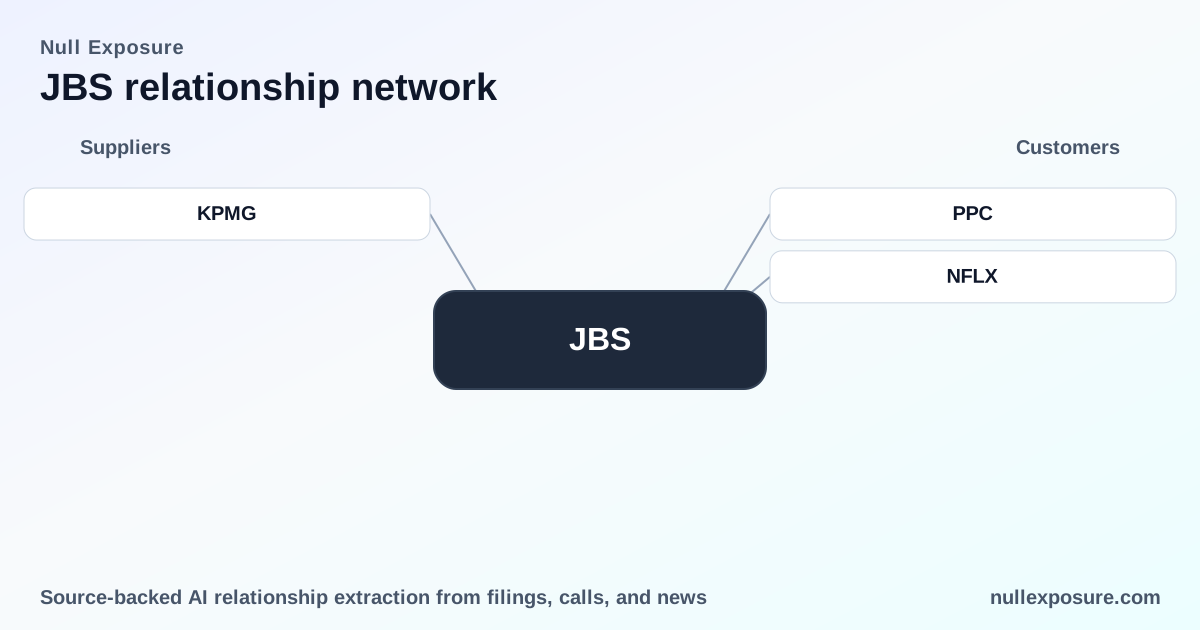
JBS customer relationships: what investors need to know
JBS N.V. is a vertically integrated global protein and food processor that monetizes through high-volume meat processing, branded prepared foods, and wholesale supply contracts with retailers and foodservice operators. Revenues come from a mix of commodity and branded sales across beef, pork, poultry and prepared meals, with margins driven by scale, procurement cost management, and downstream product innovation. For investors evaluating customer counterparty risk and growth optionality, the company’s disclosed customer mentions in the 2025 Q3 earnings call illuminate both core upstream exposure and emerging consumer-facing partnerships. For a concise view of JBS’s commercial footprint, visit https://nullexposure.com/.
Executive snapshot: key commercial takeaways
- Scale and diversification are core strengths. JBS operates across proteins and product formats, which reduces single-channel dependence while keeping raw material exposure high.
- Retail and foodservice remain critical revenue anchors. Long-term supply relationships and branded shelf placement drive recurring volumes and predictable cash flow.
- Innovation is a growing margin lever. New ready-meal portfolios and partnerships signal deliberate moves up the value chain toward higher-margin, consumer-facing products.
Operating model signals and business constraints investors should track
Treat these as company-level operational characteristics rather than relationship-level claims. JBS’s business model shows a mix of contracting postures: long-term supply relationships with major retailers and distributors coexist with spot and commodity-linked procurement that introduces price cyclicality. Concentration is sectoral rather than counterparty—revenue is concentrated in proteins and foodservice/retail channels, which raises sensitivity to input cost swings and consumer demand cycles. Criticality is high for large customers and major retail chains where shelf placement and volume commitments materially affect plant utilization. Maturity is uneven: commodity protein processing is a mature, low-margin core, while branded prepared foods and innovation initiatives (e.g., air‑fryer portfolios, ready meals) are younger, higher-margin growth levers. No discrete customer-specific contractual constraints were flagged in the provided dataset.
Relationships disclosed in JBS’s 2025 Q3 earnings call
Below are every customer-related mention captured from the 2025 Q3 earnings call transcript (document jbs-2025q3-earnings-call). Each entry below is reproduced and summarized in plain English with the cited source context.
Pilgrim’s Pride / PPC — jbs-2025q3-earnings-call (first seen 2026-03-07)
Pilgrim’s Pride was referenced as a growth-supporting business with a diversified portfolio and efficiency improvements that support expansion; this positions Pilgrim’s Pride as a meaningful poultry operating unit within JBS’s consolidated operations. According to the 2025 Q3 earnings call transcript (document jbs-2025q3-earnings-call, first seen March 7, 2026), management highlighted ongoing efficiency gains driving Pilgrim’s Pride growth.
PPC / Pilgrim’s Pride — jbs-2025q3-earnings-call (duplicate entry, first seen 2026-03-07)
The second listing is a duplicate mention of Pilgrim’s Pride (PPC) from the same earnings call, repeating that Pilgrim’s Pride continues to grow on the back of portfolio diversification and efficiency improvements. The duplicate entry in the same 2025 Q3 call confirms Pilgrim’s Pride’s prominence in JBS’s poultry strategy (jbs-2025q3-earnings-call, March 2026).
Netflix / NFLX — jbs-2025q3-earnings-call (first seen 2026-03-07)
JBS disclosed a consumer-facing partnership that includes bringing its brand closer to the consumer through initiatives with Netflix as part of broader innovation efforts, such as launching high-protein ready meals and an Air Fryer portfolio. In the 2025 Q3 earnings call (document jbs-2025q3-earnings-call, March 7, 2026), management framed the tie-up with Netflix as part of strategic marketing and product distribution moves to increase direct consumer relevance.
NFLX / Netflix — jbs-2025q3-earnings-call (duplicate entry, first seen 2026-03-07)
This duplicate mention reiterates the Netflix partnership within the same quarter’s earnings discussion, reinforcing that JBS is pursuing media-linked promotion and co‑branded consumer product initiatives. The second parsed mention in the 2025 Q3 call (jbs-2025q3-earnings-call, March 2026) emphasizes the same strategic intent around innovation and brand reach.
Why these relationships matter for investors
The Pilgrim’s Pride references underscore JBS’s internal consolidation and scale in poultry, an operating segment that provides downside protection when beef and pork cycles are volatile. Pilgrim’s Pride contributes to production flexibility and incremental margin through efficiency gains. The Netflix mentions are structurally different: they signal a deliberate push into consumer engagement and higher-margin prepared foods, representing a strategic shift from commodity wholesaling toward branded, marketed SKUs.
These two relationship types—subsidiary operating scale and media/consumer partnerships—illustrate JBS’s dual pathway to earnings resilience: protect core volume via vertical integration and extract higher margin via brand-led product innovation.
Visit https://nullexposure.com/ for deeper relationship analytics and to track future disclosures.
Investment implications and watchlist
- Margin dynamics: Expect core protein margins to remain correlated with agricultural input costs; the branded-ready meal strategy is intended to expand gross margins if consumer adoption scales. Track gross margin and operating margin trends in upcoming quarters.
- Concentration risk vs. upside optionality: While Pilgrim’s Pride dilutes single-protein exposure, JBS remains concentrated in protein markets; successful execution of consumer partnerships (e.g., Netflix) materially influences margin expansion.
- Execution risk on consumer pivot: Partnerships and new product portfolios require marketing intensity and distribution scale; failure to convert trial into repeat purchases would limit upside.
- Disclosure cadence: Monitor subsequent earnings calls and filings for contract details or revenue attribution that could shift risk assessments from qualitative to quantifiable.
Final takeaways
- Pilgrim’s Pride is core operational capacity and an ongoing contributor to growth via efficiency gains. The earnings call frames it as a stable volume source within JBS’s poultry footprint.
- The Netflix collaboration signals JBS’s strategic pivot toward consumer-branded, higher-margin products. This is a deliberate move to complement commodity processing with marketing-driven revenue.
- Company-level signals point to a mixed contracting posture (long-term retail supply and spot commodity exposure), high sector concentration, and an explicit push to mature branded offerings.
For active investors and operators tracking counterparty exposure and revenue quality, these customer mentions are material signposts of where JBS is allocating commercial effort and where earnings leverage is most likely to emerge. Explore ongoing relationship monitoring and forward-looking coverage at https://nullexposure.com/.