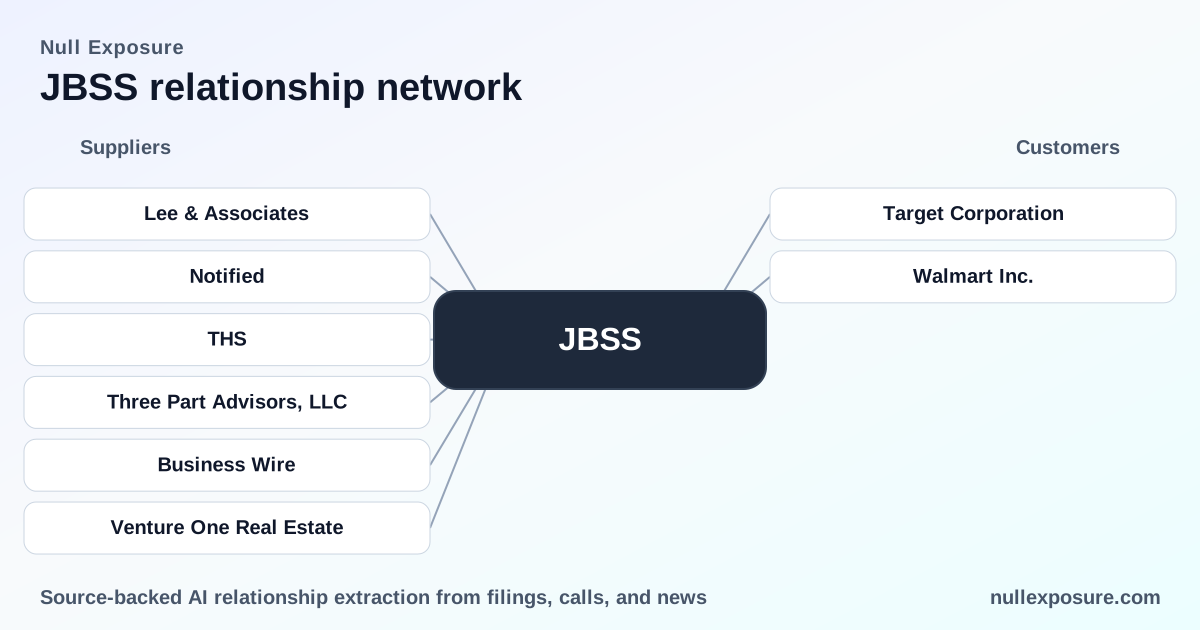
John B. Sanfilippo & Son (JBSS): Customer Concentration, Contracting Posture, and What Walmart/Target Relationships Mean for Investors
John B. Sanfilippo & Son (JBSS) operates as a processor, manufacturer and distributor of tree nuts, peanuts and a portfolio of snack and nutrition bars, monetizing through wholesale and retail sales across three distribution channels: consumer retail, commercial ingredient customers, and contract manufacturing. The company converts agricultural supply into packaged consumer goods and private-label products, capturing margins across processing, manufacturing and distribution, while depending materially on a small set of large retail customers for a substantial share of revenues. For investors, JBSS is a cash-generative, niche food-processor with clear topline concentration risk driven by the retail channel.
If you want deeper relationship signals and sourcing for portfolio due diligence, visit https://nullexposure.com/ for the full view of the JBSS customer map.
Why the customer picture matters now
JBSS reports fiscal sales heavily skewed toward a handful of retailers: Walmart accounted for roughly 40% of net sales in FY2025, and Target represented about 11%. Those two relationships alone explain a material portion of JBSS’s revenue volatility and bargaining dynamics. High concentration into large, sophisticated grocery chains compresses pricing leverage and exposes JBSS to slotting, promotional funding shifts, and category-level volume swings—but it also supplies predictable scale and working capital flow if relationships remain stable.
The two headline relationships (what the filings say)
This section covers every customer relationship found in the review.
-
Walmart Inc.
JBSS discloses that net sales to Walmart accounted for approximately 40% of its net sales for fiscal 2025, up from 39% in FY2024 and 36% in FY2023, indicating growing concentration with the retailer. According to JBSS’s FY2025 Form 10-K (filed June 26, 2025), Walmart is the single largest customer and represents the largest revenue dependency for the company. -
Target Corporation
JBSS reports net sales to Target represented about 11% of net sales in fiscal 2025, down from 13% in FY2024 and 15% in FY2023, reflecting a modest share relative to Walmart but still a top-tier retail partner. This disclosure is drawn from JBSS’s FY2025 Form 10-K (filed June 26, 2025).
What those relationships imply for revenue and risk
- Concentration risk is real and material. With Walmart at ~40% of revenues, JBSS’s sales profile is dominated by one buyer; any change in that buyer’s assortment strategy, promotional cadence, or private-label prioritization has outsized earnings implications.
- Scale benefits offset some risks. Large retail partners deliver volume stability, efficient distribution and predictable accounts receivable cycles that support JBSS’s working capital model and can underpin margin resilience when commodity pricing stabilizes.
- Visibility into future cash flow is conditional. Annual and quarterly purchase patterns from big-box retailers create predictable base-demand, but margin volatility will follow input-cost swings and retailer-driven promotional dynamics.
Company-level contracting and operating signals
The company’s filings provide useful, actionable signals about how JBSS manages customer relationships and commercial risk. These are company-level characteristics, not relationship-specific assertions.
- Short-term contracting posture. JBSS executes many fixed-price commitments with commercial customers and other customers for terms typically between three and twelve months, and payment terms largely settle within ~30 days. Commitments with terms of six months or more represented only about 2% of annual net sales in fiscal 2025. This implies limited long-term price protection against commodity swings and a business that re-prices frequently to market conditions.
- U.S.-centric operations. JBSS operates effectively in one reporting unit and a single operating segment, selling almost entirely within the United States, which concentrates both market opportunity and regulatory/supply chain exposure domestically.
- Integrated manufacturer-distributor model. The company both manufactures and distributes its product suite, selling through consumer, commercial ingredient and contract manufacturing channels; that vertical integration gives margin control and co-manufacturing flexibility but also concentrates operational risk in processing facilities.
- Active, diversified customer base with a few dominant accounts. JBSS sells to approximately 210 customers, which supports breadth, but the revenue split shows high concentration toward a handful of key retailers—this is a classic mix of diversification at the account-count level and concentration at the revenue level.
These signals combine into a clear operating profile: a short-duration contracting model with domestic concentration, tight working-capital cycles, and meaningful revenue dependence on major retail partners. For investors, that translates to a company that wins on operational execution and commodity management, but which is exposed to retailer terms and category-level pricing pressure.
Balance-sheet and margin context investors should keep front-of-mind
JBSS reported positive operating margins and generated EBITDA consistent with a mid-cap packaged-food player; its FY2025 disclosures show profitability and an established dividend policy. However, the company’s margin path is exposed to agricultural commodity cycles and the negotiating leverage of large retail customers. Active inventory and procurement management are therefore core to protecting margin and cash flow.
Investment implications and monitoring checklist
Investors evaluating JBSS should focus on a handful of monitoring items tied to the customer map and operating signals:
- Track retailer revenue share trends quarterly—Walmart’s share is the primary single-point risk.
- Monitor contract tenor and hedging language in filings to assess price protection; the company’s short-term fixed-price posture points to earnings sensitivity to nut commodity moves.
- Watch working-capital dynamics and receivables days given rapid payment cycles reported.
- Observe product-mix shifts between private label and branded channels, as changes will affect margin mix and bargaining leverage.
If you’re doing deeper counterparty diligence or portfolio-level exposure mapping, NullExposure provides the relationship-level filings and cross-checks used to build these signals—see more at https://nullexposure.com/.
Final take
JBSS combines manufacturing capability and distribution scale in a defensible snack/ingredient niche, but the company’s revenue profile is concentrated and operated on short contracting cycles within the U.S. market. For investors, JBSS is an operationally solid, cash-generative business whose upside is tethered to commodity cycle management and the stability of a few large retail relationships—Walmart in particular is the defining counterparty for upside and downside in the near term.