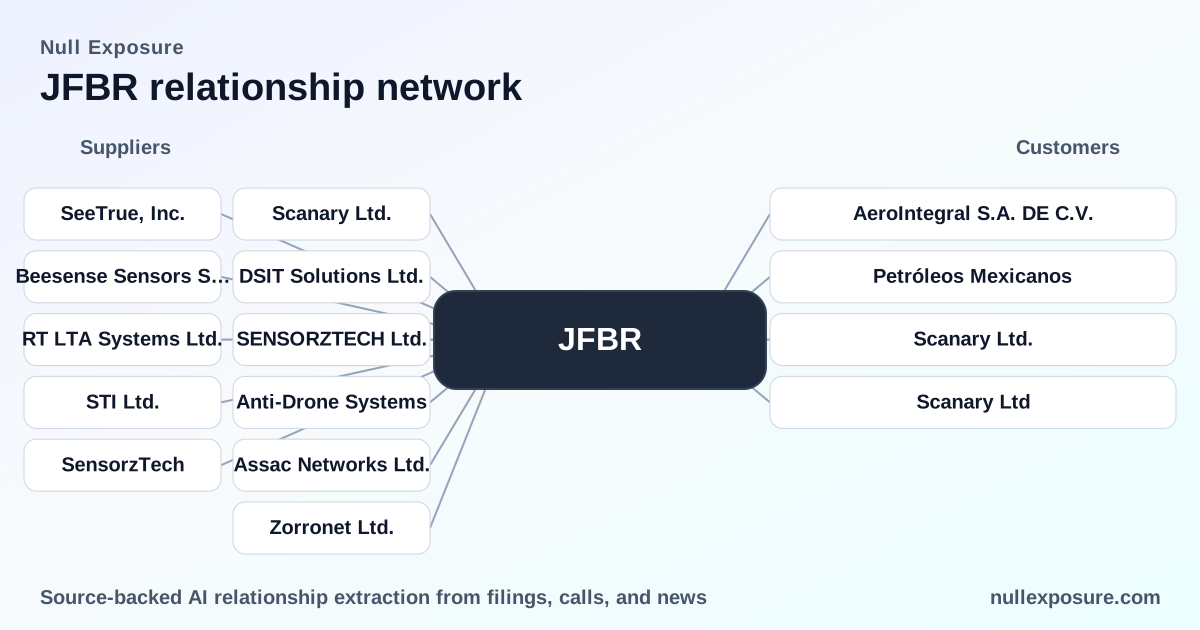
JFBR’s customer relationships signal a strategic pivot from Amazon retail to B2B/B2G homeland-security distribution
Jeffs’ Brands Ltd (Nasdaq: JFBR) is a data-driven e-commerce business that is actively redeploying capital and commercial effort into homeland security through its wholly owned subsidiary, KeepZone AI Inc. The company is monetizing this pivot by executing exclusive reseller and distribution agreements and by taking strategic equity positions, shifting revenue sources from consumer marketplace sales to multi‑year reseller fees, distribution margins, and government/enterprise contracts. For relationship-level intelligence, visit https://nullexposure.com/.
What changed: headline partnership activity and why it matters
Jeffs’ Brands has announced several discrete commercial tie-ups in early 2026 that collectively define the new go‑to‑market for KeepZone AI’s counter‑UAS (anti‑drone) solutions. These relationships create immediate distribution channels in Mexico and a pathway to government and critical‑infrastructure customers, while also reflecting a larger corporate pivot toward higher‑touch B2B and B2G sales. The company’s path to scale in this space is partnership‑led rather than organic R&D or direct procurement.
AeroIntegral S.A. DE C.V. — Reseller appointment in Mexico (GlobeNewswire, Jan 28, 2026)
Jeffs’ Brands’ KeepZone AI entered into a reseller agreement authorizing AeroIntegral to resell certain counter‑unmanned aerial systems (C‑UAS) in Mexico, executed under KeepZone’s exclusive reseller arrangement with a leading aerospace defense technology developer. According to a GlobeNewswire release dated January 28, 2026, the appointment grants AeroIntegral regional distribution rights and aligns KeepZone with a defense technology partner for hardware supply.
AeroIntegral S.A. DE C.V. — Expanded company statement (GlobeNewswire, Jan 28, 2026)
The company reiterated the reseller appointment in a separate GlobeNewswire statement on January 28, 2026, framing the move as part of Jeffs’ Brands’ expansion into global homeland security and highlighting KeepZone’s exclusive reseller relationship with the aerospace developer that supplies the C‑UAS platforms.
Petróleos Mexicanos (Pemex) — Identified target customer set (GlobeNewswire, Feb 25, 2026)
Jeffs’ Brands explicitly named Mexican government and state entities, including the Secretaría de la Defensa Nacional, Guardia Nacional, and Petróleos Mexicanos, as intended end customers for its C‑UAS offerings, subject to legal and regulatory approvals. A GlobeNewswire release on February 25, 2026 lists Pemex among targeted critical‑infrastructure customers, signaling an operational focus on energy sector security contracts.
Scanary Ltd. — Distribution agreement referenced in media (The Manila Times via GlobeNewswire, Feb 23, 2026)
Media coverage recounts a December 2025 distribution agreement between KeepZone AI and Scanary Ltd., which forms part of Jeffs’ Brands’ distribution network. The Manila Times reported on February 23, 2026 that the company pivoted into homeland security following this December agreement, indicating Scanary’s role as a distribution partner in the early commercial footprint.
Scanary Ltd. — Press release distribution noted in The Globe and Mail (Press release, early 2026)
A press release distributed through mainstream financial channels in early 2026 referenced the December 2025 distribution agreement with Scanary Ltd., and connected that deal to KeepZone AI’s first anti‑drone order while noting a Nasdaq compliance review. The Globe and Mail carried the announcement, underscoring the public and regulatory profile of these transactions.
Operating model and business‑model signals — what investors should infer
The recent relationship disclosures provide clear company‑level signals about how Jeffs’ Brands now operates in the defense and security vertical:
- Contracting posture: The firm is adopting an alliance‑and‑reseller model rather than direct manufacturing or wholesale distribution. Exclusive reseller and distribution agreements indicate reliance on third‑party suppliers for core hardware and on channel partners for local go‑to‑market execution.
- Concentration and counterparty risk: Early commercial activity is concentrated among a small set of resellers and a single aerospace supplier relationship, which elevates counterparty concentration risk even as it accelerates market entry.
- Criticality of customers: Targeting government agencies and national oil companies (e.g., Pemex) raises the stakes—contracts are likely higher value and longer dated but subject to procurement rules and approvals that extend sales cycles.
- Maturity and revenue predictability: This is an early‑stage commercial rollout. Revenue will be lumpy and partner‑dependent while Jeffs’ Brands builds reference customers and secures regulatory clearances.
- Contract complexity and compliance: Moving into defense and critical infrastructure inherently increases compliance, export control and contracting complexity relative to Amazon marketplace operations.
These signals point to a higher margin opportunity profile over time but also to longer cash conversion cycles and elevated execution risk during commercialization.
What each relationship means for growth, margin and risk
- AeroIntegral S.A. DE C.V. (GlobeNewswire, Jan 28, 2026): The reseller appointment in Mexico gives KeepZone immediate access to a local channel for C‑UAS sales and service, accelerating geographic penetration while introducing dependence on local partner execution (GlobeNewswire, Jan 28, 2026).
- AeroIntegral S.A. DE C.V. — company framing (GlobeNewswire, Jan 28, 2026): The duplicate disclosure reinforces the strategic framing that KeepZone’s path to market will be partner‑driven and reliant on an existing aerospace supplier relationship to provide the underlying hardware (GlobeNewswire, Jan 28, 2026).
- Petróleos Mexicanos (GlobeNewswire, Feb 25, 2026): Naming Pemex among target customers signals a focused commercial strategy toward energy and critical infrastructure accounts, which can lift contract sizes but will require procurement approvals and sector‑specific security clearances (GlobeNewswire, Feb 25, 2026).
- Scanary Ltd. (The Manila Times / TMT Newswire, Feb 23, 2026): The December 2025 distribution agreement with Scanary is cited as a foundational distribution move that underpins KeepZone’s early order flow, indicating early revenue pathways through third‑party distributors (Manila Times, Feb 23, 2026).
- Scanary Ltd. (The Globe and Mail press release, early 2026): Press distribution through high‑visibility outlets ties the Scanary agreement to KeepZone’s first anti‑drone order and to public‑company governance events, signalling that these commercial activities are material to investor communications and regulatory scrutiny (The Globe and Mail, early 2026).
Key takeaways for investors and operators
- Growth vector: Partnered distribution into Mexico and targeted outreach to government and energy customers create a credible near‑term channel for anti‑drone solutions.
- Execution risk: High counterparty concentration, procurement timelines, and regulatory compliance will determine whether early orders scale into predictable revenue.
- Margin potential: Distribution and reseller margins, plus possible recurring service revenues, offer upside versus pure e‑commerce margins if Jeffs’ Brands secures multi‑year government or enterprise contracts.
- Operational priorities: Focus on partner management, export/compliance readiness, and building verifiable operational references with government and critical‑infrastructure customers.
For investors and operators tracking JFBR’s pivot, the next data points to watch are contract awards from named PEMEX or defense agencies, revenue recognition from Scanary/AeroIntegral channels, and any further supplier disclosures from the aerospace partner. For ongoing relationship intelligence and to benchmark these developments against comparable commercial pivots, visit https://nullexposure.com/.
Jeffs’ Brands is moving from low‑touch marketplace retail to high‑touch B2B/B2G distribution; that transition creates clear upside if executed, but it amplifies execution and concentration risk in the near term.