9F Inc (JFU) — Customer relationships and the receivables risk investors must price
9F Inc operates a digital financial account platform in China that integrates third‑party financial services, personalizes product distribution, and monetizes through fee income, interest and spread economics, and partner servicing arrangements tied to retained assets under management. Public filings and reported results through mid‑2025 show material revenue and gross profit, but a structural divergence between strong gross margins and negative operating margin that makes customer credit and counterparty disputes a direct earnings lever. For a deeper look at customer exposure and one headline dispute, see the NullExposure homepage for broader coverage: https://nullexposure.com/.
The headline relationship: PICC Property and Casualty — a receivable under legal scrutiny
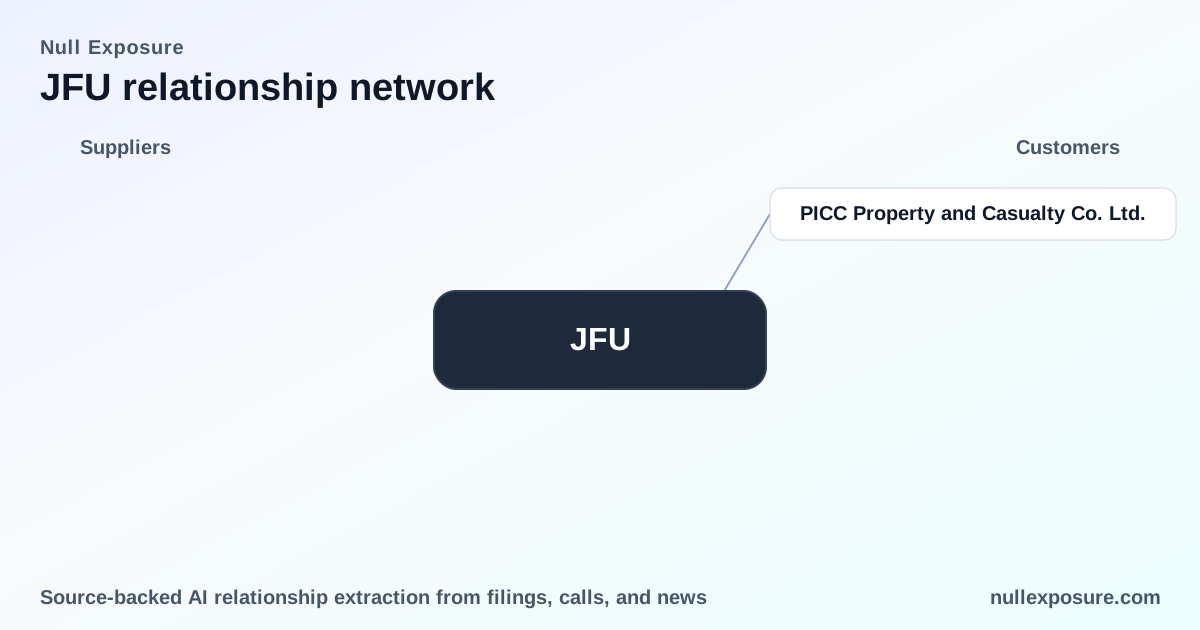
A March 2026 news report alleged that investors contend 9F failed to disclose that certain accounts receivable classified as uncollectible were actually funds owed by PICC Property and Casualty Co., Ltd., tying a large counterparty to a material accounting dispute. According to USA Herald (March 10, 2026), plaintiffs in an IPO‑related suit claim these receivables should have been transparent in disclosures (https://usaherald.com/chinese-fintech-9f-moves-to-dismiss-ipo-lawsuit/).
- PICC Property and Casualty Co. Ltd.: The allegation is that funds 9F labeled as uncollectible correspond to amounts due from PICC, raising questions about revenue/receivable recognition and counterparty concentration. Source: USA Herald, March 10, 2026 (news report).
This dispute is a single, concrete customer relationship captured in our coverage but its implications extend across financial statement quality, counterparty concentration, and potential litigation risk.
Why this single relationship matters for investors
9F’s model routes consumer flows and partner products through its platform, which concentrates credit transfer and settlement exposure with institutional partners. The PICC allegation directly targets the integrity of receivables and disclosure practices, so investors should treat this not as an isolated bookkeeping quibble but as a potential signal for:
- Counterparty concentration risk: If large receivables are tied to a few institutional partners, a dispute or nonpayment has outsized P&L and liquidity implications.
- Earnings quality: The company reports strong gross profit ($204.8M TTM) and positive EBITDA, yet operating margin is negative; adjustments for disputed receivables can swing reported profitability meaningfully.
- Legal and reputational risk: Litigation tied to IPO disclosures can reprice both governance premium and access to capital markets.
Company‑level operating signals investors should factor in
There are no constraints flagged in the customer‑relationship constraints feed for JFU, which in itself is a signal: no third‑party constraint excerpts were captured for the customer scope. Absent explicit constraints, the company profile and financials provide the next best operating signals.
- Contracting posture: 9F functions as an integrator between retail accounts and financial institutions; contracting is bilateral with institutional partners and distribution agreements with product providers. That posture makes the firm a node of settlement risk rather than a pure originator of credit.
- Concentration and ownership structure: Public data show high insider ownership (≈47%) and negligible institutional ownership, which concentrates control and reduces typical institutional governance pressure on counterparty and disclosure practices.
- Criticality and maturity: 9F is a listed firm with meaningful revenue (Revenue TTM ~$290M) and high gross margin but a negative operating margin; this combination reflects a business that has matured revenue lines but still invests heavily in operating scale, making short‑term earnings sensitive to customer receivable shocks.
- Financial resilience: Positive EBITDA and an EV/EBITDA multiple consistent with low market valuation indicate that counterparties and receivable recognition are central to enterprise value today.
Those signals are company‑level and are not attributed to any specific customer because the constraints feed contains no explicit constraint excerpts naming relationships.
Practical implications for underwriting and portfolio managers
Underwriting 9F credit or sizing an equity position requires active monitoring across three vectors:
- Receivable composition and aging: Track how much of accounts receivable are linked to a few institutional counterparties versus diversified retail flows.
- Litigation and disclosure timeline: Watch court filings and IPO‑related disclosures for adjustments to previously reported receivables. The PICC allegation is already in the public record via litigation reporting (USA Herald, Mar 2026).
- Governance and shareholder alignment: High insider ownership changes the remediation calculus—activist or institutional catalysts for disclosure improvements are currently scarce.
Relationship-by-relationship review (complete coverage)
PICC Property and Casualty Co. Ltd. — Investors alleged that 9F classified certain accounts receivable as uncollectible even though those amounts were funds owed by PICC, raising potential disclosure and receivable recognition issues; this allegation is reported in an IPO‑related lawsuit narrative. Source: USA Herald news report, March 10, 2026 (https://usaherald.com/chinese-fintech-9f-moves-to-dismiss-ipo-lawsuit/).
What to watch next and actionable signals
- Quarterly receivables disclosure: Reconciliations and counterparty schedules that show concentration and aging will move the valuation more than top‑line growth metrics.
- Court docket developments: A resolution or settlement of the PICC allegation will re‑rate governance risk and potentially reverse provisions or recoup amounts.
- Earnings‑quality adjustments: Reclassifications or restatements tied to disputed receivables will have immediate P&L and cash‑flow impacts given the firm’s operating leverage.
For investors and operators wanting continuous monitoring and structured signals around 9F’s customer exposures and litigation trajectory, NullExposure maintains an updated tracker and relationship analytics hub at https://nullexposure.com/.
Bottom line
9F is a revenue‑generating platform with robust gross margins but operating leverage that amplifies customer disputes. The PICC receivable allegation is the single customer relationship flagged in our coverage and it is material because it strikes at receivable recognition and counterparty concentration—two principal drivers of near‑term value. Investors should prioritize receivable composition, litigation outcomes, and governance signals when sizing exposure to JFU.