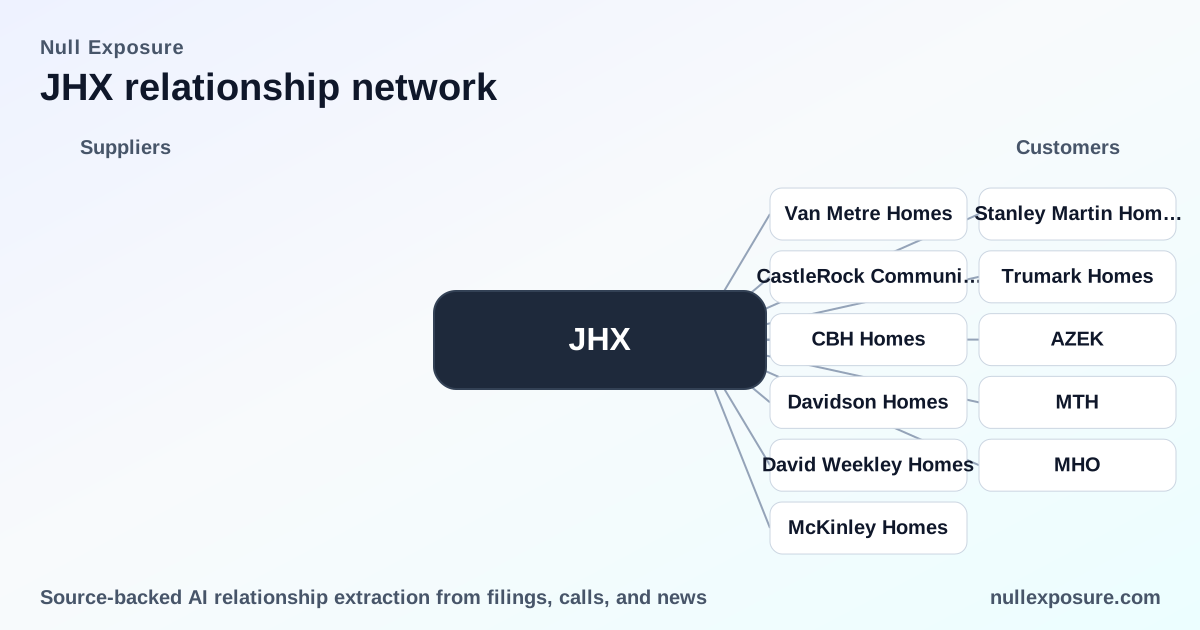
James Hardie (JHX) — Customer Map and Commercial Levers for Investors
James Hardie manufactures and sells fiber cement and related building products to large national homebuilders, regional builders and remodelers; it monetizes through product sales, installation support and multi-year exclusive supply agreements that create recurring demand and margin leverage. Recent multi-year national exclusivity deals with major builders and a strategic growth platform agreement with AZEK materially raise revenue visibility and embed Hardie deeper into the U.S. homebuilding supply chain. For a deeper look at the source coverage behind these relationships, visit https://nullexposure.com/.
Why the customer roster matters more than raw volumes
James Hardie's move into multi-year national exclusivity agreements signals a deliberate contracting posture: the company is securing preferred-supplier status with large builders rather than selling primarily on spot price. That posture converts product sales into higher-quality revenue streams—greater predictability, potential for higher gross margins, and stronger switching costs for builders that standardize on Hardie siding and trim.
The customer list also reflects concentration toward national and high-volume regional builders, which is a double-edged sword: concentration increases revenue visibility when partnerships hold, but it also raises customer-dependent execution risk if a large partner pivots. Operationally, James Hardie is demonstrating maturity—its investor-day engagement with partners and a strategic tie-up with AZEK show a company shifting from product supplier to integrated building-products platform.
A note on data extraction: no formal constraints were machine-extracted for contracting thresholds or exclusivity terms, so the qualitative signals above come from company statements and press coverage rather than structured contract disclosures.
Customer-by-customer: what each relationship signals for revenue and risk
Below are plain-English summaries of every customer relationship captured in the source coverage, each with its original source called out for investor diligence.
Meritage Homes (MTH)
Meritage is listed among builders with newly announced multi-year national hard siding and trim exclusivity agreements, indicating Meritage has standardized Hardie products across its national footprint and provides predictable, high-volume demand. According to James Hardie's 2025 Q4 earnings call commentary (reported March 2026), Meritage is part of this group commitment.
M/I Homes (MHO)
M/I Homes is also named in the company’s announcement of multi-year national exclusivity for Hardie siding and trim, signaling a deepening commercial partnership that supports recurring sales into M/I Homes’ communities. This information was disclosed in JHX’s 2025 Q4 earnings call (March 2026).
David Weekley Homes
David Weekley appears on the same list of national exclusivity partners, which positions Hardie as the preferred exterior solution for one of the larger U.S. private builders and improves forward-looking revenue visibility. The mention originates from James Hardie’s 2025 Q4 earnings call (March 2026).
Stanley Martin Homes
Stanley Martin is included among the builders that have executed multi-year national exclusivity agreements, reinforcing the pattern of Hardie locking in supply relationships with established national builders. This was stated in the JHX 2025 Q4 earnings call (March 2026).
CastleRock Communities
CastleRock Communities is cited as a party to the same multi-year exclusivity package, suggesting Hardie is targeting large production builders and volume-driven residential segments. Source: James Hardie 2025 Q4 earnings call (March 2026).
Trumark Homes
Trumark Homes is another named builder in the list of exclusivity agreements, extending Hardie’s reach across multiple national builders and regions. This disclosure came during the JHX 2025 Q4 earnings call (March 2026).
CBH Homes
CBH Homes was identified among the firms securing national exclusivity for Hardie’s siding and trim, underlining Hardie’s strategy to make product selection decisions more sticky at the builder level. Source: James Hardie 2025 Q4 earnings call (March 2026).
Davidson Homes
Davidson Homes is included in the multi-year exclusivity group, reinforcing the company’s broad penetration across national and regional builders. The detail was provided in JHX’s 2025 Q4 earnings call (March 2026).
McKinley Homes
McKinley Homes appears in the exclusivity cohort, showing Hardie’s campaign to convert builder portfolios into consistent, recurring customers. Source: James Hardie 2025 Q4 earnings call (March 2026).
Van Metre Homes
Van Metre Homes publicly dropped vinyl in favor of fiber cement, choosing James Hardie products for new designs—an explicit example of product substitution that improves installed ASPs and long-term warranty exposure for Hardie. This detail was discussed at the company’s investor day and reiterated in the 2025 Q4 earnings call (March 2026).
Tri Pointe Homes (TPH)
Tri Pointe Homes included James Hardie as a partner in the “LivingWell” wellness-driven home concept, where Hardie provided Hardie® fiber cement siding for model homes, reflecting brand placement in higher-profile product initiatives. This was noted in a GlobeNewswire release and BuilderOnline coverage in late March/early May 2026 (Mar–May 2026).
RPS Remodeling
RPS Remodeling and an individual partner example (Rick James of RPS) were mentioned in coverage describing channel shifts—one remodeler transitioned decking away from a competitor to TimberTech, while remaining a siding partner—illustrating how Hardie participates in the remodeler/contractor channel as well as new construction. Reported in earnings-call transcripts and follow-up news coverage in May 2026 (Investor call transcripts and media summaries, May 2026).
AZEK Company (AZEK)
James Hardie announced a strategic initiative with AZEK to create a leading growth platform in building products, signaling potential M&A-style scale benefits, cross-selling opportunities and broader product portfolio integration. Company statements on the 2025 Q4 earnings call (late March 2026) quantified this as a strategic platform move.
What these relationships imply for investors
- Commercial strategy: Hardie is locking in multi-year exclusivity deals with national builders—this converts transactional sales into higher-quality contractual demand and supports better revenue visibility.
- Concentration and counterparty risk: A meaningful share of incremental demand is concentrated in large builders; if one large partner changes specification, quarterly results could be volatile despite longer-term contracts.
- Product substitution and margin upside: Remarks from Van Metre and inclusion in Tri Pointe’s wellness concept show product substitution (vinyl → fiber cement) and premium positioning that support higher installed pricing and margin expansion.
- Platform growth: The AZEK collaboration is a structural signal: Hardie is moving toward broader building-products integration, which increases cross-sell potential and creates scale economics across siding and adjacent categories.
- Channel diversity: Coverage spans national builders, regional builders and remodelers, indicating diversified go-to-market channels that reduce single-channel dependency despite concentration within large-builder partnerships.
If you want a concise, sourced map of James Hardie’s customer relationships and the commercial implications for modeling revenue and counterparty risk, explore full coverage at https://nullexposure.com/.
Bottom line
James Hardie has converted product leadership into contractual relationships with scale builders and is executing a strategic partnership to enlarge its building-products footprint. For investors, the company’s commercial posture—favoring multi-year exclusivity and platform partnerships—creates higher revenue visibility and margin potential, balanced by concentration risk with a handful of large builders.