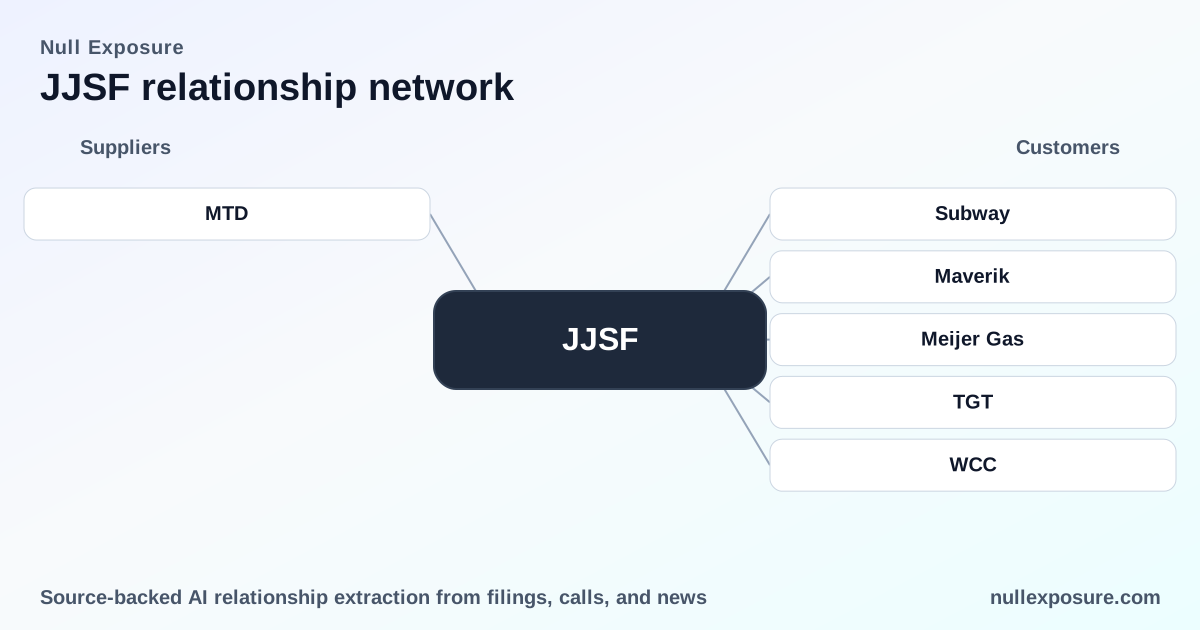
J&J Snack Foods (JJSF) — customer relationships and what they mean for investors
J & J Snack Foods generates revenue by manufacturing and distributing branded frozen snacks and beverages (ICEE, Dippin’ Dots, Superpretzel, Hola! Churros, etc.) to large retail and foodservice customers, monetizing through product sales, equipment placement, and ancillary repair/maintenance services. The business mixes short-term transactional supermarket and foodservice contracts with higher-margin bundled offerings tied to brand/licensing and equipment service, producing a revenue base concentrated among a handful of large customers while retaining pricing flexibility. For a concise commercial-risk scorecard and source-backed relationship mapping, visit https://nullexposure.com/.
Quick investor thesis
J & J Snack is a branded packaged-foods manufacturer whose growth strategy is product innovation and retail/foodservice rollouts with national partners. Revenue is materially concentrated — top ten customers roughly account for mid-40% of sales — and the company operates with short-term sales contracts and a mix of direct distribution and third-party brokers. That structure yields predictable near-term cash flows but exposes margins to retailer negotiation and customer mix shifts.
Customer relationships: who they sell to (direct citations)
Below are every relationship identified in public coverage and where those mentions were recorded. Each entry is a plain-English summary with the source named.
-
Subway — J & J developed a custom footlong churro for Subway in 2023, engineered specifically to fit Subway’s operational needs while preserving the product experience, illustrating J & J’s capability to deliver custom formats for major foodservice partners. Source: Snack & Bakery article covering the Hola! Churros rollout (March 2026).
-
Maverik — The Froot Loops–inspired ICEE flavor from J & J is listed as available at select retailers including Maverik, showing the company’s channel penetration into convenience-store chains and travel-retailer formats. Source: Food Business News coverage of the Froot Loops ICEE launch (March 2026).
-
Meijer Gas — Meijer Gas was cited alongside Maverik as an initial retail outlet for the new Froot Loops ICEE flavor, indicating distribution placements that target quick-serve convenience and gas-station forecourt channels. Source: Food Business News (March 2026).
-
Urban Air Adventure Park — Dippin’ Dots (and related frozen-novelty brands) became the exclusive frozen-treat provider at Urban Air Adventure Park nationwide, expanding J & J’s footprint across more than 350 locations and demonstrating success in experiential/entertainment venue partnerships. Source: Simply Wall St summary of brand partnership activity (May 2026).
-
TGT (Target) — The Food Business News release notes the Froot Loops ICEE rollout will include Target stores; the item is referenced with ticker TGT in coverage, underlining expansion into national big-box retail chains. Source: Food Business News (March 2026).
-
Target — Coverage also directly lists Target among retailers slated to receive the Froot Loops ICEE product this summer, reinforcing Target as a formal retail partner for new SKU launches. Source: Food Business News (March 2026).
-
Wesco (WCC) — Wesco appears in the same Food Business News distribution list for the Froot Loops ICEE roll‑out; inclusion of a distribution/retail partner like Wesco reflects J & J’s multi-channel placement strategy across entertainment venues and supermarkets. Source: Food Business News (March 2026).
What these relationships reveal about the operating and commercial model
These customer ties, combined with company disclosures, sketch a coherent operating profile:
-
Short-term contracting posture with transactional buyers. J & J’s own disclosures state that product performance obligations are generally satisfied within 30 days and that customers typically do not enter long-term contracts; this implies high revenue visibility in the near term but limited long-term contractual lock-in.
-
Large-enterprise counterparties dominate the book. The company explicitly identifies supermarket chains and major retailers as primary customers; coverage naming Target, Maverik, Meijer, and national foodservice partners aligns with a buyer base of large enterprises that command negotiating leverage on price, slotting, and promotions.
-
Geographic concentration across North America. Public statements note frozen-beverage and foodservice sales primarily in the United States, Mexico and Canada; coverage of U.S. national rollouts and venue partnerships reinforces a North American commercial footprint.
-
Material customer concentration. Company filings disclose the top ten customers accounted for 46% of sales in FY2025, signaling material counterparty concentration that elevates single-customer and channel risk relative to more diversified packaged‑foods peers.
-
Hybrid route-to-market: seller + distributor + service provider. J & J sells direct to retailers, routes product through food brokers and independent distributors, and provides repair/maintenance services on customer-owned equipment — a blended model that supports product placement but also creates operational complexity and service obligations.
-
Services segment niche. Repair and maintenance contracts are recognized over time and represent a complementary revenue stream that enhances stickiness in equipment-dependent categories (e.g., beverage dispensers), offering modest margin uplift and higher customer switching costs where equipment is installed.
Key investment implications
-
Revenue resilience with pricing pressure risk. Short-term contracts and reliance on large retail partners mean headline sales are resilient in recessions for staple indulgences, but margins are vulnerable to negotiations, promotional activity, and commodity cost swings.
-
Product innovation and channel execution are drivers of upside. Successful national rollouts—evidenced by ICEE flavor extensions and entertainment-venue exclusives—are high-leverage events that convert marketing spend into expanded shelf and venue penetration.
-
Concentration is a balanced risk. Top-ten customer concentration (~46% of sales) provides scale economics but also raises idiosyncratic risk; loss or weakening of a major account would materially affect near-term results.
-
After-sales services add differentiation. Equipment maintenance revenue creates operational stickiness and an installed-base revenue stream that improves lifetime customer value relative to pure SKU suppliers.
For a consolidated scorecard that maps these customer exposures against financial metrics and scenario stress tests, see more at https://nullexposure.com/.
Final take
J & J Snack’s commercial profile is scale-oriented, North America-focused, and execution-driven: new SKU rollouts and venue partnerships unlock growth, while short-term contracts and customer concentration create profit volatility and demand active account management. Investors should weigh the company’s proven route-to-market and innovation pipeline against the negotiating leverage of national retail partners and the concentrated customer base when modeling forward margins and downside scenarios.