Jack Henry & Associates: customer momentum, sticky economics, and what the win-flow tells investors
Jack Henry & Associates (NASDAQ: JKHY) is a payments and core banking technology provider to community and regional financial institutions; it monetizes through a mix of software licenses, long-term hosting and maintenance contracts, transaction processing fees, and professional services. The company’s economics are driven by highly recurring service revenue, multi-year contract structures, and usage-based processing fees that scale with client activity—a profile that supports durable margins and strong free cash flow generation. For investors assessing customer relationships, recent announcements reveal continued core conversions, targeted fraud and AML deployments, and ecosystem integrations that extend both revenue visibility and cross-sell optionality.
For a concise navigator to these relationship signals, visit the Null Exposure homepage: https://nullexposure.com/
How Jack Henry’s commercial model actually works in practice
Jack Henry sells a hybrid product set: on-premise licensed software, hosted private and public cloud offerings, transaction processing services, and professional services for conversions and integrations. Contractual design is a key value determinant:
- A substantial portion of hosted and recurring payment services run on multi-year contracts (typically six years for hosted and recurring electronic payment solutions), creating predictable recurring revenue and switching costs.
- On-premise customers use one-year maintenance/license arrangements while hardware sales are recognized on delivery, so there is a mix of both long-duration and short-duration revenue streams.
- Processing revenue is transaction-based and "stand-ready" in nature—fees are charged per transaction with tiered or variable pricing, producing upside in periods of higher client activity.
These characteristics produce concentration toward domestic financial institutions (international revenue under 1%), a service-provider orientation with licensor economics for software customers, and a generally mature relationship base focused on long-term retention and cross-sell. These are company-level operating signals derived from Jack Henry’s public disclosures (FY2025–FY2026 filing language and investor materials).
Client wins and partnerships you should track now
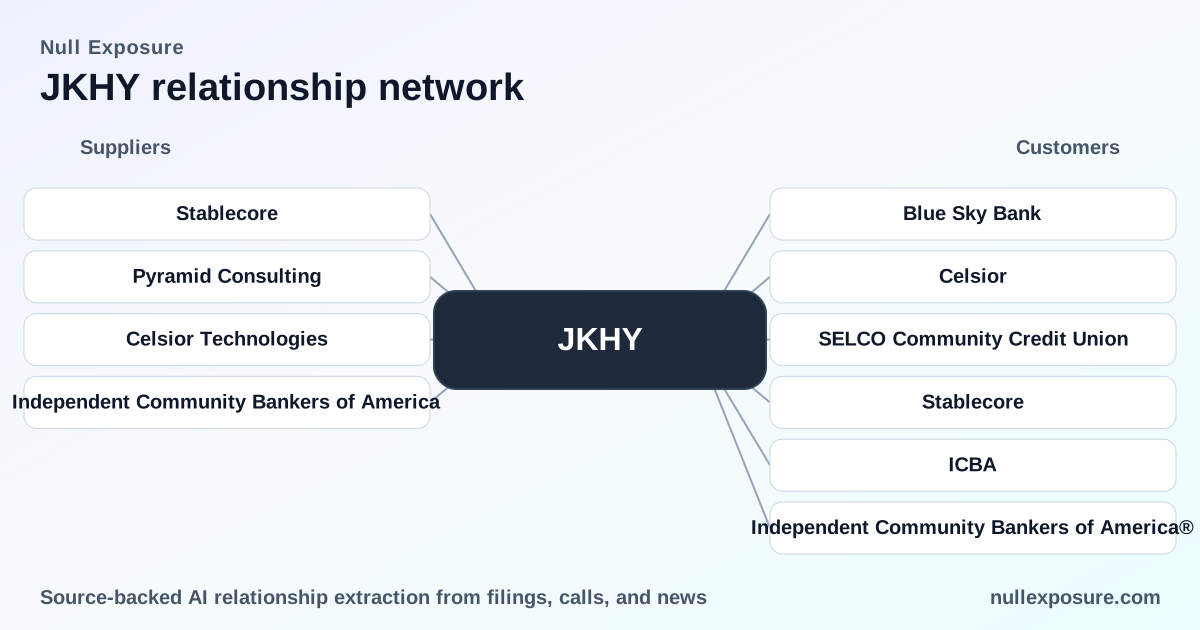
Below I catalog every customer and partner relationship surfaced in the available signals; each entry is a plain-English summary with a concise source reference.
Blue Sky Bank
Blue Sky Bank selected Jack Henry to modernize retail and commercial banking with a mix of self-service and personal banking experiences, signaling a core and digital transformation engagement. Source: company press release reported via PR Newswire / Sahm Capital (Feb–Mar 2026).
QCR Holdings (QCRH)
QCR Holdings confirmed that its new core and AI-enabled digital modernization efforts will rely on Jack Henry as a primary partner, positioning Jack Henry as the integrator of AI capabilities into retail and commercial workflows. Source: QCRH Q1 2026 earnings call transcript and analyst Q&A (May 2026).
Mercantile Bank (MBWM)
Mercantile Bank plans a core upgrade to Jack Henry’s platform as part of its merger-driven integration, leveraging the acquirer’s prior experience to execute a conversion targeted for completion by Q1 2027. Source: merger coverage via Pulse2 (reported Mar 2026).
SELCO Community Credit Union
SELCO adopted Jack Henry’s Financial Crimes Defender for fraud mitigation and AML, a focused deployment that highlights Jack Henry’s traction in compliance and risk tooling. Source: Jack Henry press and trade coverage reported across Digital Transactions, Finviz, and MarketScreener (Feb–Mar 2026).
FM Bank
FM Bank selected Jack Henry to “elevate service,” indicating a customer-facing upgrade or digital modernization engagement alongside Quoin Financial Bank. Source: Jack Henry PR summarized on Finviz (Mar 19, 2026).
Quoin Financial Bank
Quoin Financial Bank joined FM Bank in selecting Jack Henry’s solutions to improve customer service capabilities, consistent with targeted retail/commercial digital upgrades. Source: Jack Henry PR (Mar 19, 2026).
Celsior
Celsior joined Jack Henry’s Fintech Integration Network, a partnership that broadens Jack Henry’s third-party fintech ecosystem and creates integration-led cross-sell opportunities. Source: coverage on SimplyWall.St (Mar 2026).
Stablecore
Stablecore integrated with Jack Henry to enable stablecoin payment acceptance, reflecting Jack Henry’s strategy to expand payments rails and fintech integrations. Source: SimplyWall.St and Digital Transactions reporting (Mar 2026).
Independent Bancshares Inc.
Independent Bancshares selected Jack Henry to modernize core infrastructure, a typical mid-market core conversion that supports recurring services and processing revenue. Source: MarketScreener and Loop Capital reporting (Mar–May 2026).
Independent Community Bankers of America (ICBA)
The ICBA added Jack Henry’s Financial Crimes Defender to its Preferred Service Provider program, formally expanding Jack Henry’s distribution and endorsement channel into community banking. Source: PR Newswire / ICBA program announcement (Mar 2026).
MainStreet Bancshares (MNSB)
MainStreet Bancshares referenced long-term use of Jack Henry for remote deposit and core processing, reinforcing Jack Henry’s entrenched position among legacy clients for payments and deposit services. Source: earnings call coverage (The Globe and Mail / Motley Fool transcripts, Mar 2026).
Farmers National Banc (FMNB)
Farmers National Banc continues planning for a core conversion and migration to Jack Henry, with elevated near-term technology spend and migration costs disclosed, indicating typical conversion cadence and investment. Source: earnings and disclosure coverage via TradingView (May 2026).
What these relationships imply for revenue quality and risk
Taken together, the deal flow shows three strategic dynamics that matter to investors:
- Recurring, sticky revenue: multiple core conversions and hosted client contracts indicate revenue that converts to long-duration maintenance and processing streams (consistent with Jack Henry’s disclosure of typical six-year hosted contracts).
- Cross-sell into risk and payments: Financial Crimes Defender wins (SELCO, ICBA program) and fintech integrations (Stablecore, Celsior) show execution on product bundling and platform monetization.
- Conversion cadence and near-term expense: core migrations (Mercantile, Independent Bancshares, FMNB) drive upfront professional services and integration spend that depress margin temporarily but increase long-term ARR and processing revenue.
Key takeaways for investors
- Stickiness is real: long-term hosting and recurring payment contracts create durable revenue and high customer lifetime value.
- Platform+ecosystem strategy: fintech network integrations and channel endorsements (ICBA) expand distribution without proportionally large sales spend.
- Conversion risk is bounded: migration announcements imply near-term implementation costs and execution risk, but successful conversions deepen product penetration.
- Geographic concentration: revenue is overwhelmingly domestic (<1% international), focusing regulatory and competitive exposure on U.S. community and regional banks.
For more signals and a centralized view of customer relationships and contract characteristics, see the Null Exposure research hub: https://nullexposure.com/
Investors should weigh the growth runway provided by core conversions and ecosystem expansion against the timing of professional services revenue and integration costs; the customer flow documented in recent announcements supports continued ARR growth and incremental processing volume over the medium term.
Bold final takeaway: Jack Henry’s recent customer activity demonstrates classic SaaS-plus-payments economics—long-term contracted revenue plus transaction-linked upside—making customer retention and core migration execution the primary drivers of near- to medium-term value creation.