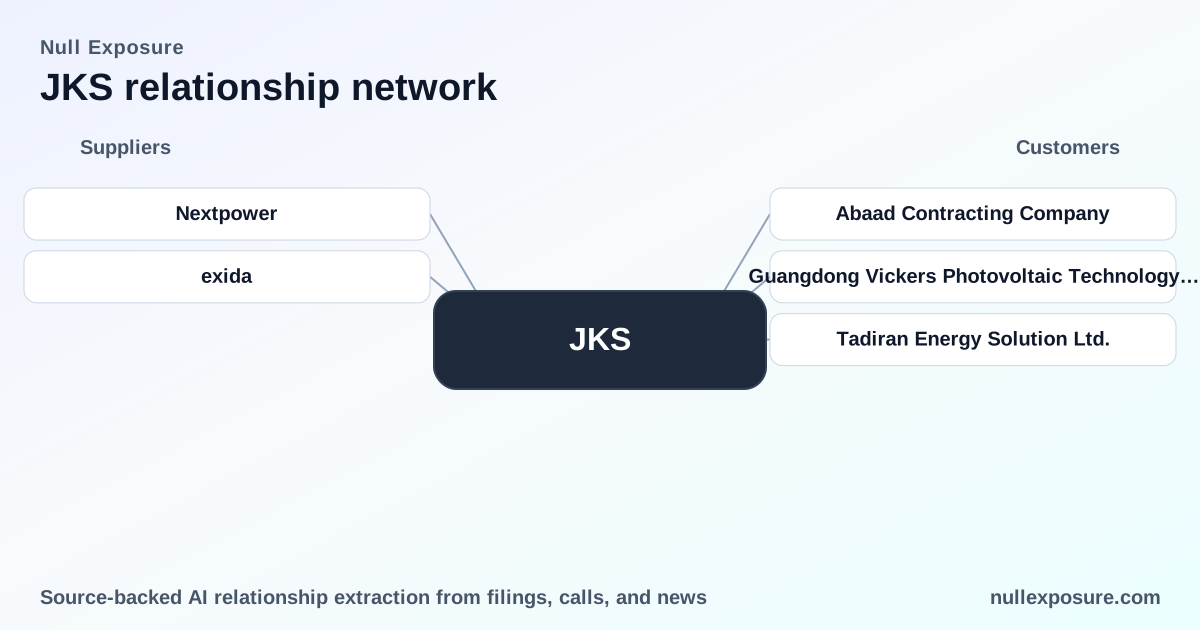
JinkoSolar (JKS) — customer relationships that define revenue mix and execution risk
JinkoSolar sells photovoltaic modules, energy storage systems and project-level equipment and monetizes through product sales to commercial & industrial (C&I) customers, EPC/project supply agreements and downstream project participation; the company captures value from module and ESS hardware sales and from large project integrations that drive recurring O&M and spare-part revenues. For investors, the portfolio of named customers and project partners signals a dual revenue stream: commodity-like module sales supplemented by higher-margin system and storage contracts that increase customer stickiness and cross-sell opportunity. Learn more about the coverage and signals at https://nullexposure.com/.
Quick take for investors: what matters now
JinkoSolar’s disclosed customer relationships in public news highlight three themes that drive near-term investor decisions:
- Growing ESS sales alongside module supply — Jinko is shifting from pure module supplier to integrated ESS vendor, which increases order ticket size and delivery complexity.
- Geographic diversification — named customers span the Middle East and Europe, reducing single-market concentration risk.
- Partner and project exposure — relationships with contractors, local integrators and developers show a mix of transactional sales and project-level commitments that require reliable delivery and warranty performance.
Financial context: Revenue TTM is listed at 63.9 billion CNY with negative EPS and compressed profit margins, indicating that execution on higher-margin system sales will be essential to restore profitability. As of the latest quarter (2026-03-31), investors should weigh sales progress against operating margins and working-capital demands.
Reported customer and project relationships (source-by-source coverage)
Abaad Contracting Company — large containerized ESS order for Uganda
JinkoSolar will supply two 20ft containerized SunTara ESS units (totaling 6.88 MWh) to Abaad Contracting Company for the Bussi Island project in Uganda, reflecting Jinko’s role as a vendor of large-format, liquid-cooled energy storage systems in international C&I and island-grid markets. According to GreenBuildingAfrica’s March 10, 2026 article, the shipment is part of a multi-customer dispatch of modular ESS products to the Mideast and African markets (https://www.greenbuildingafrica.co.za/jinko-solar-supplies-ci-ess-to-bussi-island-in-uganda/).
Guangdong Vickers Photovoltaic Technology Company Limited — bulk C&I ESS installation
JinkoSolar agreed to supply 70 sets of C&I energy storage systems to Guangdong Vickers Photovoltaic Technology Company Limited, representing a total installed capacity of roughly 15 MWh and underscoring scale demand from Chinese integrators for packaged storage solutions. The transaction and capacity figure were reported by GreenBuildingAfrica on March 10, 2026 (https://www.greenbuildingafrica.co.za/jinko-solar-supplies-ci-ess-to-bussi-island-in-uganda/).
Tadiran Energy Solution Ltd. — SunGiga ESS units for peak shaving in the Mideast
JinkoSolar sold eight SunGiga ESS units (combined rated capacity of 1.72 MWh) to Tadiran Energy Solution Ltd., targeted at peak shaving applications for Mideast customers and highlighting product segmentation between containerized SunTara units and smaller SunGiga deployments. This sale was noted in the same GreenBuildingAfrica coverage on March 10, 2026 (https://www.greenbuildingafrica.co.za/jinko-solar-supplies-ci-ess-to-bussi-island-in-uganda/).
ELLO (Ellomay) — module supplier to 300 MW Talasol PV project in Spain
JinkoSolar supplied ultra-high-efficiency Cheetah modules used in the 300 MW Talasol photovoltaic plant in Spain, where Ellomay/its project vehicle reached grid connection in December 2020; this confirms Jinko’s continuing participation in large-scale European utility projects as a module vendor. TaiyangNews reported the module deployment and project milestones on March 9, 2026 (https://taiyangnews.info/business/300-mw-solar-pv-project-online-in-spain).
What these relationships reveal about JinkoSolar’s operating model
The customer list demonstrates that JinkoSolar operates on a mixed contracting posture: transactional hardware sales to developers and integrators (modules, smaller ESS units) combined with project-supply and containerized ESS contracts that impose longer delivery horizons and integration risk. The move into large-capacity storage systems increases contract size and supply-chain dependency while strengthening after-sales revenue potential via O&M and warranty services.
Because the supplied data set contained no formal operational constraints or contract excerpts, there is no structured disclosure here of contract length, payment milestones or concentration limits; therefore, company-level signals must be inferred from customer types and product mix rather than from explicit contractual constraints.
Implications for revenue concentration, criticality and maturity
- Concentration: Customers listed are diverse in geography and type (contractor, local integrator, independent power developer), suggesting moderate customer diversification rather than heavy reliance on a single buyer. This reduces single-counterparty revenue shock but increases execution complexity across regions.
- Criticality: ESS and module deliveries to island and utility projects are mission-critical for buyers; missed deliveries or warranty issues would have outsized reputational and financial consequences. These are strategic wins that also raise the bar on supply-chain reliability.
- Maturity: Module supply to a 300 MW Spanish plant reflects established capability in utility-scale projects, while the ESS orders signal a maturing storage product line that is transitioning from pilot deployments to larger commercial rollouts.
Risk and upside for investors
- Upside: higher-margin system and ESS sales can materially improve gross margin profile if JinkoSolar sustains volume and controls component costs. International project wins give access to developed-market pricing and longer-term service contracts.
- Risk: Execution risk increases with ESS integration; large containerized systems require complex logistics, thermal-management warranties and local commissioning capabilities. Jinko’s negative EPS and thin operating margins mean that delivery setbacks could pressure cash flow and working capital further—monitor order backlogs, timing of shipments and warranty reserve disclosures in upcoming filings.
For ongoing monitoring, investors should review quarterly order-book updates and delivery schedules in JinkoSolar filings and track operational metrics tied to ESS rollouts. Additional analysis and relationship mapping are available at https://nullexposure.com/.
Bottom line
The disclosed customer relationships signal that JinkoSolar is evolving from a pure module supplier into an integrated vendor of energy storage and system-level solutions, with the potential for higher-ticket sales and recurring service revenue but also increased delivery and execution risk. Investors should track execution on these ESS contracts and the company’s ability to convert project wins into margin expansion over the next four quarters.