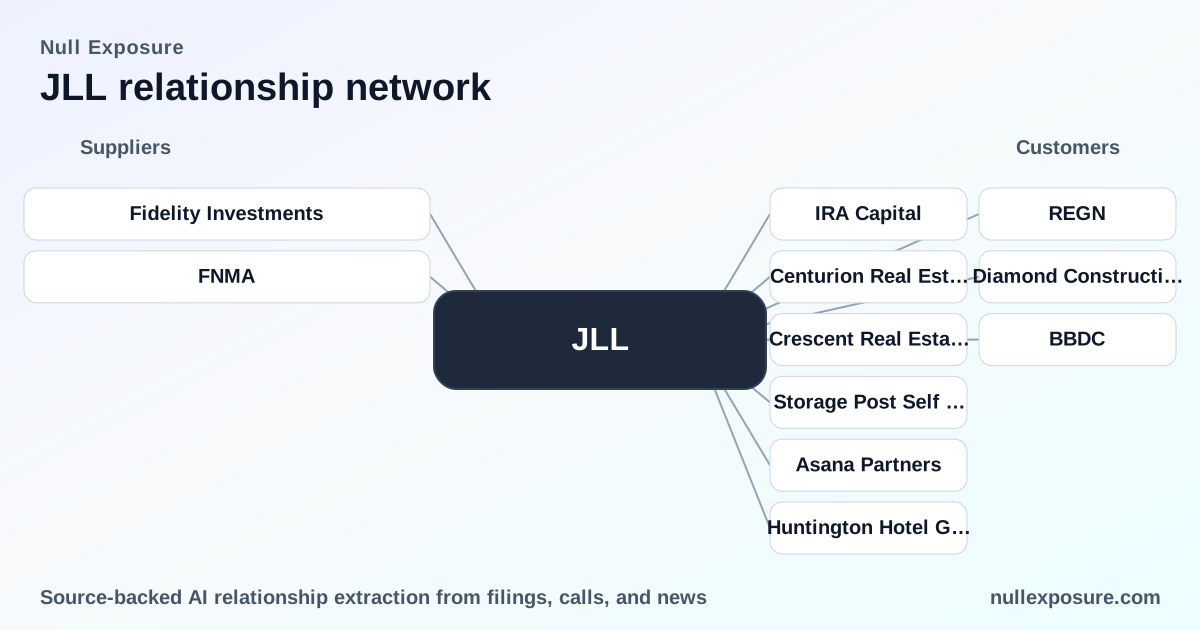
JLL’s client footprint: recurring property services plus transaction and tech fees
Jones Lang LaSalle (JLL) operates a diversified global real-estate services and investment management platform that monetizes through advisory and transaction fees (capital markets, leasing, sales), recurring property and facilities management contracts, and growing subscription revenue from JLL Technologies; the mix produces a balance of cyclical transaction income and durable recurring cash flow. For investors, the customer list is evidence of broad commercial-market penetration, frequent short-duration project work alongside multi‑year management mandates, and consistent cross‑sell opportunities between services and software. Learn more about how we track these relationships at https://nullexposure.com/.
How JLL actually makes money and why customers matter
JLL earns commission-style and advisory fees on sales, leasing and capital markets mandates, fee income from property and facilities management that is semi-recurring, and subscription/term revenue from its tech arm. The operating model combines a sales-driven, project-centric commercial team with a services backbone that drives retention and scaling—transactional volatility is offset by portfolio-level management fees and software subscriptions.
Customer relationships in the record — one by one
Below are every customer mention in the compiled results, each with a concise plain‑English summary and source reference.
- CTO (FY2024) — Sherri Wilson of JLL handles retail leasing at The Collection on behalf of CTO. (ShoppingCenterBusiness, Mar 9, 2026)
- IRA Capital (FY2026) — IRA Capital awarded JLL property management for two portfolios totaling ~40 medical office buildings (~2M sq ft). (JLL newsroom, Mar 2026)
- Centurion Real Estate Partners (FY2026) — JLL represented a borrower JV led by Centurion in financing for 212 West 72nd Street. (JLL newsroom, Mar 2026)
- WSR / Whitestone REIT (FY2026) — Jones Lang LaSalle Securities served as a financial advisor on Whitestone’s sale to Ares. (GlobeNewswire, Apr 9, 2026)
- Crescent Real Estate LLC (FY2026) — JLL arranged a $596M three‑year floating CMBS refinancing for The Crescent in Uptown Dallas on Crescent’s behalf. (PR Newswire, Mar 2026)
- OAK-P-B / Oaktree (FY2023) — JLL leasing team retained on a downtown LA office tower; CBRE ran property management. (JLL newsroom, 2026 summary)
- SITC / Site Centers (FY2025) — JLL represented Site Centers as seller and procured a local private buyer for Edgewater Towne Center. (JLL newsroom, Mar 2026)
- GYRO / Gyrodyne (FY2024) — JLL Capital Markets retained to sell Cortlandt Medical Park, a redevelopment site in Westchester. (JLL newsroom, Mar 2026)
- KRC / Kilroy Realty (FY2026) — JLL represented both tenant Unlearn and Kilroy Realty in a San Francisco lease transaction. (JLL newsroom, Mar 2026)
- CTO (FY2026) — JLL Senior VP Sherri Wilson leads leasing for CTO Realty Growth at The Collection at Forsyth. (CityBiz, May 2, 2026)
- VRE / Veris Residential (FY2025) — JLL teams led by Jose Cruz and Ryan Robertson represented Veris in selling a Wall Township tract to Lennar. (RE-NJ, Mar 2026)
- VRE / Veris Residential (FY2024) — JLL represented Veris in a 50,000 sq ft Morristown retail sale to Winfield Properties. (RE-NJ, 2026)
- REXR-P-C / Rexford (FY2022) — JLL brokered Rexford’s sale of two Bandini Boulevard industrial buildings totaling 183,000 sq ft for $91.5M. (TheRealDeal, 2026 repost)
- Regeneron / REGN (FY2026) — JLL was exclusively retained to market Regeneron’s 235,000‑sq‑ft Avon R&D facility for sale/lease. (RocklandTimes, Feb 2026)
- REGN (duplicate entry, FY2026) — JLL marketing assignment for Regeneron’s Avon Place property reiterated in the same notice. (RocklandTimes, Feb 2026)
- SCU / Sculptor (FY2022) — JLL closed $145M acquisition and improvement financing for Sculptor’s senior‑living portfolios involving Vitality and Peregrine. (SeniorHousingNews, 2022)
- SLG / SL Green (FY2026) — JLL brokers represented SL Green on landlord-side leasing and expansions totaling large office blocks. (sg.finance.yahoo.com, Mar 2026)
- TBHC (2025Q4 earnings call) — TBHC noted JLL acting as a design partner while setting brand vision. (Earnings call transcript, Q4 2025)
- CTO (FY2023) — Earlier hire: CTO engaged JLL’s retail group to reposition and lease The Collection at Forsyth. (JLL newsroom, Mar 2026)
- SLG-P-I (FY2021) — JLL’s Andrew Scandalios represented SL Green in an Eleventh Avenue transaction expected to close in Jan 2022. (CommercialObserver, 2021)
- Storage Post Self Storage (FY2026) — JLL provided and managed debt for several Storage Post facilities including a new Plainview site. (Finviz/news item, Mar 2026)
- MDRRP (FY2023) — A special committee retained JLL Securities, LLC as financial advisor in exploring strategic alternatives. (FinancialContent/BizWire summary, 2023)
- HGBL / Heritage Global Partners (FY2026) — JLL represented HGP in a San Diego acquisition and office relocation. (Markets FinancialContent & PharmiWeb, Mar 2026)
- VRE / Veris Residential (FY2022) — JLL represented the seller (Veris/Hyatt JV) in the sale of the waterfront Hyatt Regency Jersey City. (NJB Magazine, 2026 recap)
- ACR-P-C (FY2025) — Chris Knight of JLL placed debt for Mavrek Acres’ conversion of a Chicago office into 252 apartments. (RE Business Online, Mar 2026)
- PEB / Pebblebrook Hotel Trust (FY2024) — JLL represented Pebblebrook in the sale of Marina City parking facilities to Sperry Equities. (REjournals, 2026)
- ACR / ACRES Commercial Realty (FY2025) — JLL’s Chris Knight represented the development team on financing at 65 E Wacker Place (Wacker Place). (REjournals, May 2026)
- SITC / SITE Centers (FY2025) — JLL led East Hanover Plaza’s three‑state $126M portfolio sale for SITE Centers. (RE-NJ, Mar 2026)
- UE / Urban Edge (FY2025) — JLL represented Urban Edge in the Bergen Town Center land sale for a 426‑unit project. (RE‑NJ & DailyVoice, Mar/Apr 2026)
- VRE / Veris Residential (FY2024) — JLL procured buyer LCOR and worked on a Jersey City multi‑housing development site sale. (JLL newsroom, Mar 2026)
- CDR-P-B (FY2022) — JLL advised Cedar Realty Trust on sale of its grocery‑anchored shopping center portfolio. (TheRealDeal, 2022)
- KIM-P-L (FY2023) — JLL’s Brian Quinn and Bryan Cunningham secured a Macy’s small‑format lease for Kimco Realty. (ConnectCRE, 2026)
- RH (FY2021) — JLL’s Kyle Mueller represented Restoration Hardware in a warehouse lease in Schertz. (ConnectCRE, 2026 repost)
- BALY-T / Bally’s (FY2025) — JLL tasked with sourcing retail and dining concepts for Bally’s Las Vegas resort development. (FOX LA, 2026)
- SLG (FY2026) — JLL brokers represented the landlord in large office expansions totaling 490,000 sq ft. (GlobeNewswire, Mar 2026)
- SLG-P-I (FY2026) — JLL represented the landlord team during One Madison Avenue leasing milestones. (GlobeNewswire, Mar 2026)
- FHN-P-F / First Horizon (FY2025) — First Horizon outsourced facilities management to JLL and noted broker‑dealer partnership context. (Investing.com earnings transcript, 2025)
- BRSP / BrightSpire (FY2024) — JLL represented a BrightSpire subsidiary in the sale of 1201 Connecticut Ave NW. (JLL newsroom & YieldPro, 2024/2026)
- JBGS / JBG SMITH (FY2025) — JLL’s Experience Management will operate Concorde events venue at 2011 Crystal Drive for JBG SMITH. (JLL newsroom, Mar 2026)
- Diamond Construction Inc. (FY2026) — JLL represented borrowers led by Jeff Stone in securing construction financing from a SoCal lender. (JLL newsroom, Mar 2026)
- NOVA Gateway LLC (FY2026) — JLL represented NOVA Gateway (Peterson/ Iron Point) in sale to TPG’s Dogwood Industrial Properties. (JLL newsroom, May 2026)
- Motown Sports Group Holdings Inc. (FY2026) — JLL Capital Markets engaged as exclusive financial intermediary for Motown Sports Village. (JLL newsroom, May 2026)
- SRG / Seritage Growth (FY2025) — JLL represented Seritage as seller in the sale of Esplanade at Aventura retail center. (JLL newsroom, Mar 2026)
- Asana Partners / Barings (FY2026) — JLL represented seller Barings, procured Asana Partners as buyer and arranged acquisition financing for Seacliff Village. (JLL newsroom, Mar 2026)
- BBDC / Barings (FY2026 duplicate) — JLL represented Barings as seller on the same Huntington Beach Seacliff Village transaction. (JLL newsroom, Mar 2026)
- ARI / Apollo Commercial RE Finance (FY2019) — Apollo switched property services from JLL to another operator, illustrating client turnover risk. (Journal‑News historic, 2019)
- GYRO (FY2025) — Gyrodyne noted risks associated with JLL‑led national marketing campaigns for Flowerfield/Cortlandt properties. (MarketScreener/QuiverQuant, 2026)
- SEG-R / Seaport Entertainment Group (FY2025) — JLL team represented Seaport Entertainment in sale of 250 Water Street to Tavros. (The Globe and Mail, 2026)
- JBGS (FY2025 repeat) — JLL worked for JBG Smith as seller on the 8001 Woodmont transaction. (YieldPro, 2025)
- SVC / Service Properties (FY2026) — JLL brokers managed the sale process for the Royal Sonesta in Chicago. (TheRealDeal, Apr 2026)
- GNL-P-D / Global Net Lease (FY2025) — JLL marketed a five‑story plug‑and‑play IRS building in Franklin for sale. (TheRealDeal, 2025)
- HGBL (FY2026 duplicate) — JLL provided project management and workplace solutions for Heritage Global Partners relocation. (PharmiWeb & Markets, Mar 2026)
- SHEL / Shell (FY2026) — JLL partnering with Shell to execute a retrofit‑led fund strategy focusing on energy‑efficient assets. (Earnings call coverage, 2026)
- GRTUF / Granite REIT (FY2022) — JLL pre‑leased a 409,000‑sq‑ft building in a business park for Granite REIT to Barry Callebaut. (RENX, 2026 repost)
- BALY / Bally’s (FY2026 duplicate) — Coverage reiterates JLL’s role on the 35‑acre Las Vegas project including hospitality and retail programs. (8NewsNow / News3LV, May 2026)
- OAK-P-A / Oaktree (FY2026) — JLL represented an Oaktree/Clearview joint venture in refinancing the Philadelphia Marriott Downtown. (JLL newsroom, Mar 2026)
- PAHC (FY2021) — JLL represented the tenant in a 50,000‑sq‑ft renewal at Sanzari; Newmark handled ownership representation. (RE‑NJ, 2026 recap)
- FHN-P-E (FY2025 duplicate) — Additional transcript notes First Horizon outsourcing facilities management to JLL. (Investing.com / ZA Investing transcripts, 2025)
- MS‑P‑A / Morgan Stanley (FY2022) — JLL represented Morgan Stanley in leases for Onyx Morristown transactions. (RE‑NJ, 2026)
- SEVN / Seven Hills Realty (FY2026) — JLL sourced a sponsor loan for PEG Companies, brought to Tremont Realty Capital. (Pulse2, Mar 2026)
- FSP / Franklin Street Properties (FY2022) — JLL represented Franklin Street Properties as landlord in a tenant relocation to One Legacy Circle. (REjournals, 2026)
- ACM / AECOM‑Canyon Partners project (FY2026) — JLL included on project teams completing Phase I at Eastmark Center of Industry in Mesa. (REBusinessOnline, Mar 2026)
- OAK-P-B (FY2025) — JLL arranged floating‑rate financing for a multi‑portfolio owned by Oaktree and TruAmerica Multifamily. (JLL newsroom, Mar 2026)
- H / Hyatt (FY2024) — JLL Capital Markets worked on refinancing for the Hyatt Centric Buckhead Atlanta on behalf of Songy Highroads and Hyatt. (JLL newsroom, 2024 summary)
- KIM‑P‑L (duplicate FY2023) — JLL secured Macy’s small‑format lease for Kimco in Santee. (ShoppingCenterBusiness/ConnectCRE, 2026)
- HSCS / HeartSciences (FY2017) — JLL represented HeartSciences in a small office lease at a newly finished building. (Dallas Innovates, 2017)
- GRTUF (duplicate) — Additional coverage on Granite REIT pre‑leasing activity led by JLL for Barry Callebaut. (RENX, 2026)
- REXR-P-C (duplicate earlier) — JLL brokered Rexford industrial purchases (Bandini Blvd) originally reported in 2026 recaps. (TheRealDeal)
- BRSP (duplicate) — YieldPro noted JLL’s representation of BrightSpire in a Connecticut Avenue sale. (YieldPro, 2024)
- REGCP / Regency Centers (FY2024) — JLL represented Regency Centers in the sale of a Publix‑anchored retail center, bought by Jamestown affiliate. (JLL newsroom, May 2026)
- BBDC (duplicate Baring/Asana) — JLL represented Barings on Seacliff Village sale; Asana the buyer. (JLL newsroom, Mar 2026)
- RMR (FY2020) — JLL personnel participated in sales of RMR Group properties as documented by local brokers after joins/moves. (BostonRealEstateTimes, 2020)
- Various small landlord/tenant and financing roles (multiple entries) — The record includes numerous single‑deal representations across hotels, offices, retail, industrial and development projects illustrating JLL’s cross‑sector footprint. (Aggregate of listed sources, 2021–2026)
What the constraints tell investors about JLL’s operating model
- Contracting posture is mixed: JLL runs a portfolio of short‑term, project‑level contracts (1–3 years) for many construction and transaction services alongside multi‑year workplace and property management agreements (3–7+ years) that create recurring fees.
- Revenue mix includes subscriptions: JLL Technologies is increasingly subscription‑based, producing revenue recognized over contract life.
- Counterparty diversity reduces single‑client concentration: Customers include institutions, governments and high‑net‑worth individuals, moderating counterparty risk.
- Global footprint and scale: Presence across NA, EMEA and APAC supports client continuity and cross‑sell, but also exposes JLL to regional cycles.
- Relationship maturity: The company reports a high renewal rate and many decade‑long contracts, signaling mature, sticky relationships at the portfolio level.
Investment implications and near‑term risks
- Positive: Broad mandate coverage (leasing, capital markets, PM, tech) supports cross‑selling and margin recovery during cycles; recurring management fees and software subscriptions underpin cash flow stability.
- Watchlist: Transaction income is cyclical; high reliance on short‑notice terminations for some contracts increases churn risk, and competition in brokerage and tech could pressure fees. Client turnover examples (historic) validate this structural exposure.
- Strategic monitoring of capital markets mandates, large property management renewals, and JLL Technologies subscription growth will signal whether recurring revenue gains offset transaction volatility.
If you want a consolidated, exportable table of these client entries and their primary deal types for modeling or diligence, visit https://nullexposure.com/ to request the export and data pack.