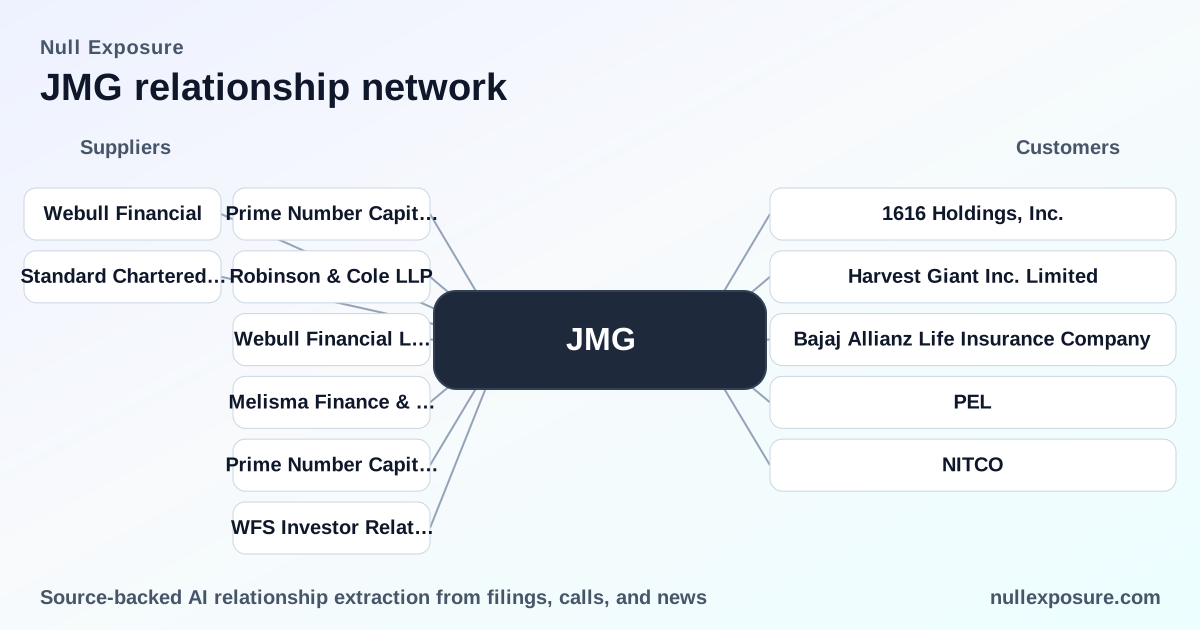
JMG customer landscape: concentration, counterparty signals, and implications for investors
Journal Media Group Inc (JMG) operates a local-news-centric media business that monetizes primarily through targeted print and digital advertising, supplemented by multimedia sponsorships and community events. For investors focused on customer risk and revenue durability, the critical lens is concentration of advertising relationships, the maturity of contractual arrangements with local advertisers, and how quickly digital revenue can substitute for print declines. Explore deeper at https://nullexposure.com/.
What the profile tells us about business risk and transparency
The supplied company profile contains no market-capitalization, revenue, or margin entries and the relationship constraints list is empty, which signals limited financial granularity in this feed for JMG. From an operating-model perspective, that absence is itself actionable: it indicates lower visibility into contract duration, payment terms, and customer concentration schedules for due diligence. For an investor, that translates into two practical concerns:
- Concentration risk is a priority to quantify if advertising buyers are few and large, since lost key accounts would immediately pressure margins and cash flow.
- Contracting posture and maturity (short-term ad buys versus multi-year sponsorships) is unknown from this record; absence of longer-term commitments increases cyclicality and revenue volatility.
If you want a systematically sourced view of counterparty exposures for underwriting or monitoring, JMG’s public profile here is not sufficient — contact us at https://nullexposure.com/ for expanded counterparty reports.
What the relationships in the feed actually report
Below I summarize every relationship returned in the feed. Each entry is a concise, plain-English take with the original reporting source.
Harvest Giant Inc. Limited
Harvest Giant is listed among the major accounts in a filing discussed by TradingView; that article notes the top five customers together represented 99.1% of FY2024 revenue for the company in that filing, and Harvest Giant is named as a major account. Source: TradingView (Mar 10, 2026) — https://www.tradingview.com/news/tradingview:c3d9a82ae8220:0-jm-group-global-product-sourcing-and-wholesale-provider-files-for-nyse-american-ipo/
1616 Holdings, Inc. (Five Below subsidiary)
The same TradingView item identifies 1616 Holdings — a Five Below affiliate — as a major account among the top customers that together accounted for 99.1% of FY2024 revenue in that filing. Source: TradingView (Mar 10, 2026) — https://www.tradingview.com/news/tradingview:c3d9a82ae8220:0-jm-group-global-product-sourcing-and-wholesale-provider-files-for-nyse-american-ipo/
V O Chidambaranar Port (formerly Tuticorin Port)
A shipping-industry report notes that J M Baxi Ports & Logistics secured contracts last year to operate container terminals at Jawaharlal Nehru Port and V O Chidambaranar Port, indicating large-scale terminal operations and long-term concession-style relationships. Source: IndiaShippingNews (May 3, 2026) — https://indiashippingnews.com/j-m-baxi-ports-logistics-indian-potash-ltd-team-set-to-win-a-multipurpose-cargo-berth-deal-at-vizag-port/
Bajaj Allianz Life Insurance Company
A Times of India report describes JM Financial Credit Solutions selling a 2.1% stake in its home-loans unit to Bajaj Allianz Life Insurance for ₹65.5 crore, reflecting a financial counterparty relationship rather than an advertising or content customer. Source: Times of India (reported Mar 2026) — https://timesofindia.indiatimes.com/business/india-business/jm-financial-stake-sale-company-to-sell-2-1-in-home-loans-unit-to-bajaj-allianz-life-rs-65-5-crore-deal-to-close-by-august-31/articleshow/123219317.cms
PEL (Piramal Enterprises) — regulatory-managed relationship
Outlook Business reports JM Group entities settled a Sebi case related to irregularities in NCD issue management for Piramal Enterprises, paying ₹3.92 crore; this is an example of regulatory and underwriting exposure rather than a classic customer contract. Source: OutlookBusiness (Mar 2026) — https://www.outlookbusiness.com/markets/jm-group-entities-settle-case-of-lapses-in-debt-issue-with-sebi-pay-39-cr
Piramal Enterprises (duplicate entry in feed)
The same OutlookBusiness article discusses the Piramal Enterprises NCD matter; the feed lists both PEL and Piramal Enterprises separately but they reference the same regulatory settlement. Source: OutlookBusiness (Mar 2026) — https://www.outlookbusiness.com/markets/jm-group-entities-settle-case-of-lapses-in-debt-issue-with-sebi-pay-39-cr
Jawaharlal Nehru Port
IndiaShippingNews documents that J M Baxi gained contracts to operate terminals at Jawaharlal Nehru Port, a major container gateway, signalling operationally critical port-concession relationships with multi-year revenue profiles typical of terminal operators. Source: IndiaShippingNews (May 3, 2026) — https://indiashippingnews.com/j-m-baxi-ports-logistics-indian-potash-ltd-team-set-to-win-a-multipurpose-cargo-berth-deal-at-vizag-port/
Visakhapatnam Port
The same IndiaShippingNews piece reports a consortium including J M Baxi is set to mechanise and operate a multi‑purpose cargo berth at Visakhapatnam Port on a 30‑year contract, implying long-term concession revenue if executed. Source: IndiaShippingNews (May 3, 2026) — https://indiashippingnews.com/j-m-baxi-ports-logistics-indian-potash-ltd-team-set-to-win-a-multipurpose-cargo-berth-deal-at-vizag-port/
Lux Industries Limited (GenX affiliate)
ZeeBiz notes GenX, an affiliate of Lux Industries, manufactures affordable men’s athleisure via J.M. Hosiery and Company Limited; this entry flags manufacturing and brand-supply relationships within apparel verticals, not direct media advertising. Source: ZeeBiz (FY2022 reporting) — https://www.zeebiz.com/trending/sports/news-indian-super-league-club-chennaiyin-fc-announces-this-firm-as-associate-sponsor-for-upcoming-isl-season-197091
NITCO / Nitco Ltd
LiveMint reports JM Financial acquired two luxury apartments as settlement of debt owed by promoter companies of Nitco Ltd, indicating a credit-recovery and asset-repurchase interaction rather than an operational customer contract. Both NITCO and Nitco Ltd entries in the feed reference the same transaction. Source: LiveMint (Mar 2026) — https://www.livemint.com/companies/news/jm-financial-buys-two-luxury-south-mumbai-apartments-for-rs60-crore-11652280831338.html
Interpreting these signals for JMG investors
- Key takeaway: the feed mixes operational customers with financial and regulatory counterparty events. Several entries reflect JM Group / JM Financial activities and port-concession wins rather than standard advertising customers for a media company, so treat each relationship category separately when modelling revenue risk.
- Concentration & criticality: where the feed highlights top-five customers representing 99.1% of revenue for a cited filing, that demonstrates extreme concentration risk for the referenced entity; if a JMG-like business had similar concentration it would be a material red flag for cash-flow stability. Source: TradingView (Mar 10, 2026).
- Contract maturity signal: the port concession references (30‑year term) indicate long‑dated revenue profiles in the logistics examples, while the finance-sector items (stake sales, NCD settlements) show episodic one-off transactions; JMG investors should seek the split between short-term ad buys and any multi-year sponsorships in company disclosures.
What to do next
- For underwriting exposure or portfolio monitoring, obtain granular schedules of client revenue by account and contract length; the current feed provides relationship labels but not contract economics.
- To commission an expanded counterparty report or to access curated summaries across peers, visit https://nullexposure.com/ and request a tailored briefing.
Bold final point: investors must treat the relationships in this feed as mixed-signal intelligence — operational customers, financial counterparties, and regulatory events are all present — so allocate diligence resources accordingly.