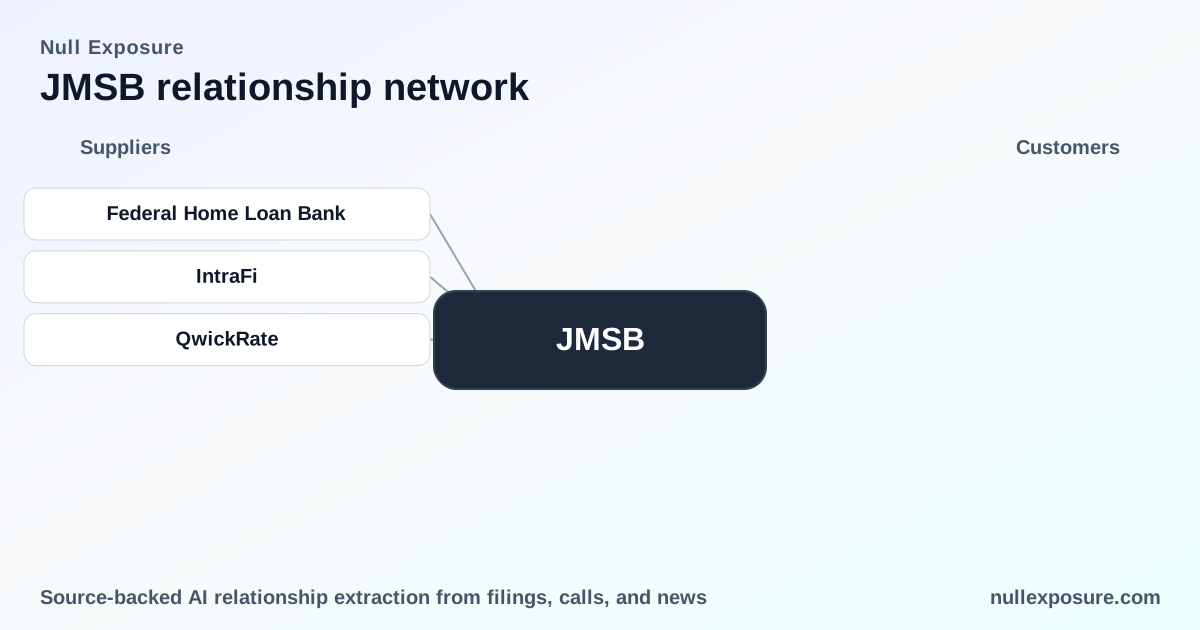
John Marshall Bancorp (JMSB): SBA Guaranty, Customer Footprint, and What Investors Should Price In
John Marshall Bancorp operates as the bank holding company for John Marshall Bank, a regional commercial bank focused on the Washington, D.C. metropolitan area. The company monetizes primarily through net interest margin on commercial and consumer lending, fee income from deposit and ancillary services, and commissions from insurance placements. Recent disclosure activity around SBA-guaranteed loans highlights an active playbook for credit risk transfer and fee-generating servicing relationships.
For a deeper look at counterparty and contract dynamics supported by public filings, visit https://nullexposure.com/.
The headline relationship: John Marshall and the U.S. Small Business Administration
John Marshall has submitted a guaranty purchase request to the U.S. Small Business Administration and expects to receive the full guarantee payment, reflecting typical bank activity under the SBA 7(a) program. According to an 8‑K filing reported May 3, 2026, the company is pursuing SBA guaranty recovery tied to an SBA‑guaranteed loan position (stocktitan/8‑K, May 3, 2026). This is a direct counterparty interaction with the federal guarantor that converts a credit exposure into a guaranteed receivable.
Why the SBA interaction matters for investors
John Marshall’s use of SBA guarantees materially affects the bank’s credit management and liquidity profile. Under the SBA 7(a) program, the bank can sell the guaranteed portion of loans into the secondary market while retaining the unguaranteed slice and the servicing rights, which preserves fee income and reduces risk-weighted exposure (company disclosures). This structure delivers three investor-relevant outcomes:
- Credit mitigation: guaranteed proceeds reduce realized loan losses on qualifying SBA loans.
- Fee and servicing economics: retaining servicing rights creates recurring non‑interest income streams.
- Liquidity and capital management: sale of guaranteed portions improves on‑balance liquidity and regulatory capital metrics.
Relationship detail — U.S. Small Business Administration (one-line investor summary)
The bank submitted a guaranty purchase to the SBA and expects to receive the full guarantee payment, converting a portion of credit exposure into a government‑backed receivable (8‑K filed May 3, 2026 via stocktitan). This interaction reflects routine SBA 7(a) program mechanics that the bank uses to manage credit and retain servicing economics.
How John Marshall’s contract mix shapes revenue durability
John Marshall runs a mixed contracting posture that blends long‑duration lending with short‑term service relationships:
- Long-term lending: Typical maturities for certain loan types extend up to ten years, aligning with commercial lending books and creating interest income durability.
- Short-term services: Non-interest revenue derives from deposit-related services and ancillary customer services that are accounted for under ASC 606 and generally tied to the period services are performed.
These contract types together create a stable base of interest income complemented by recurring but shorter-duration fee income, which improves revenue predictability while leaving variability tied to deposits and fee volumes.
Customer profile and geographic concentration
John Marshall deliberately focuses on a regional, relationship-driven commercial banking model:
- Primary customers: small and medium-sized businesses, business owners and employees, professional corporations, non-profits, and retail individuals.
- Geography: concentrated in the Washington, D.C. metro (Arlington, Fairfax, Loudoun and Prince William counties in Virginia; Montgomery County in Maryland; and the District of Columbia).
This client mix leads to mid‑market SME concentration with geographically clustered credit risk, which supports strong local relationship banking but creates sensitivity to regional economic cycles.
Roles the bank plays for customers
Public disclosures show John Marshall acting in multiple client roles:
- Lender and seller: the bank originates loans and can sell guaranteed portions of SBA loans to transfer credit risk.
- Service provider and servicer: relationship managers deliver commercial banking services, and the bank retains servicing on sold loans—capturing servicing fees and maintaining customer touchpoints.
- Insurance intermediary: the company places insurance policies and earns commission revenue on premiums maintained during the period.
These roles are revenue-multipliers: lending produces interest margin, selling/servicing creates fee income, and insurance placements add commission flows.
Operational signals investors should weigh
Several company-level signals emerge from the filings and disclosures:
- Contract length diversity (short-term fee contracts vs. long-term loans) supports a blend of predictable interest income and variable service fees.
- Counterparty mix skewed to small businesses and mid-market customers increases SME credit exposure but leverages local relationship strength.
- Active use of off‑balance solutions (guaranty purchases and sales of guaranteed loan portions) demonstrates a proactive credit transfer strategy.
- Service orientation and retention of servicing rights indicate a deliberate pursuit of recurring non-interest income.
Key risk factors and valuation context
Investors should weigh the following, anchored in disclosed metrics:
- Regional concentration risk: heavy exposure to the D.C. metro limits geographic diversification.
- SME credit cyclicality: small- and mid-size enterprise portfolios can be sensitive to local economic shocks.
- Reliance on government guarantees for loss recovery in certain credits introduces timing and procedural execution risk even when guarantees are expected.
From a valuation lens, John Marshall trades with Market Capitalization of $296.6M, Price-to-Book of ~1.13, Trailing P/E of 13.65, and Return on Equity ~8.65% as reported for the latest period through 2026‑03‑31 (company data). These figures position the bank as a modestly priced regional player with room for multiple expansion if net interest margins and fee growth prove sustainable.
Bottom line: what to watch next
The SBA guaranty payment disclosed in early May 2026 is a near-term credit event that improves the bank’s realized recovery profile and supports fee income from retained servicing. Investors should monitor:
- Confirmation and timing of the guaranteed payment.
- Trends in SBA and other government-guaranteed loan sales and servicing revenue.
- Regional loan performance in the D.C. market and any shifts in deposit behavior.
For continual monitoring of counterparty interactions and to track disclosure-driven credit swings, visit https://nullexposure.com/ for structured coverage and relationship analytics.