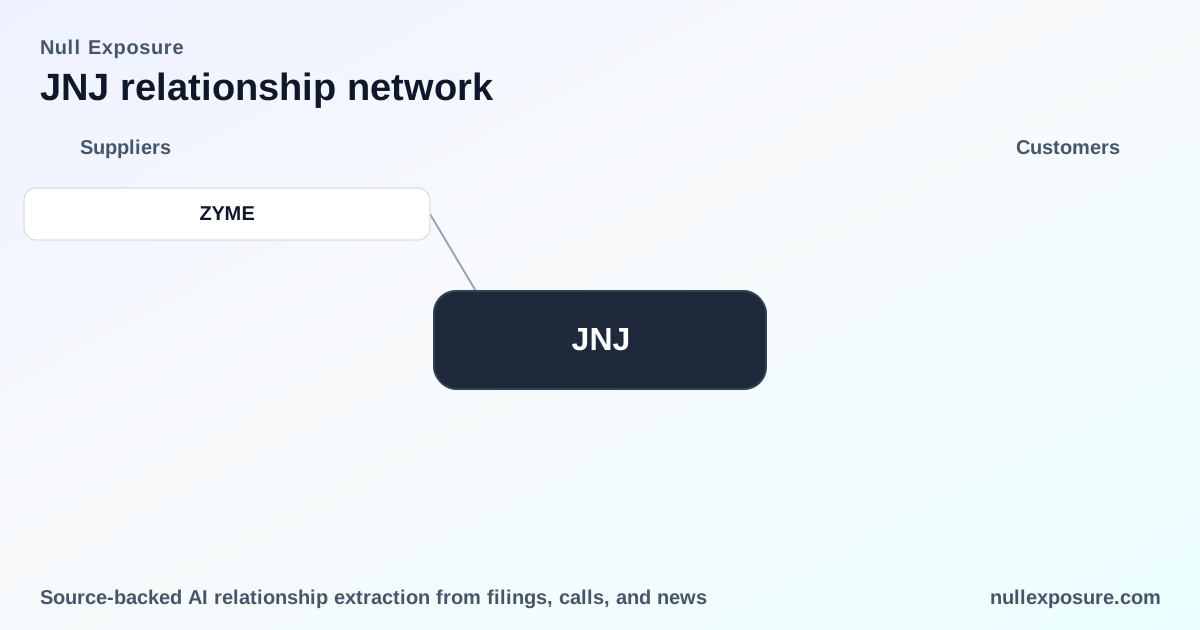
Johnson & Johnson — customer relationships that drive product reach and strategic optionality
Thesis: Johnson & Johnson monetizes a globally diversified portfolio across Innovative Medicine, MedTech and Consumer Health by selling finished pharmaceuticals and devices, licensing assets, and structuring clinical supply and collaboration agreements that offload development cost while keeping commercial optionality. Its revenue mix is driven by direct sales to providers and large wholesalers, recurring product supply, and a steady cadence of partnerships and divestitures that convert R&D assets into liquidity and strategic focus. For investor intelligence on counterparties and customer flows, visit https://nullexposure.com/.
The commercial posture that underpins J&J's customer ecosystem
Johnson & Johnson operates as a global, vertically integrated commercial engine that blends internal commercialization with structured external relationships. Fiscal 2025 disclosures show approximately 43% of sales outside the U.S., split across Europe (~23%), Asia-Pacific & Africa (~15%) and other regions, reinforcing a geographically diversified revenue base (fiscal 2025). The company also relies materially on a small set of wholesalers, with three distributors collectively representing roughly 21.8%, 15.5% and 11.1% of total gross revenues in 2025; that concentration translates to both distribution leverage and counterparty concentration risk. Finally, J&J’s model mixes direct-to-hospital and retailer channels with contract supply and licensing arrangements, making it at once a seller, distributor partner and buyer of specialized services and assets.
Key operating signals:
- Global reach and geographic scale support commercial resilience and pricing levers across markets (fiscal 2025 regional breakdown).
- Concentration in a few wholesalers creates outsized single-counterparty exposure while enabling broad retail reach (2025 wholesaler disclosure).
- Multi-role commercial posture: J&J functions as seller, distributor partner and licensor to biotech and medtech firms, shaping counterparties’ development and go-to-market strategies.
Customer map — every identified relationship and what it means for investors
Below are concise, investor-focused summaries of each relationship captured in public reporting and company announcements.
-
MeiraGTx (MGTX) — MeiraGTx agreed to acquire botaretigene sparoparvovec (bota‑vec) from Johnson & Johnson for a $25 million upfront payment plus future royalties, and entered a commercial supply agreement with J&J Innovative Medicine for manufacturing. This transaction represents J&J converting a development asset into near-term cash and ongoing royalty optionality. (MeiraGTx press releases and multiple news reports, May 2026).
-
ORIC Pharmaceuticals (ORIC) — ORIC announced a clinical trial collaboration and supply agreement with Johnson & Johnson to evaluate enozertinib in combination with amivantamab (including subcutaneous formulation) in first-line NSCLC with EGFR exon 20 mutations, reflecting J&J’s role as a supply collaborator for oncology combination trials. (GlobeNewswire, Jan–Feb 2026).
-
Monte Rosa Therapeutics (GLUE) — Monte Rosa entered a supply agreement with Johnson & Johnson under which J&J will provide ERLEADA® (apalutamide) for a Monte Rosa‑sponsored Phase 2 study combining MRT‑2359 with apalutamide in metastatic castration‑resistant prostate cancer. The arrangement highlights J&J’s practice of supporting external clinical programs via supply rather than co‑sponsorship. (GlobeNewswire and SimplyWall.St, March–May 2026).
-
Contineum Therapeutics (CTNM) — Johnson & Johnson began recruiting patients for a Phase 2 study of PIPE‑307/JNJ‑89495120, demonstrating J&J’s role as clinical sponsor/developer for certain licensed assets and its ongoing reliance by smaller biotech partners to run trials. (Company filings and press releases cited March 2026; Contineum disclosures).
-
Royalty Pharma (RPRX) — Royalty Pharma committed to a $500 million R&D agreement with Johnson & Johnson focused on advancing JNJ‑4804, underlining J&J’s ability to attract capital partners for late‑stage or pre‑commercial investigational medicines. (Investing.com and related news coverage, May 2026).
-
TrumpRx (news item) — Media reported that J&J listed Xarelto on a government drug discount platform referred to in news coverage as “TrumpRx,” indicating strategic channel appearances for high-volume medicines. (Biospace, May 2026).
-
Grifols (GRFS) — Grifols’ Vistaseal fibrin sealant was introduced in combination with J&J Ethicon devices as part of a global partnership, showing J&J’s medtech units can function as co‑commercialization and distribution partners for third‑party biologic devices. (Medical Design & Outsourcing, referenced in 2026 coverage of earlier FY2019 activity).
-
Anika Therapeutics (ANIK) — Anika’s Orthovisc and Monovisc products are available in the U.S. via distribution by J&J MedTech, illustrating J&J’s use of its MedTech distribution channels to expand third‑party product reach. (TradersUnion, May 2026).
-
Legend Biotech (LEGN) — CARVYKTI® (ciltacabtagene autoleucel) development involved Johnson & Johnson as a development partner, signaling J&J’s strategic role in CAR‑T development and commercialization collaborations. (Coverage citing 2025 developments).
-
Lexeo Therapeutics (LXEO) — Lexeo announced a research collaboration with Johnson & Johnson to investigate localized cardiac delivery of gene therapy using Impella technology, signaling J&J’s interest in device-mediated gene delivery research. (QuiverQuant, March 2026).
-
Addex Therapeutics / ADXN (ADXN) — Addex reported it regained rights to ADX71149 and related mGlu2 program from Johnson & Johnson, reflecting J&J’s periodic portfolio pruning or rights re‑transfer following strategic reprioritization. (ADXN earnings call, 2025 Q2).
-
Integra LifeSciences (IART) — Integra agreed to acquire Acclarent from Ethicon (a J&J MedTech company) for approximately $275 million, an example of J&J divesting non‑core device assets to specialist medtech buyers. (MassDevice and MedTechDive summaries; GlobeNewswire, Dec 2023 announcement).
-
Cidara Therapeutics (CDTX) — Cidara reported payment of a $45 million milestone under a Janssen license agreement tied to its ANCHOR study, which demonstrates how J&J’s Janssen business executes milestone‑driven license economics with biotech partners. (GlobeNewswire, Nov 2025).
-
Decoy Therapeutics / Salarius (SLRX) — The company received QuickFire Challenge funding via BLUE KNIGHT, a collaboration between Johnson & Johnson Innovation – JLABS and BARDA, illustrating J&J’s innovation‑hub funding pathways into early‑stage antiviral work. (GlobeNewswire, Dec 2025).
-
Nanobiotix (NBTX) — Progress on NBTXR3 development cited a partnership with Johnson & Johnson, showcasing J&J’s role in advancing novel oncologic modalities through collaborative development. (Industry coverage, March 2026).
-
Protagonist Therapeutics (PTGX) — Protagonist reported that because a drug was developed with J&J, Janssen handles global marketing efforts, demonstrating J&J’s common arrangement to take lead on commercialization for partnered assets. (InsiderMonkey commentary, May 2026).
-
Stereotaxis (STXS) — Management noted supply chain pressures, including prior uncertainty around Johnson & Johnson catheter supply, highlighting that J&J functions as a supply node whose availability can materially affect OEM partners. (TradingView/filings, May 2026).
-
Senti Biosciences (SNTI) — Senti is a resident company of Johnson & Johnson Innovation’s JLABS in South San Francisco, reflecting J&J’s accelerator model that creates early privileged access to promising cell and gene companies. (PR Newswire, Senti funding announcement; JLABS residency noted in corporate communications).
-
Coherus Biosciences (CHRS) — Coherus entered into a clinical supply agreement with Johnson & Johnson for a Phase 1b trial, and analysts noted the arrangement as validation of the CCR8 target, demonstrating J&J’s role in enabling investigational target validation via supply arrangements. (Analyst coverage and news summaries, May 2026).
What the relationship map implies for investors
- J&J leverages supply and collaboration agreements to retain downstream commercial optionality while transferring development risk upstream to partners or through milestone economics. Transactions such as the MeiraGTx sale and Integra divestiture show active portfolio reshaping into cash and royalties.
- Concentration in a few wholesalers is a corporate risk lever: those distribution relationships drive revenue scale but also concentrate counterparty risk across markets (2025 wholesaler disclosures).
- J&J’s global footprint reduces single‑market exposure, yet localized supply constraints (e.g., catheter supply issues noted by partners) can still create short‑term operational risk for customers and co‑developers.
- Early‑stage engagement via JLABS and sponsored awards creates a steady pipeline of prospective partners and provides J&J a privileged view of innovation while keeping equity or commercial optionality.
Bottom line for operators and investors
Johnson & Johnson’s customer relationships span supply, licensing, clinical collaboration and selective divestiture; this mix is a deliberate tool to monetize R&D, maintain global commercial dominance, and limit capital intensity on early programs. Investors should track (1) wholesaler concentration metrics, (2) material supply agreements that support external trials, and (3) asset sale and royalty terms that convert pipeline value into recognized cash flows. For continuous monitoring of J&J counterparties and structured deal flows, see https://nullexposure.com/.
Key takeaway: J&J’s commercial strategy balances broad distribution scale with selective partnerships and asset monetization, creating recurring revenue while concentrating counterparty exposure in a few large distributors.