Juniper Networks (JNPR): Customer relationships reconfigured by HPE integration
Juniper builds high-performance networking hardware and AI-native software (Mist AIOps, cloud-native routing) and monetizes through a mix of product sales, recurring software subscriptions, licensing, and professional services. The company’s customer footprint is being reshaped into a more concentrated, platform-driven model as Juniper technology is folded into larger vendor solutions—most notably Hewlett Packard Enterprise—turning product engineering into a channel and go-to-market force that will materially influence revenue composition and contract terms going forward. For ongoing monitoring of relationship-driven signals visit https://nullexposure.com/.
Why customers and integrations now determine valuation upside
The newsflow in FY2025–FY2026 shows Juniper transitioning from a standalone vendor into a strategic technology supplier inside larger networking stacks. That transition changes the commercial dynamics: revenue shifts from one-off hardware transactions to platform license and integration revenue, while distribution and renewal cadence become linked to partner sales cycles. Investors should value Juniper not only as a product vendor but as a strategic IP and software supplier to major systems integrators and OEMs.
Operating model signals — what the customer mix implies for JNPR
- Contracting posture: Integration with large OEMs implies enterprise licensing and source-code licensing commitments, not only standard hardware purchase orders. This increases contract complexity and long-tail revenue but also lengthens sales and legal cycles.
- Concentration: The relationship map shows concentration risk centered on a dominant partner; that concentration improves scale but amplifies dependency on partner execution.
- Criticality: Juniper technology is being embedded into mission-critical offerings (AI-native networking, RAN, cloud-edge), raising technical and commercial stickiness and supporting higher-margin software monetization.
- Maturity: The product portfolio feeding these integrations—Mist AIOps, cloud-native routing, campus fabric—are mature, enterprise-grade offerings, which supports predictable renewals and professional services demand.
These are company-level signals derived from the partnership and integration announcements in FY2025–FY2026; they summarize how Juniper’s go-to-market and revenue profile are evolving as the company becomes a strategic supplier to large OEMs and service providers.
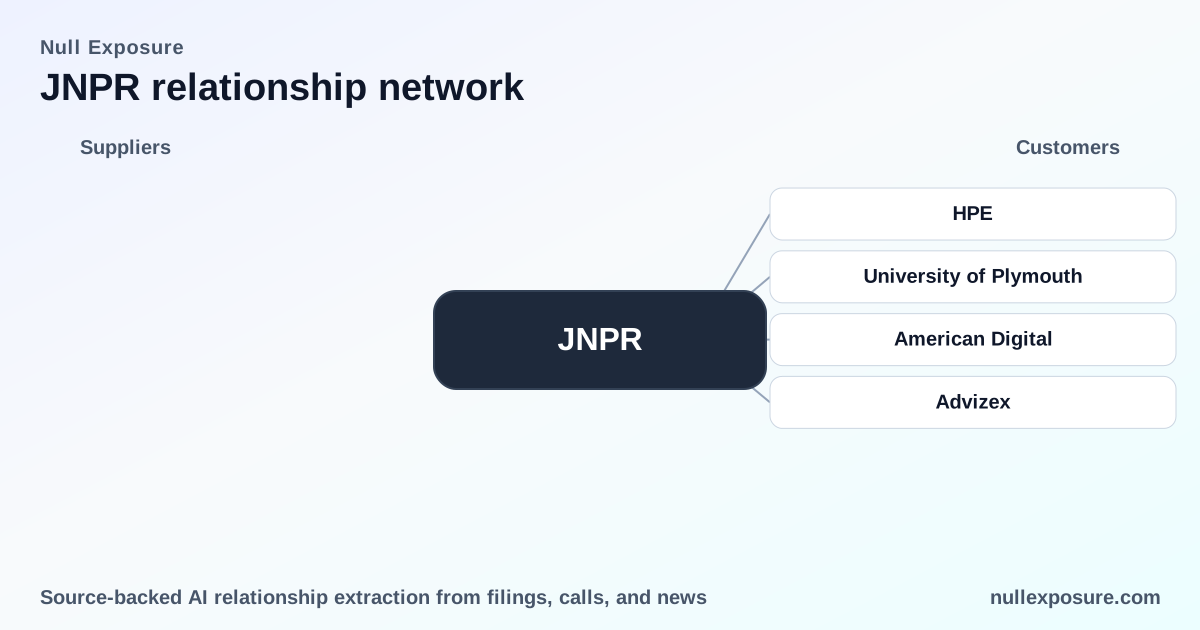
Customer relationships — the full list and what each means for investors
Hewlett Packard Enterprise (HPE)
- Juniper’s technology is being integrated across HPE’s networking and compute portfolio, including Mist AIOps, cloud-native routing in ProLiant servers, and deeper Aruba retail networking capabilities; HPE completed a transformative acquisition and is licensing Juniper IP to create an AI-native networking stack. (Sources: DatacenterDynamics, CRN, SiliconAngle; FY2025–FY2026 — see https://www.datacenterdynamics.com/en/news/hpe-closes-14bn-acquisition-of-juniper-networks/ and https://www.crn.com/news/networking/2026/)
- Implication: HPE is the dominant commercial vector for Juniper technology, shifting revenue mix toward embedded licensing and joint go-to-market outcomes.
HPE Aruba
- HPE Aruba has infused its retail and campus networking portfolio with Juniper Mist technology to enable AI-powered, self-driving networks for retail and enterprise customers. (Source: CRN, FY2026 — https://www.crn.com/news/networking/2026/hpe-aruba-s-retail-portfolio-is-now-infused-with-juniper-mist-for-ai-powered-networking)
- Implication: Product-level integration strengthens recurring software value and upsell potential inside Aruba’s install base.
IBM
- IBM is integrating Juniper Mist AI into internal and customer-facing orchestration tools—IBM’s AskNetwork and watsonx Orchestrate usage were cited as examples of Juniper tech being used to speed network problem diagnosis. (Source: IBM Newsroom, Feb 2025 — https://newsroom.ibm.com/2025-02-28-juniper-and-ibm-to-simplify-enterprise-network-operations-with-next-era-of-gen-ai-innovation)
- Implication: Enterprise software partnerships increase Mist’s enterprise footprint and validate Juniper’s AIOps positioning with major IT services providers.
Liberty Global (LBTYB)
- Liberty Global deployed Juniper Cloud Interlink Gateways across AWS Outposts and regional cloud environments to demonstrate seamless cloud-to-premises connectivity. (Source: Liberty Global press release, FY2025 — https://www.libertyglobal.com/liberty-global-and-juniper-networks-collaborate-to-demonstrate-seamless-cloud-connections/)
- Implication: Operator and MSO adoption underlines Juniper’s role in multi-cloud and edge connectivity, supporting service-provider revenue streams.
University of Plymouth
- The University of Plymouth is adopting Juniper’s campus fabric workflow and distribution switch to automate campus networking, improve student experience, and enable microsegmentation for IoT devices. (Source: InvestingNews, FY2026 — https://investingnews.com/juniper-networks-brings-more-simplicity-scale-and-security-to-enterprise-networking-with-three-step-campus-fabric-workflow-and-new-ex-distribution-switch/)
- Implication: Education-sector deployments demonstrate the product’s appeal for managed-campus environments and validate automation-led campus use cases.
American Digital
- American Digital reported working with Juniper ahead of the HPE integration, signaling channel preparedness and existing service relationships that will feed into the broader HPE+Juniper GTM motion. (Source: CRN, FY2025 — https://www.crn.com/news/networking/2025/hpe-completes-13-4b-juniper-networks-acquisition-ceo-antonio-neri-calls-it-start-of-a-new-era)
- Implication: Established SI relationships provide professional services growth and help accelerate deployments within key verticals.
Advizex
- Advizex, a CRN-ranked solution provider, has sales teams already coordinating with HPE and Juniper to drive networking-as-a-service revenue. (Source: CRN, FY2025 — https://www.crn.com/news/networking/2025/hpe-completes-13-4b-juniper-networks-acquisition-ceo-antonio-neri-calls-it-start-of-a-new-era)
- Implication: Channel partners are positioned to commercialize integrated solutions, translating technical integration into recurring service revenue.
What investors should watch next
- Revenue concentration: Monitor HPE-linked contract disclosures and the extent to which Juniper revenue is reclassified from direct product sales into embedded OEM licensing and services. A sustained increase in OEM-embedded revenue will change margin profiles and predictability.
- Contract terms and IP licensing: Watch for explicit disclosures of source-code licensing and long-term agreements (DatacenterDyanmics flagged source-code licensing obligations in FY2025), which affect cashflow timing and legal exposure.
- Channel execution: Track SI and MSP adoption (American Digital, Advizex) to confirm that integration translates to real pipeline expansion and recurring revenue.
- Product stickiness: Track renewal cadence on Mist AIOps and uptake of cloud-native routing in edge and RAN deployments; these are the commercial levers for higher software attach rates.
For a concise feed of how relationship changes map to revenue and risk, visit https://nullexposure.com/.
Bottom line
Juniper’s customer relationships are evolving from a diversified vendor model into a concentrated, platform-oriented supplier role—most materially through HPE integration. That transition brings clear upside in recurring software and licensing economics, but it concentrates execution risk around partner sales cycles and contractual terms. Investors should revalue JNPR with a focus on partner-driven revenue, IP-licensing disclosures, and the pace at which channel partners convert integrations into recurring bookings.